Visiting the Sistine Chapel in the Vatican
The Sistine Chapel (la Cappella Sistina) is the most visited tourist attraction in the Vatican. It is an artistic treasure, famous worldwide for the wonderful paintings of Michelangelo.
Sistine Chapel Tickets and Prices
The Sistine Chapel is located inside the Vatican Museums. As such, to visit it, you simply need to purchase standard museum entrance tickets. The prices are as follows:
- Adult : €20 (+ €5 online booking fee)
- Children 6-18 years: €8 (+ €5 online booking fee)
- Children under 6: Free
For more information on how to purchase tickets, see the article regarding the Vatican Museums.
Opening Hours
The visiting hours for the Sistine Chapel coincide with those of the Vatican Museums.
In 2026, the schedule is as follows:
- Monday-Saturday: 8:00 AM - 8:00 PM (last entry at 6:00 PM)
On Sundays, the museums are closed. The exception is the last Sunday of the month, when admission is free, and the hours are 9:00 AM - 2:00 PM (last entry at 12:30 PM).
On December 24 and December 31, 2026, there is a reduced visiting schedule: 8:00 AM - 3:00 PM (last entry at 1:00 PM).
The Vatican Museums (and therefore the Sistine Chapel) are closed on the following dates in 2026:
- January 1 and 6, 2026
- February 11, 2026
- March 19, 2026
- April 6, 2026
- May 1, 2026
- June 29, 2026
- August 14 and 15, 2026
- December 8, 25, and 26, 2026
- Sundays (except the last Sunday of the month)
Where Is the Sistine Chapel?
The Sistine Chapel is located within the Apostolic Palace in Vatican City (the official residence of the Pope) and is included in the tour route of the Vatican Museums, located toward the very end.
Tip: When visiting, keep in mind that you must exit the museum 30 minutes before the official closing time. Do not leave your visit to the Sistine Chapel (which is at the farthest end of the complex) for the last half-hour, as you may no longer be allowed entry. Try to arrive there at least 45 minutes before closing time!
Access Rules
The general rules for entering the Sistine Chapel are the same as those for entering the Vatican Museums.
Additionally, inside the Sistine Chapel, it is strictly forbidden to take photographs (there are supervisors stationed inside) and the use of mobile phones is prohibited.
Information about the Sistine Chapel
Who Built the Sistine Chapel?
The person who built the Sistine Chapel was Pope Sixtus IV della Rovere. In fact, it was by his order that an older chapel - the Cappella Magna - was restored between the years 1477 and 1480. Following these reconstruction works, the chapel took the name of Pope Sixtus: the Sistine Chapel (Cappella Sistina).
Who painted the Sistine Chapel?
Although the Sistine Chapel is world-renowned for the works of Michelangelo, he is not the only artist who painted it. The painting of the Sistine Chapel was carried out in stages over a period of more than 50 years.
Between 1481 and 1482, after the chapel had been restored, the walls were painted. Famous painters of the era worked on them, including Botticelli, Perugino, Ghirlandaio, and Cosimo Rosselli, assisted by various collaborators. During this same period, the chapel's ceiling was painted with stars by Pier Matteo d'Amelia.
On August 15, 1483, the painting of the Sistine Chapel was finished, and Pope Sixtus IV consecrated the chapel, dedicating it to the Assumption of the Virgin Mary.
A new stage in the painting of the Sistine Chapel began with the election of Pope Julius II della Rovere, the nephew of Sixtus.
In 1508, Julius II decided to redo the sections of the paintings damaged by consolidation work on the chapel (which had been affected by the reconstruction of the neighboring St. Peter's Basilica) and assigned this task to Michelangelo.
This marked the beginning of Michelangelo's grueling and agonizing work. Four years of extreme temperatures and painting with his head tilted back - with paint dripping into his eyes - resulted in continuous physical and psychological suffering for the artist. In 1512, Michelangelo finished painting the ceiling and the lunettes at the top of the room, and the "new" chapel was inaugurated with a solemn Mass. It is said that after finishing the work, Michelangelo could only read something if he held the text above his head.
In 1522, the door architrave collapsed, destroying 15th-century paintings on the entrance wall by Ghirlandaio and Signorelli. These were replaced by faithful copies created by Hendrik van den Broeck and Matteo da Lecce.
Over 10 years later, at the end of 1533, another Pope - Clement VII de' Medici - commissioned Michelangelo to modify the chapel's artwork. Michelangelo did not begin the work until 1536, during the reign of Pope Paul III, and finished it in 1541. This resulted in the famous Last Judgment on the altar wall. Painting this western wall also meant the destruction of some of the original 15th-century scenes.
The paintings of the Sistine Chapel were fully restored between 1979 and 1999, a process that also removed various "interventions" (such as added loincloths) made to Michelangelo's Last Judgment over the previous centuries.
The Paintings of the Sistine Chapel
All around the chapel, the lower part of the walls (except for the west wall, where The Last Judgment is located) is painted with decorative draperies. Many of these feature the Della Rovere family coat of arms: an oak tree on a shield, positioned beneath the papal tiara and the crossed keys.
On the north wall (to your right as you face The Last Judgment), there are scenes from the life of Christ:
- The Baptism of Christ by Perugino
- The Temptation of Christ by Botticelli
- The Calling of the First Apostles (Peter and Andrew) by Ghirlandaio
- The Sermon on the Mount by Cosimo Rosselli
- The Delivery of the Keys by Perugino
- The Last Supper by Rosselli
On the south wall, there are scenes from the life of Moses:
- Moses's Journey to Egypt by Perugino
- Episodes from the Life of Moses by Botticelli
- The Crossing of the Red Sea by Biagio di Antonio Tucci
- The Handing Over of the Tablets of the Law by Cosimo Rosselli
- The Punishment of Korah, Dathan, and Abiram by Botticelli
- The Testament and Death of Moses by Luca Signorelli and Bartolomeo della Gatta
On the entrance wall (the eastern one), the final episodes of the cycles from the north and south walls are painted: The Resurrection of Christ and The Dispute over Moses's Body. The original opening scenes of these cycles, which were painted on the west wall in the 15th century, were destroyed to make room for The Last Judgment.
In the upper register above these two iconographic cycles, on either side of each window, are portraits of Popes. Higher still, in the lunettes, Michelangelo painted the Ancestors of Christ.
The Last Judgement
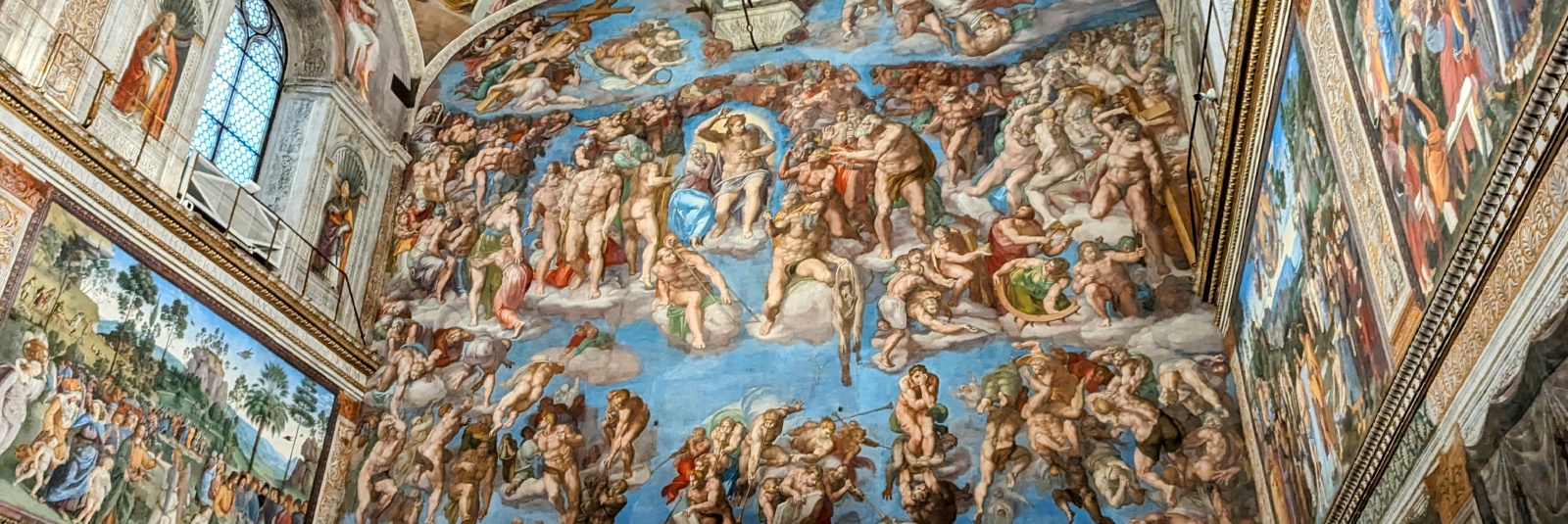
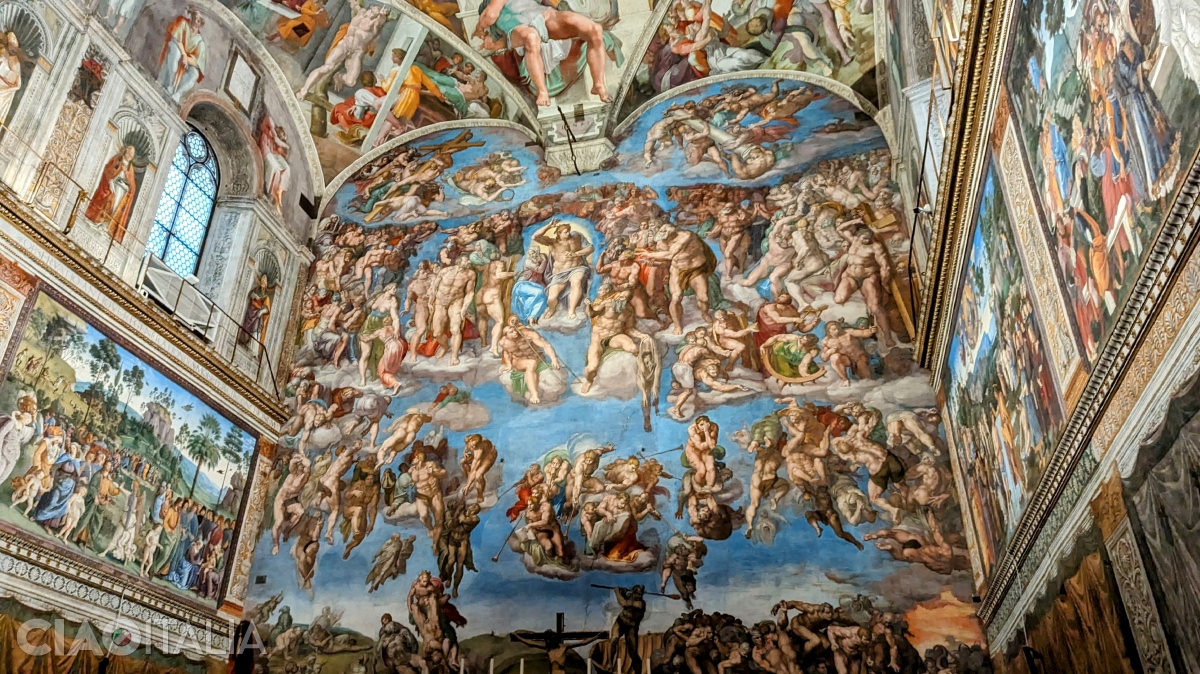
The famous scene of the Last Judgment, painted by Michelangelo between 1536 and 1541, occupies the entire west wall of the Sistine Chapel and features over 400 characters.
The powerful, relentless, and highly unconventional figure of Christ dominates the entire composition. To his left, the Virgin Mary turns her head in an attitude of resignation: the time for Judgment has arrived, and nothing more can be done.
In the lunettes above, groups of angels carry the instruments of the passion: to the left, the Cross, the dice used by Roman soldiers to gamble for Christ's tunic, and the crown of thorns; to the right, the pillar of scourging, the spear with the vinegar-soaked sponge, and the ladder used for the Descent from the Cross.
Surrounding Jesus are throngs of saints, apostles, and patriarchs - many identifiable by the symbols they carry. At the feet of Jesus and Mary are St. Lawrence with the gridiron and St. Bartholomew holding his own flayed skin (in which Michelangelo painted his self-portrait). To the right is St. Peter with the two keys, and further toward the edge are St. Catherine of Alexandria with the breaking wheel and St. Sebastian holding the arrows of his martyrdom.
Below, the angels of the Apocalypse sound their trumpets to announce the resurrection of the dead. To the left, those rising from their graves ascend toward heaven. To the right, angels and demons cast the sinners into hell, while other condemned souls are ferried across by Charon's boat.
The Ceiling of the Sistine Chapel
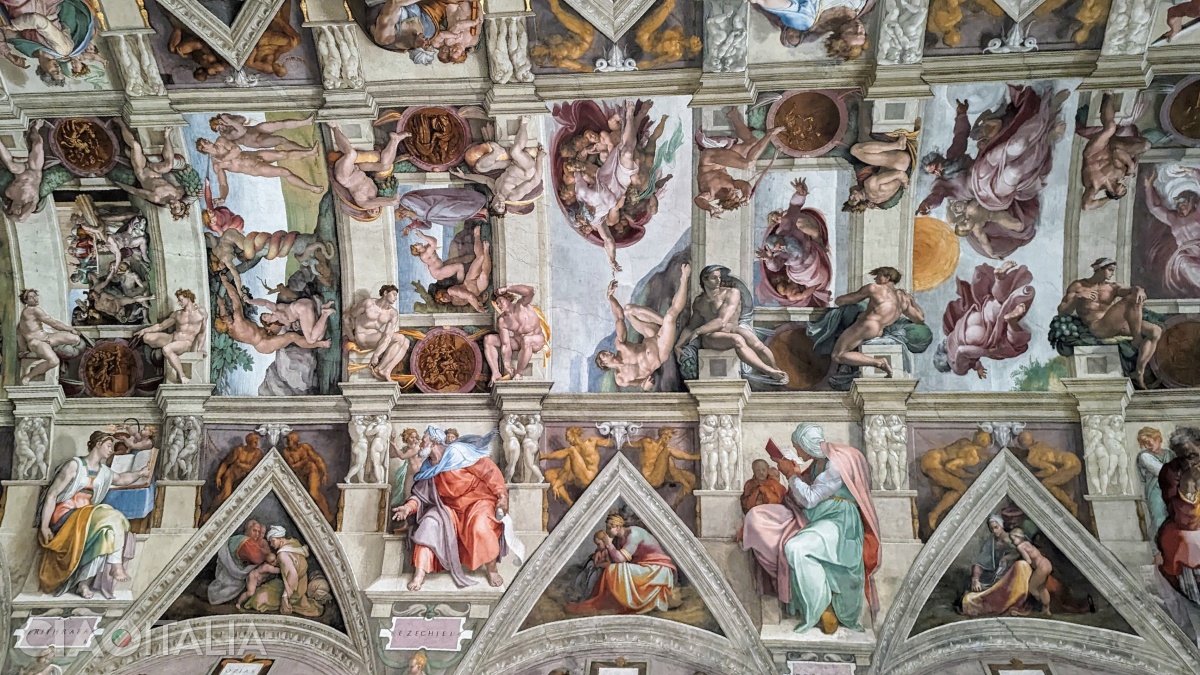
The ceiling of the Sistine Chapel consists of nine central panels featuring over 300 characters. These panels present episodes from the Book of Genesis, organized into three groups representing the origin of the universe, the origin of mankind, and the origin of evil:
- The Origin of the Universe: The Separation of Light from Darkness, The Creation of the Sun, Moon, and Plants, and The Separation of Land from Sea.
- The Origin of Mankind: The Creation of Adam, The Creation of Eve, and The Original Sin and Expulsion from Paradise.
- The Origin of Evil: The Sacrifice of Noah, The Great Flood, and The Drunkenness of Noah.
Each central panel is framed by four male nudes holding medallions that depict scenes from the Book of Kings. In art history, these nude figures are known as ignudi, the name Michelangelo himself used for them.
Along the sides, in the spaces between the triangular spandrels, are five Sibyls and seven Prophets seated on thrones (the figures who first foretold the coming of Christ). Their names are inscribed on the plaques beneath them. The prophets painted on the shorter sides are Jonah (above the wall with The Last Judgment) and Zechariah (at the opposite end).
In the eight triangular spandrels, as well as in the lunettes on the north and south walls, the Ancestors of Christ are depicted.
The triangular paintings in the corners of the ceiling represent pivotal episodes of the salvation of the people of Israel.
Facts about the Sistine Chapel
Here are a few fascinating facts regarding the Sistine Chapel:
- Michelangelo never actually wanted to paint the Sistine Chapel. He was passionate about sculpture and did not consider himself a painter; he felt the grueling work on the chapel ceiling only consumed the precious time he wished to dedicate to his statues.
- To paint the vault of the Sistine Chapel, Michelangelo had to design and build an innovative system of scaffolding.
- For the four years he worked on the Sistine Chapel ceiling, Michelangelo allowed no one to see his progress - not even the Pope. It is said that Raphael, who was working simultaneously on the Vatican Rooms (Stanze di Raffaello), supposedly stole the keys to the chapel one night and snuck in to see the frescoes.
- According to a relatively recent theory, the positioning of God and the angels surrounding Him in the Creation of Adam scene represents the human brain, symbolizing intelligence and the creative force transmitted to man by the divinity.
- In 1522, only ten years after the completion of the Genesis frescoes, Pope Adrian VI wanted them removed because he considered them vulgar. However, he died in 1523 before the destruction of the artwork could take place.
- In the 1560s, Pope Pius IV ordered the private parts of the characters in The Last Judgment to be covered, as they were deemed obscene. This censorship continued for centuries. The restoration from 1979-1999 removed most of these later additions, though those from the 16th century were preserved as historical evidence of the Counter-Reformation.
- Since 1870, the Sistine Chapel has been the site of the Conclave for the election of a new Pope.
- The door at the bottom left of The Last Judgment leads to the so-called Camera Lacrimatoria ("The Room of Tears"). This is where the newly elected Pope enters to change into his papal vestments. Inside, three robes, three pairs of shoes, and three skullcaps of different sizes are prepared, along with a pectoral cross and a ring. The room earned its name because the new Pope, overwhelmed by the weight of his new duties, often sheds tears there.