15 Things to Do in Volterra
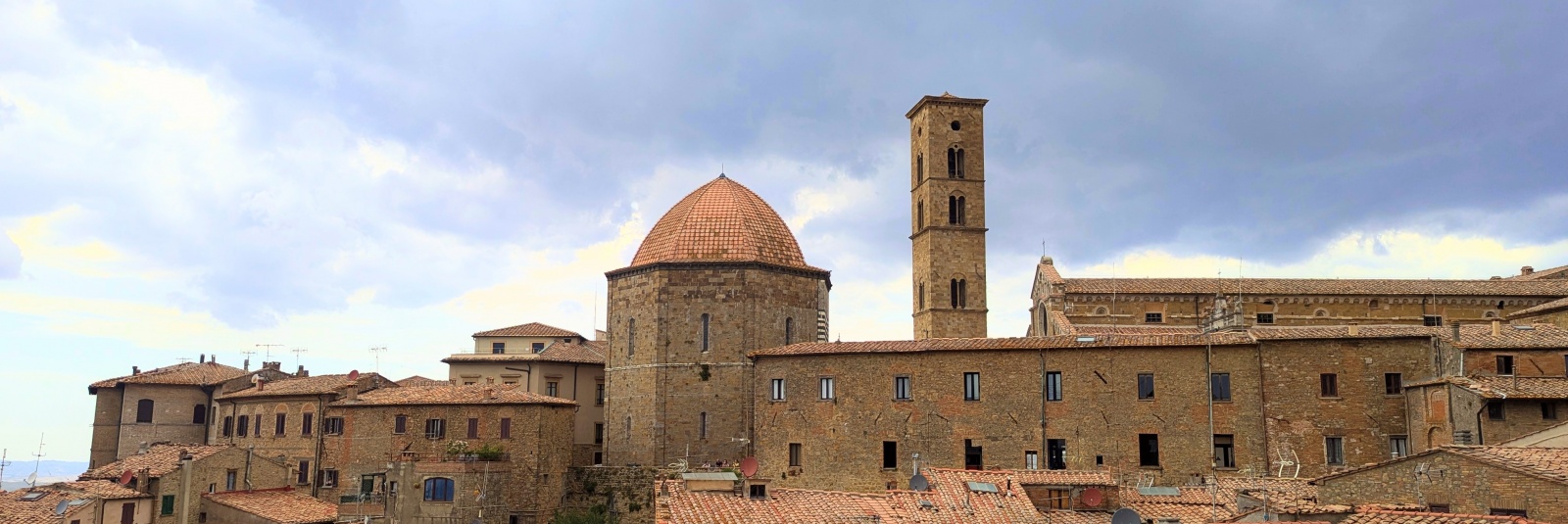
Like most medieval towns in Tuscany, Volterra is located on a hilltop, at an altitude of about 500 meters, and is surrounded by impressive walls. It's a small but charming town that, however, lives in the shadow of the much more famous San Gimignano, located nearby.
You can easily reach Volterra by car (see also the article about car rental in Tuscany) from Pisa (about 1 hour and 15 minutes), Siena (around 1 hour), or Florence (1.5 hours). The historic center is a ZTL (limited traffic zone), so you'll need to leave your car in one of the parking lots outside the walls.
One day is enough to see Volterra, but if you want to visit all the tourist attractions, you'll need two days. In that case, it might be a good idea to buy the Volterra Card, which is valid for 72 hours, costs €23, and includes entry to the main points of interest (Palazzo dei Priori, Etruscan Museum, Art Gallery, Alabaster Museum, Etruscan Acropolis, Roman Theatre, and the Diocesan Museum of Sacred Art). Otherwise, admission to each attraction separately costs €10 per person. The card can be purchased at the Tourist Information Center or at any of the museums included in the circuit.
Volterra is famous for its Etruscan roots and for the extraction and craftsmanship of alabaster. More recently, it has gained worldwide fame thanks to the "Twilight" series. Author Stephenie Meyer places the residence of the Volturi vampire family in the town of Volterra. However, if you plan to follow in the footsteps of the characters, you should know that the scenes from the movie "Twilight: New Moon" were actually filmed in the small town of Montepulciano, located about 100 km away.
It's also a good idea to stay in Volterra and use it as a base to explore other tourist attractions in the area. In general, prices are lower than in more famous locations. Some of the best hotels in the historic center include Etruria, Volterra In, and La Locanda.
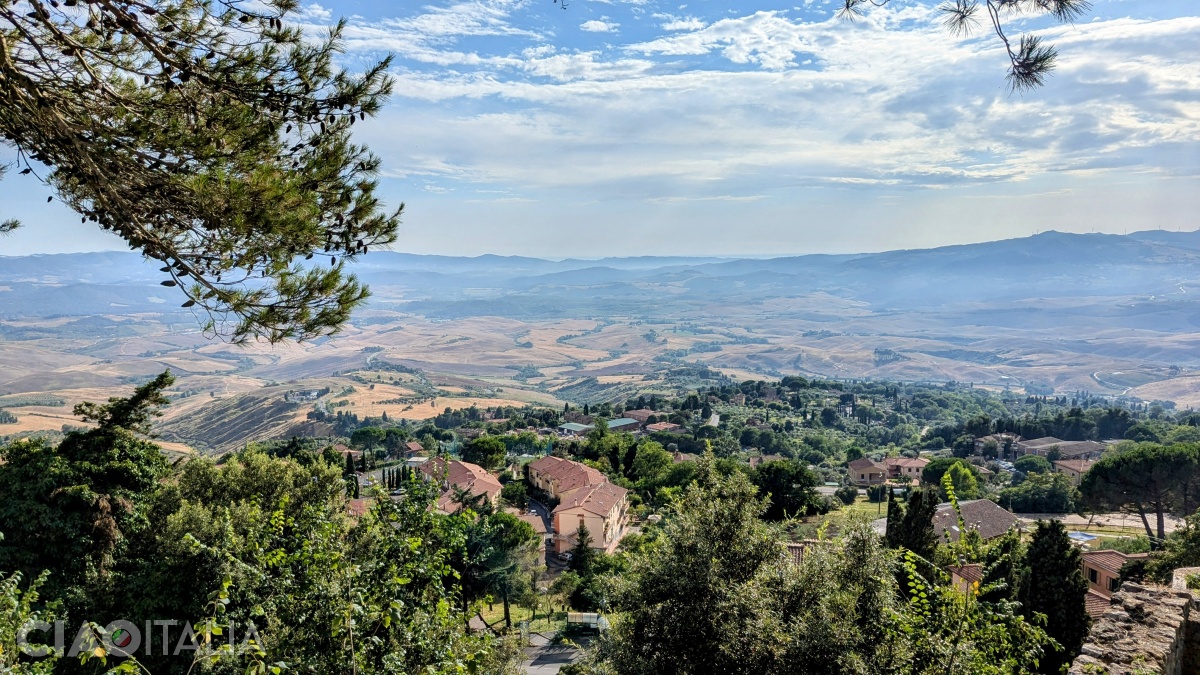
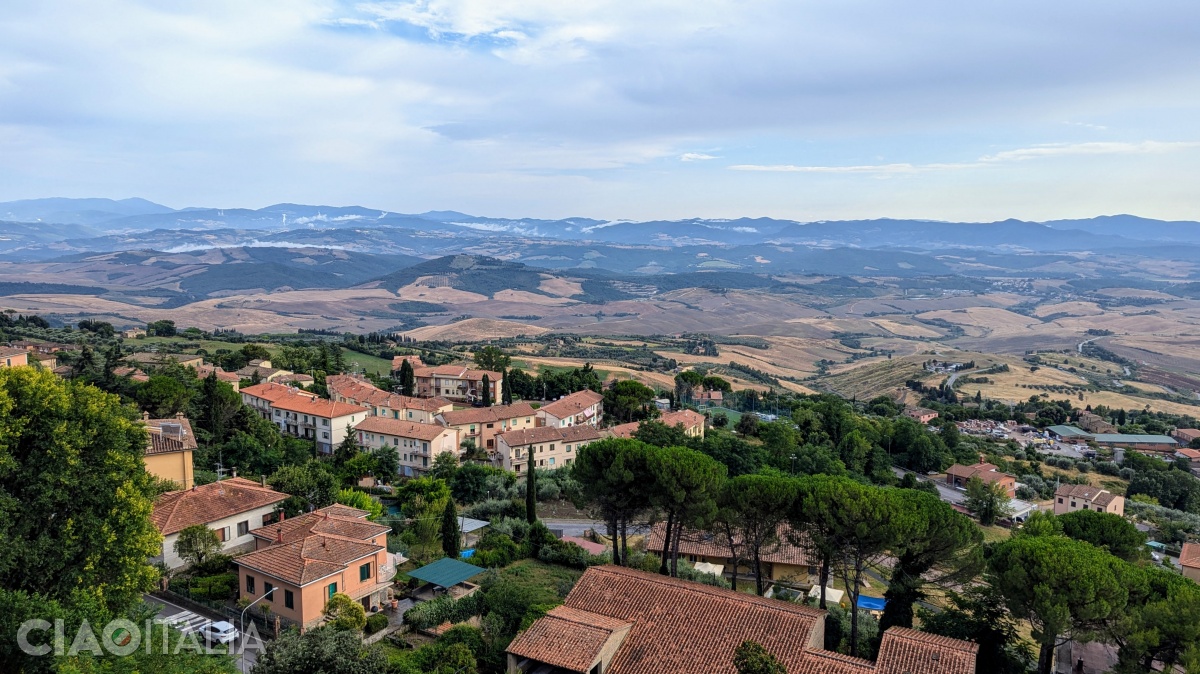
The best way to start your visit to Volterra is from Viale dei Ponti, near Piazza Martiri della Libertà, where you'll also find the underground parking La Dogana (paid). From Viale dei Ponti, you can admire both the panorama of the medieval town and the view over Val di Cecina. On clear days with good visibility, you can even glimpse the Tyrrhenian Sea and the island of Corsica on the horizon.
1. Piazza dei Priori
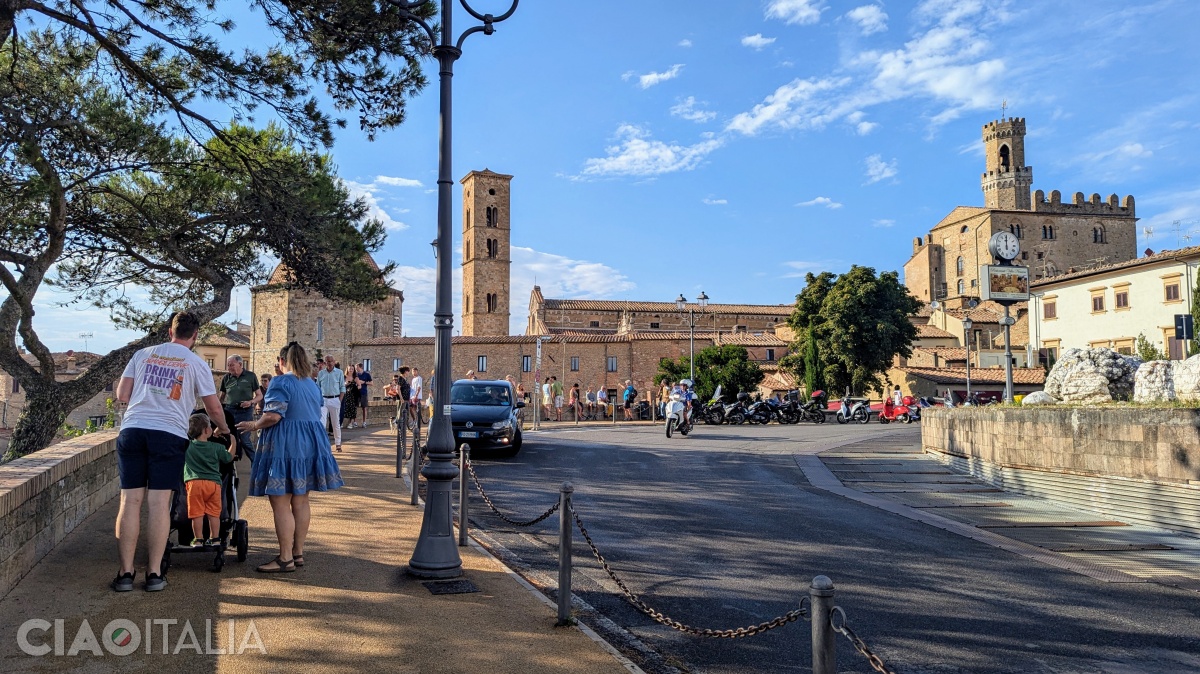
Piazza dei Priori is the heart of Volterra and one of the most beautiful medieval squares in Tuscany. You can reach it within 10 minutes from any of the seven gates leading into the town.
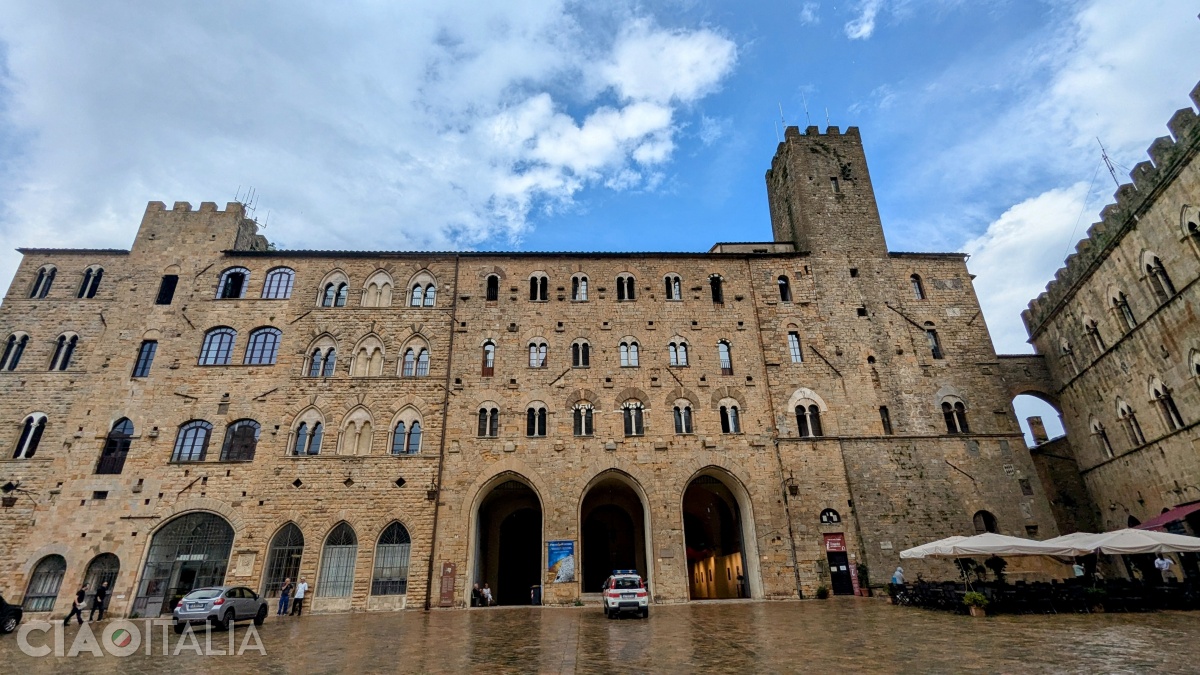
On one side of the square stands Palazzo dei Priori (described below), which today serves as the town hall and hosts exhibitions. Next to it, you'll find the Tourist Information Center.
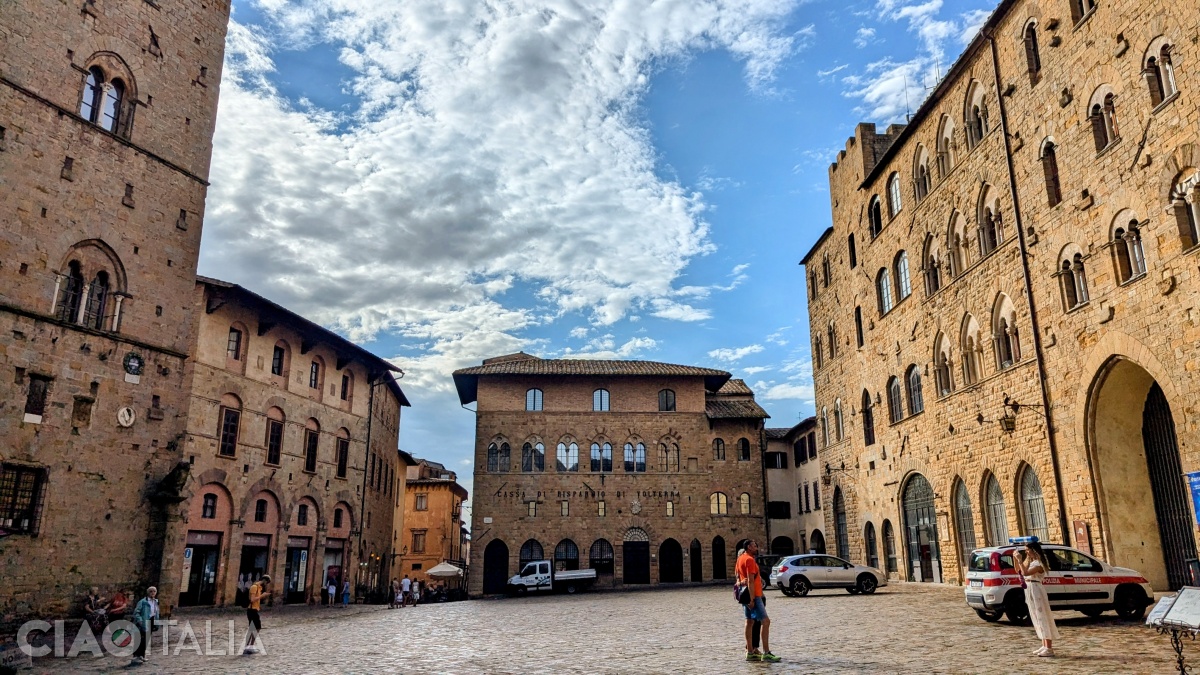
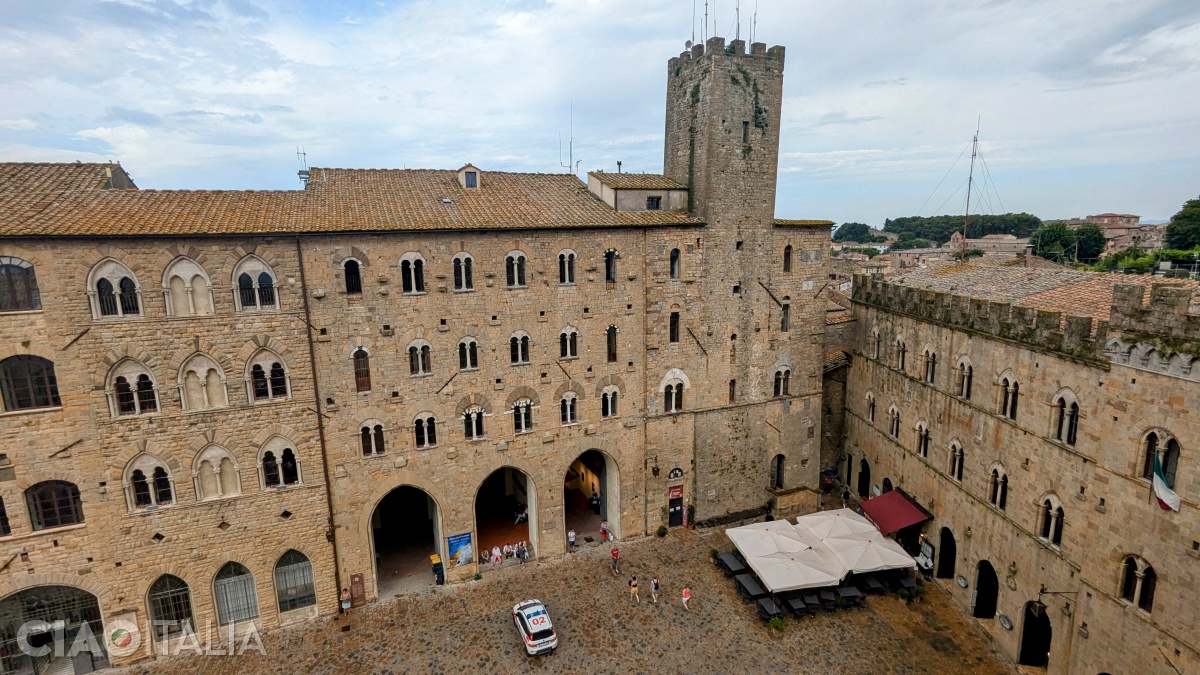
On the opposite side rises Palazzo Pretorio, whose appearance nowadays is the result of architectural modifications made after the 19th-century earthquake. In the past, the palace served as the residence of the Captain of the People and his guard.
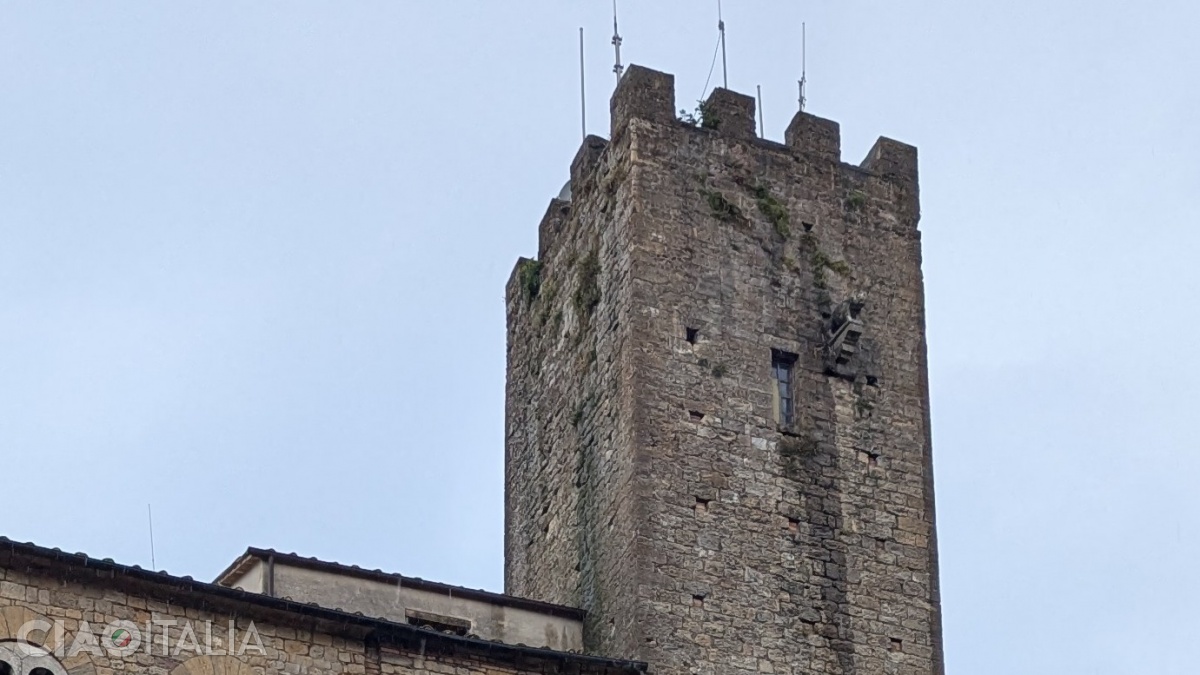
The tower rising above the building is considered one of the oldest in the city, dating back to the second half of the 12th century. It is called Torre del Podestà, but it's better known as Torre del Porcellino ("The Piglet Tower"). The amusing nickname comes from a strangely shaped stone figure placed on a bracket to the right of the tower's top window. Some say it represents a wild boar, while others believe it's a statue of a mouse - the emblem of the Topi family (whose name means "mice" in Italian), to whom the palace once belonged.
Palazzo Pretorio cannot be visited. Inside, it houses several public institutions, including the Municipal Police.
Palazzo Incontri, which incorporates both medieval and Renaissance elements, served as a seminary during the 18th century. Today, it houses the headquarters of the Volterra Savings Bank (Cassa di Risparmio).
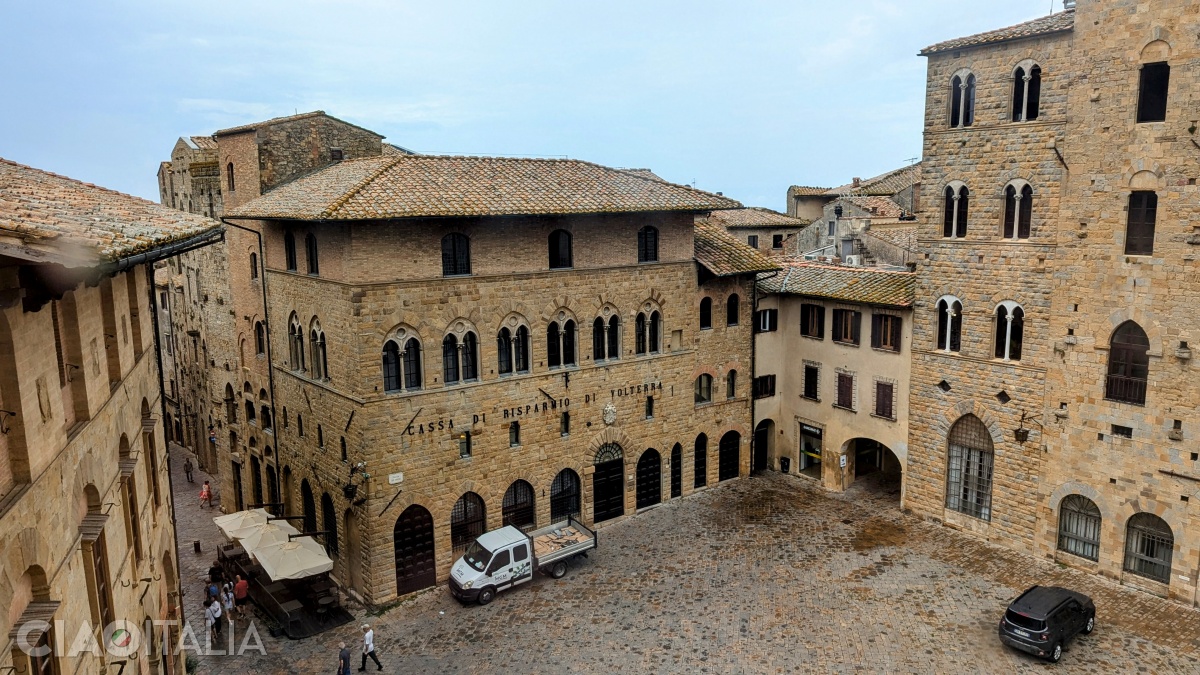
The Episcopal Palace (Palazzo Vescovile) was used in medieval times as a grain warehouse, and its loggia used to be the place where the market was held. In 1618, it was transformed into an episcopal residence. Today, it houses the Diocesan Archive. Until 2017, when it was moved to the Church of Sant'Agostino, it also hosted the Diocesan Museum of Sacred Art.
Every year, in August, Piazza dei Priori hosts the medieval festival Volterra AD 1398.
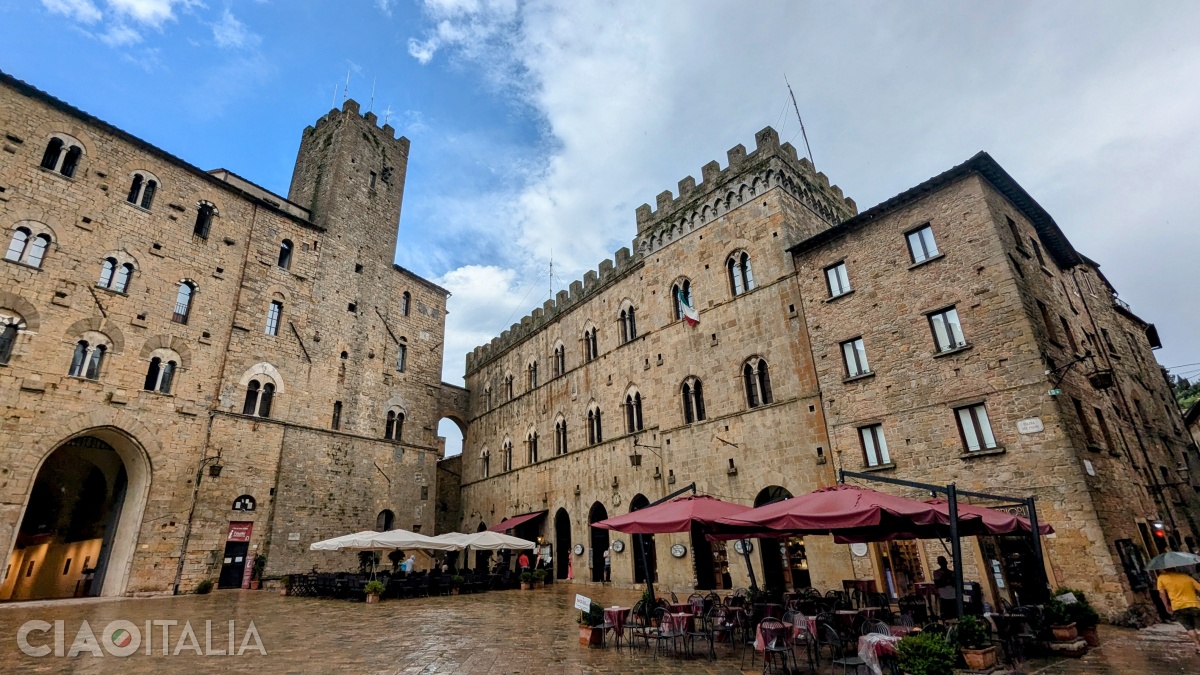
2. Palazzo dei Priori
In 1208, the authorities of Volterra decided to build an imposing palace worthy of serving as the city hall. The construction was completed only in 1257, as stated in the inscription above the entrance gate. It is the oldest town hall in Tuscany.
Palazzo dei Priori owes its name (given also to the square) to the fact that it was the residence of Volterra's eighteen priors (high magistrates).
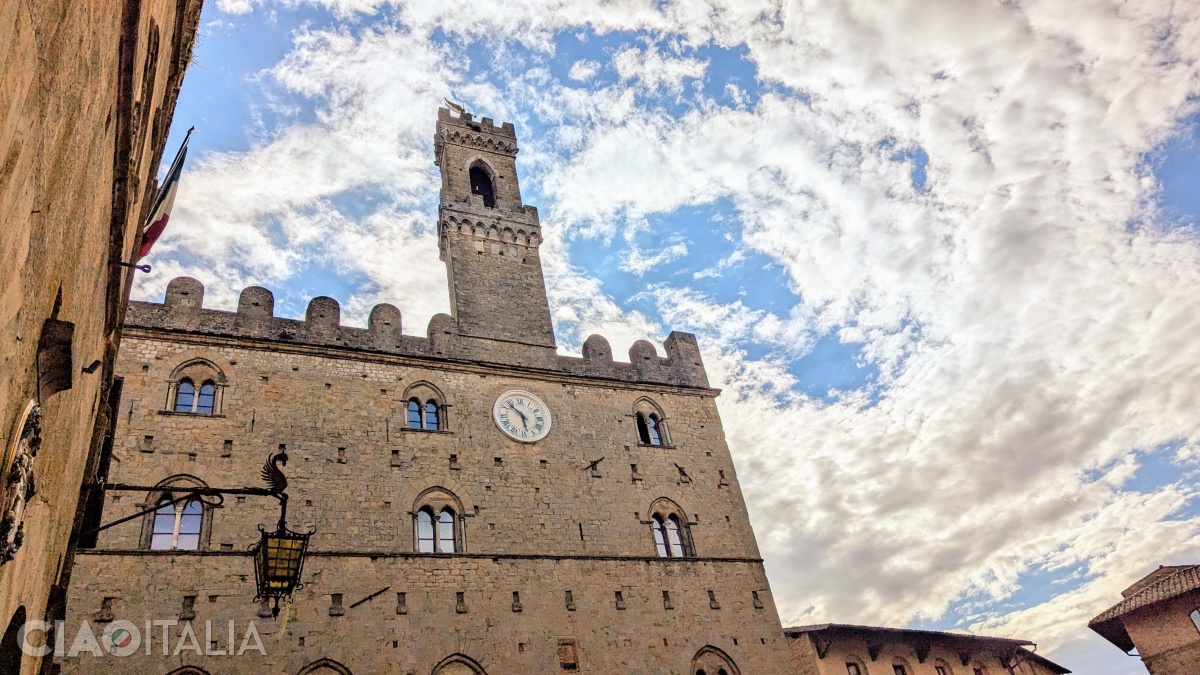
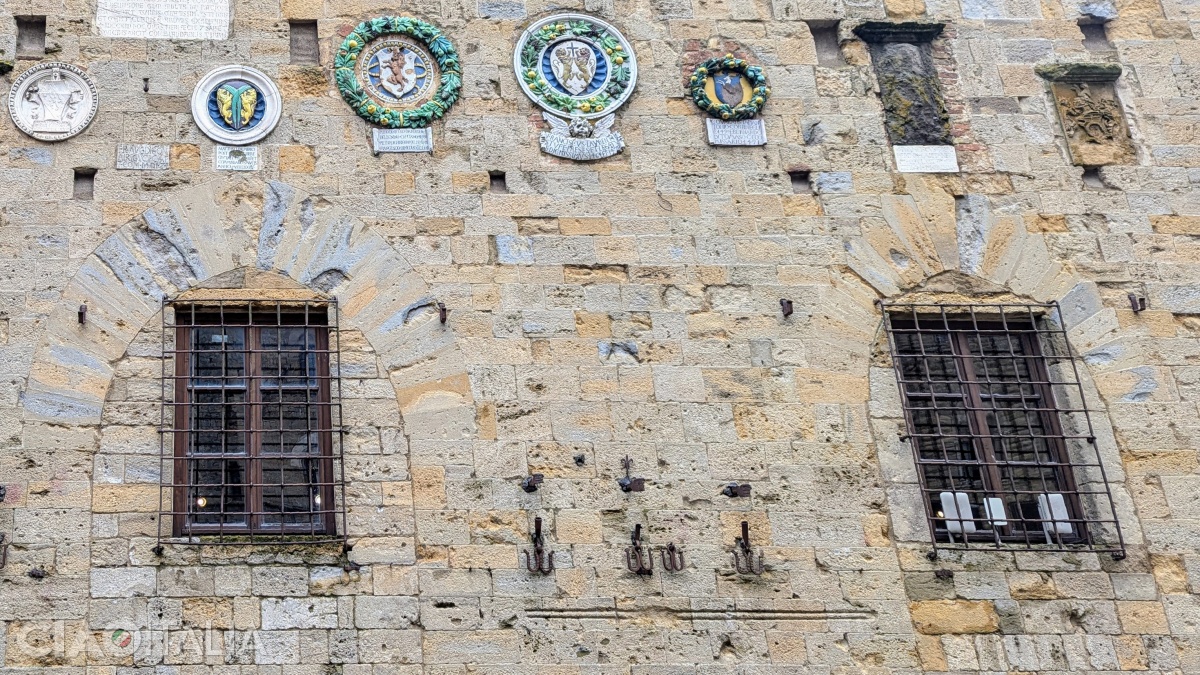
The coats of arms on the façade belong to the Captains of the People who governed Volterra in the 14th and 15th centuries. The glazed ceramic ones were created in the workshop of the famous Della Robbia artists. The lions on the side columns recall the domination of Florence over Volterra.
Between the ground-floor windows, you can see the engraved measurement unit of the medieval city (in the Middle Ages, each town had its own), known as the canna volterrana.
The tall tower, built in the 16th century, was reconstructed at the top after being damaged by the earthquake of 1846.
In the 19th century, the palace housed the Volterra Art Gallery (Pinacoteca) until it was moved to the building where it is still located today.
Today, the palace hosts the offices of the Town Hall, although part of it is open to visitors.
The entrance hall, where the ticket office is now located and where you can see the coats of arms of the priors, was once used for various meetings.
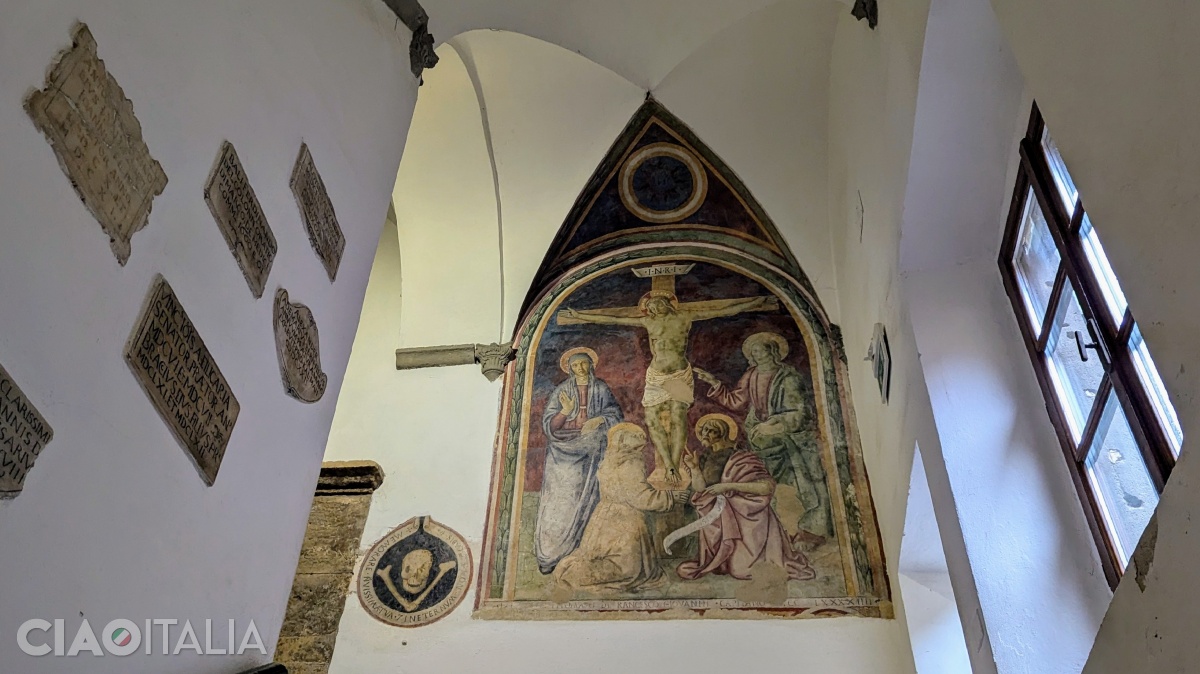
Climbing to the first floor, you'll see at the top of the staircase the fresco "The Crucifixion", painted by Pier Francesco Fiorentino in 1490.
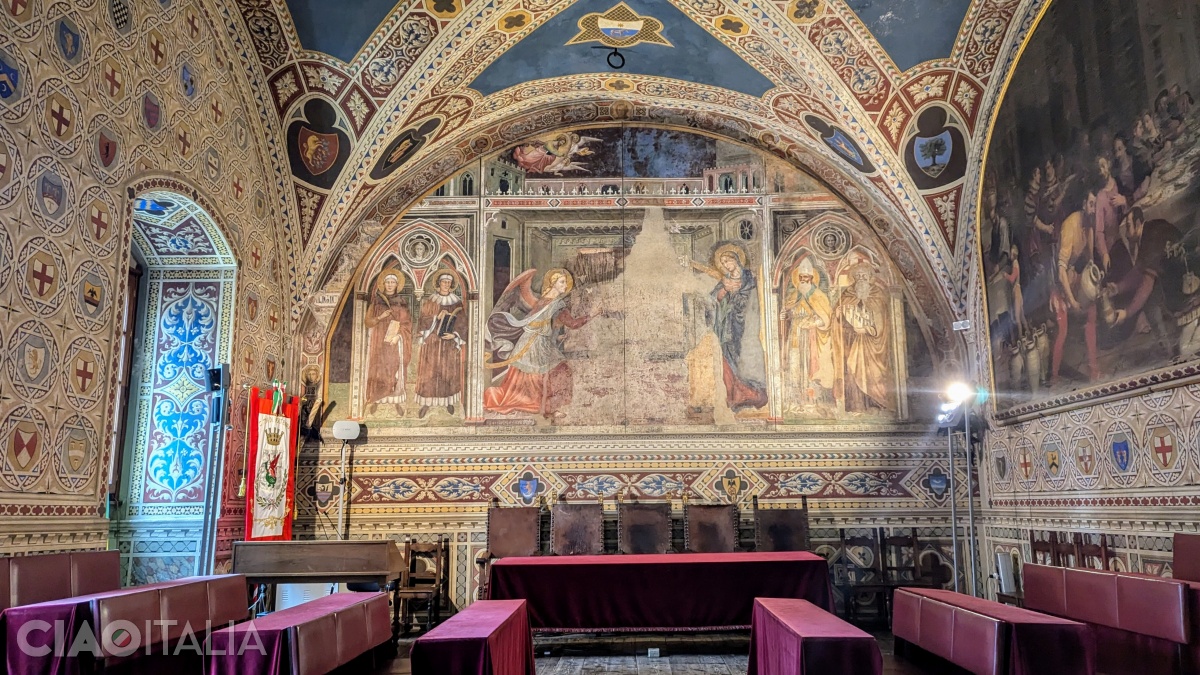
Immediately after, you'll find yourself in the beautiful Hall of the Great Council (Sala del Maggior Consiglio), which is still used today for meetings of the Municipal Council.
The decoration of the hall was completed in 1881. Floral and geometric motifs frame the coats of arms of noble families and the city's emblem (a red cross on a white background).
From the original decoration of the hall, only the "Annunciation", painted by Iacopo di Cione Orcagna in 1383, has been preserved. You can also see here the painting "The Wedding at Cana" by Donato Mascagni (16th century).
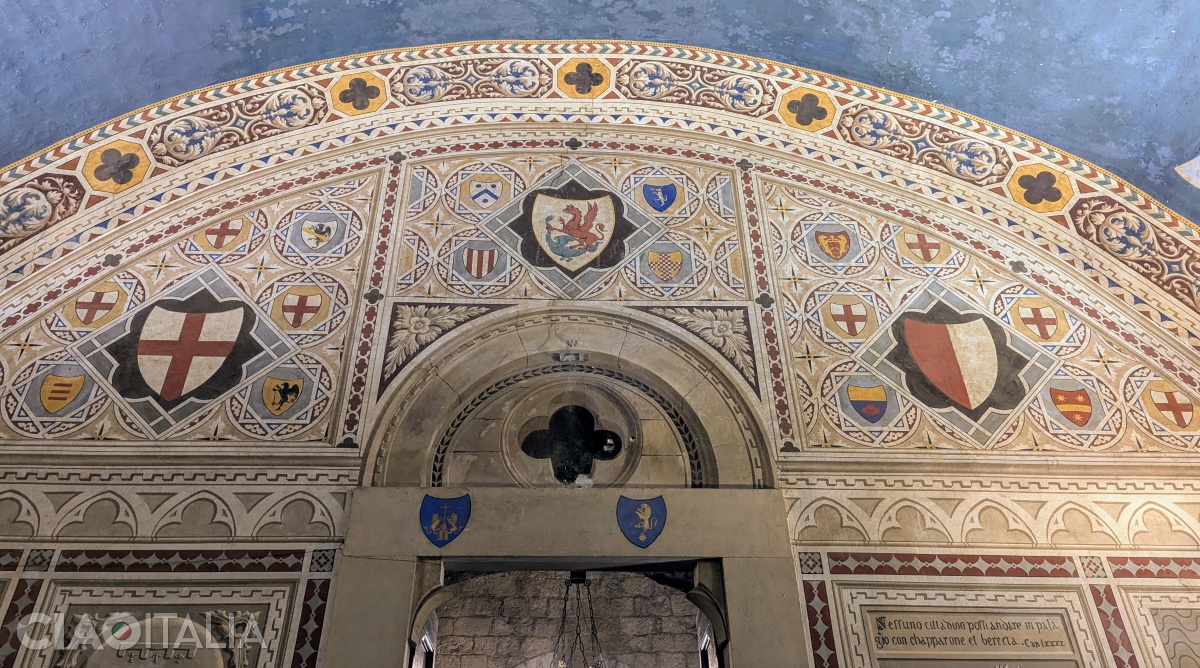
Above the entrance door to the small adjoining room (Sala della Giunta), you can see the city's coat of arms (a shield with a red cross on a white background), the Town Hall's emblem (a red griffin defeating a dragon), and the People's coat of arms (a shield divided into white and red halves). On either side of the door are displayed the Medici family coat of arms (a shield with six balls) and the Marzocco lion, symbol of Florence.
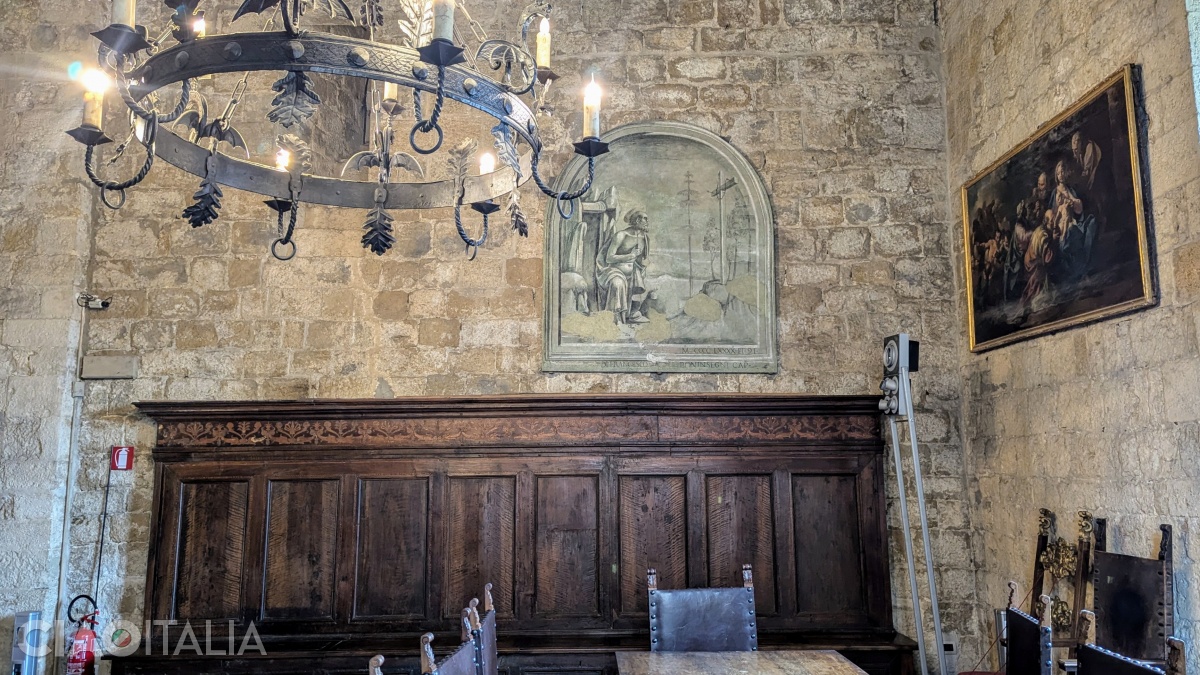
Sala della Giunta was used for smaller gatherings or less important events. On the wall facing the Council Hall are the sinopie (preparatory drawings) for Orcagna's fresco.
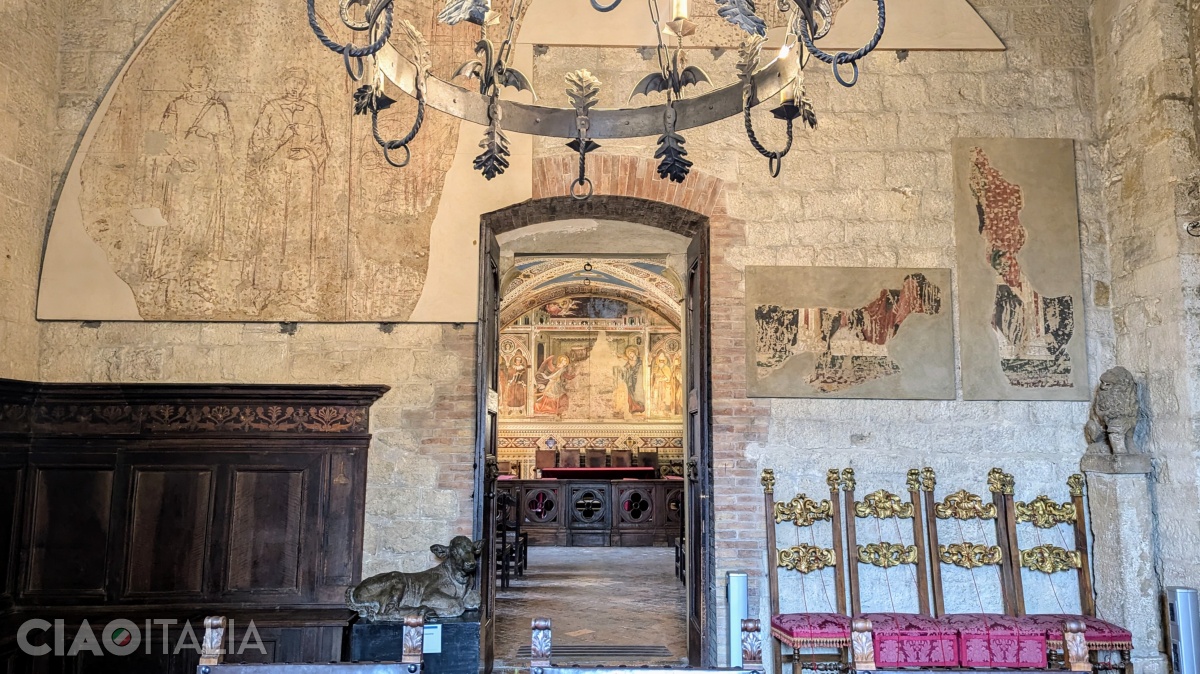
On the side walls are the magistrates' seats, dating back to the 16th century. On the left wall of the entrance is the monochrome fresco "Saint Jerome", attributed to Luca Signorelli, a painter from Cortona, created in 1491. In the same room, you can also see the painting "Jupiter" by Donato Mascagni, "The Birth of Mary" (1741) by Gian Domenico Ferretti, and "Adoration of the Magi" (1741) by Ignazio Hugford.
On the second floor were once the priors' bedrooms, a large dining hall, and a meeting room. Today, the space is used for various exhibitions, just like the rooms on the next floor.
From the third floor, when weather conditions allow, you can climb the tower. Access is limited to a maximum of five people at a time and is prohibited at the exact hour or on the half-hour, due to the loud ringing of the bells.
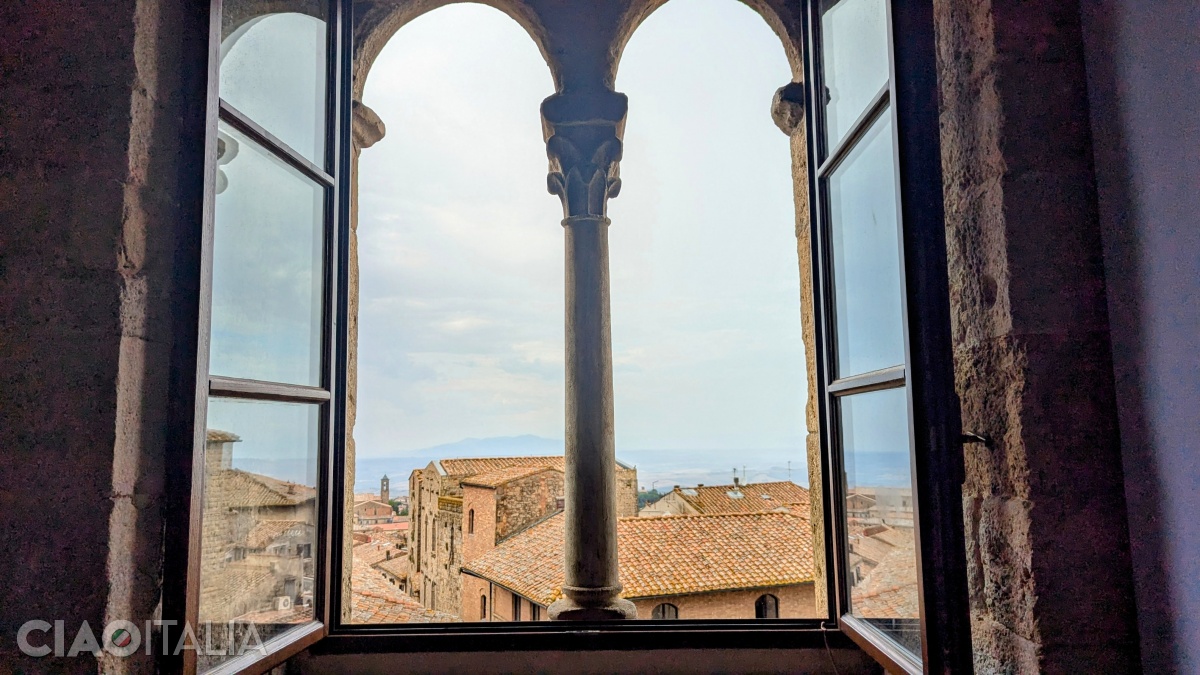
If you're unlucky and the tower is closed, as we experienced after a rainstorm that caused too much water to accumulate, you can still enjoy the panoramic view from the third-floor windows.
Palazzo dei Priori
Opening Hours:
March 10 - November 2, 2026:
- Monday-Sunday: 10:00 AM - 6:30 PM
Ticket Price (included in the Volterra Card):
- Adult: €10
- Over 60: €8
- 6-18 years: €8
- Child under 6: free
3. Buonparenti Tower Houses
Walking through Volterra, you'll see several tower houses. During the Middle Ages, these were the homes of the wealthiest families, and their purpose was not only for defense but also to display power and wealth, serving as a symbol of social status.
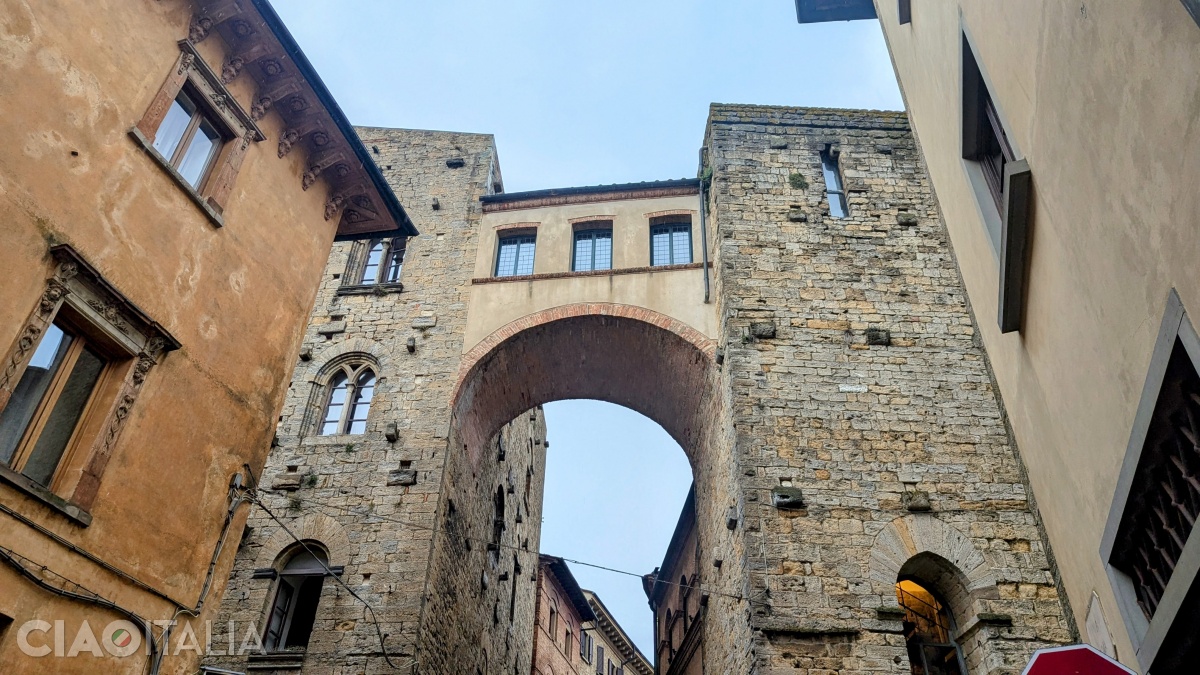
The most representative of these - the Buonparenti (or Buomparenti) Tower Houses - are very close to Piazza dei Priori, at the intersection of Buonparenti and Ricciarelli streets. The Buonparenti family tower and the fortified residence of the Angelario family are connected by an archway, offering one of the most characteristic images of 13th-century Volterra.
4. Volterra Cathedral
If Piazza dei Priori is the center of the city's civil power, Piazza San Giovanni, located just behind it, is the center of religious power.
The Cathedral of Santa Maria Assunta (il Duomo) in Volterra stands on the site where, in the 9th century, there was a small church dedicated to the Virgin Mary. In the 12th century, following an earthquake, the church was rebuilt and later enlarged in the 13th century.
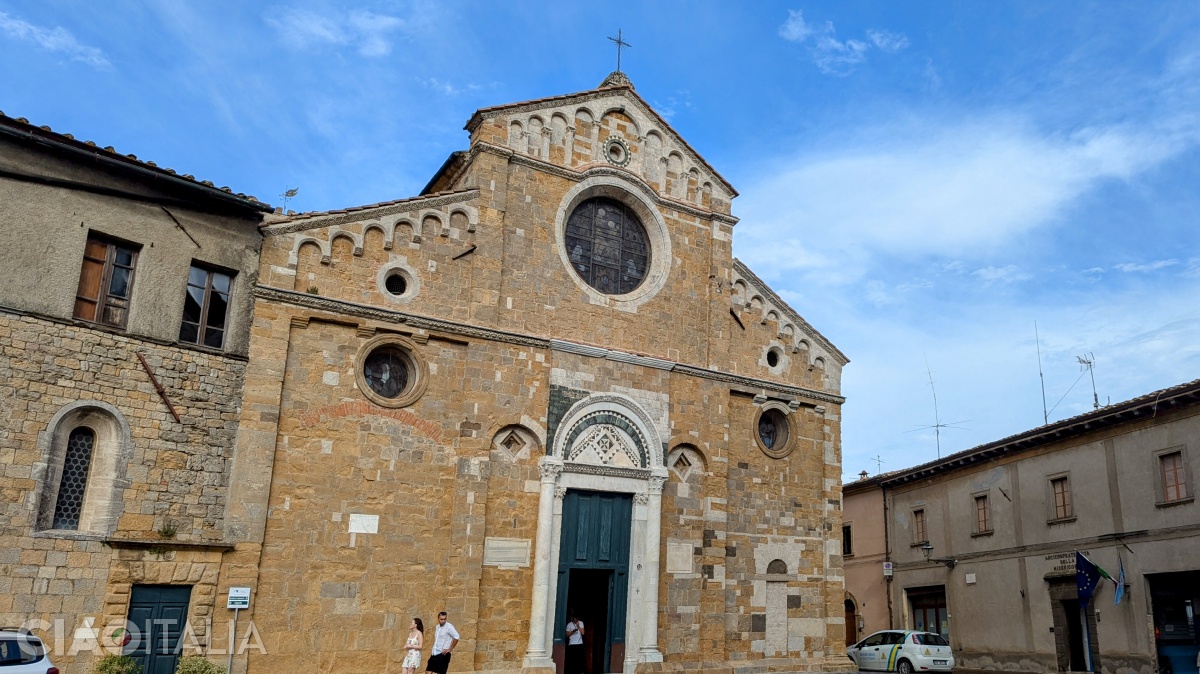
The exterior is simple. The only standout feature is the Romanesque marble portal, created in the 13th century, using material from the Roman theatre.
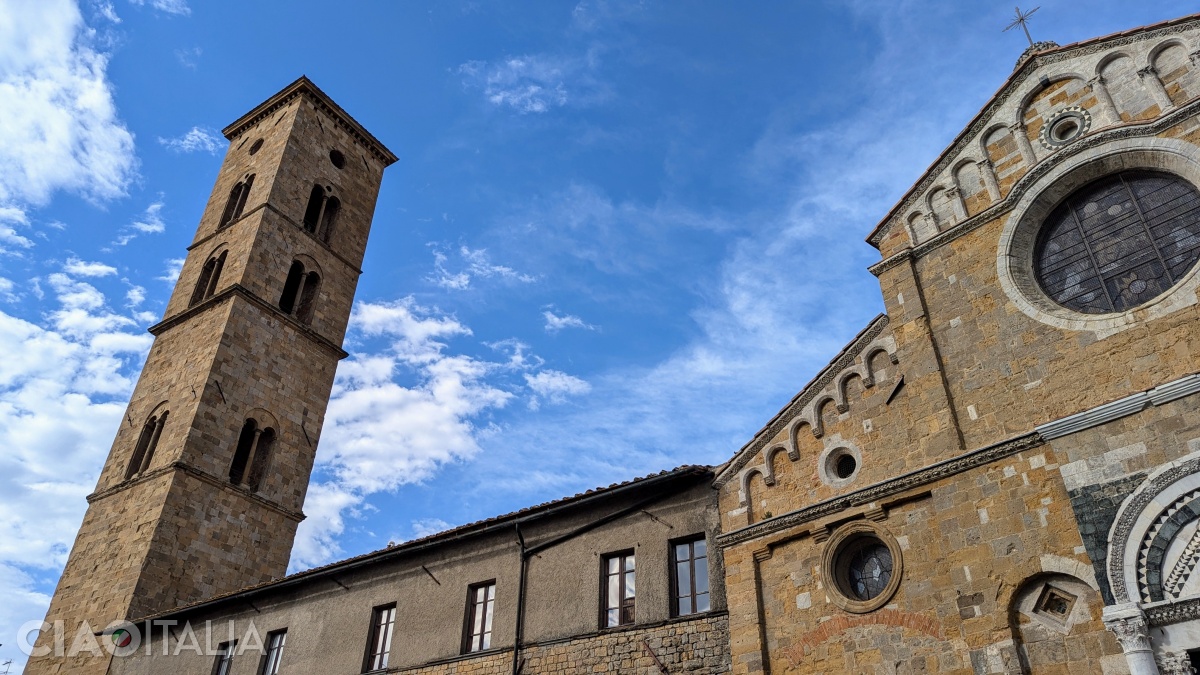
Curiously, the church's bell tower is located a little farther away, on one of the corners of San Giovanni square. The original campanile had been adjacent to the cathedral, but at the end of the 15th century, because it was at risk of collapsing, it was demolished and rebuilt in its current location.
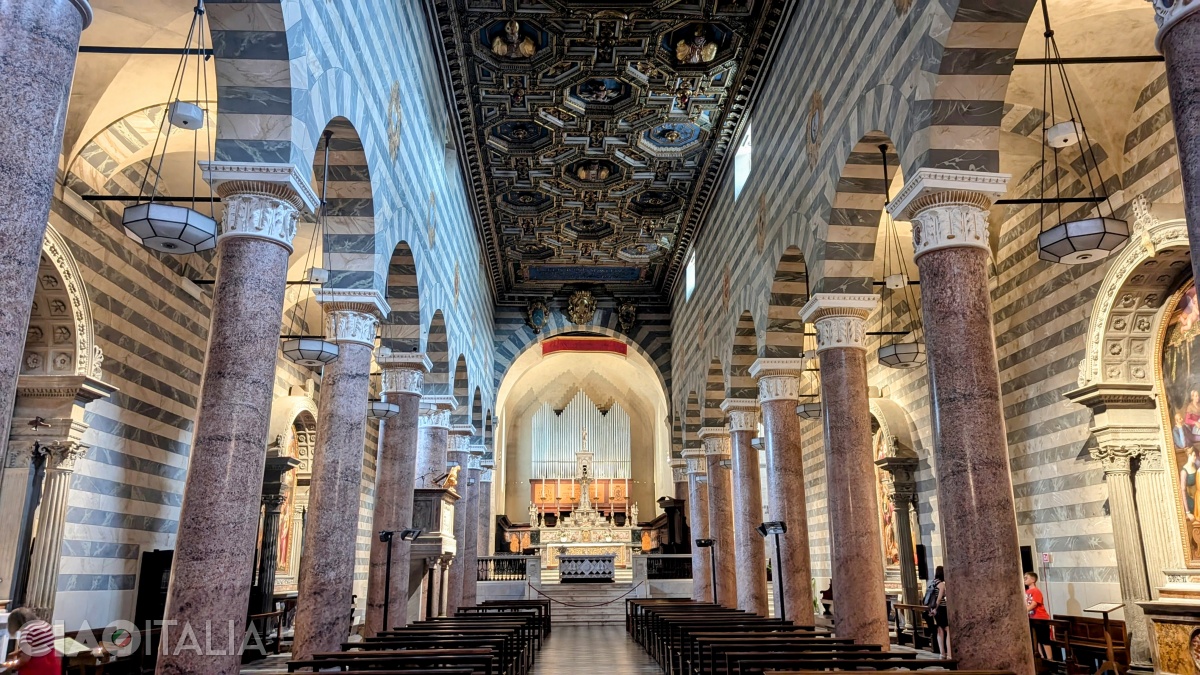
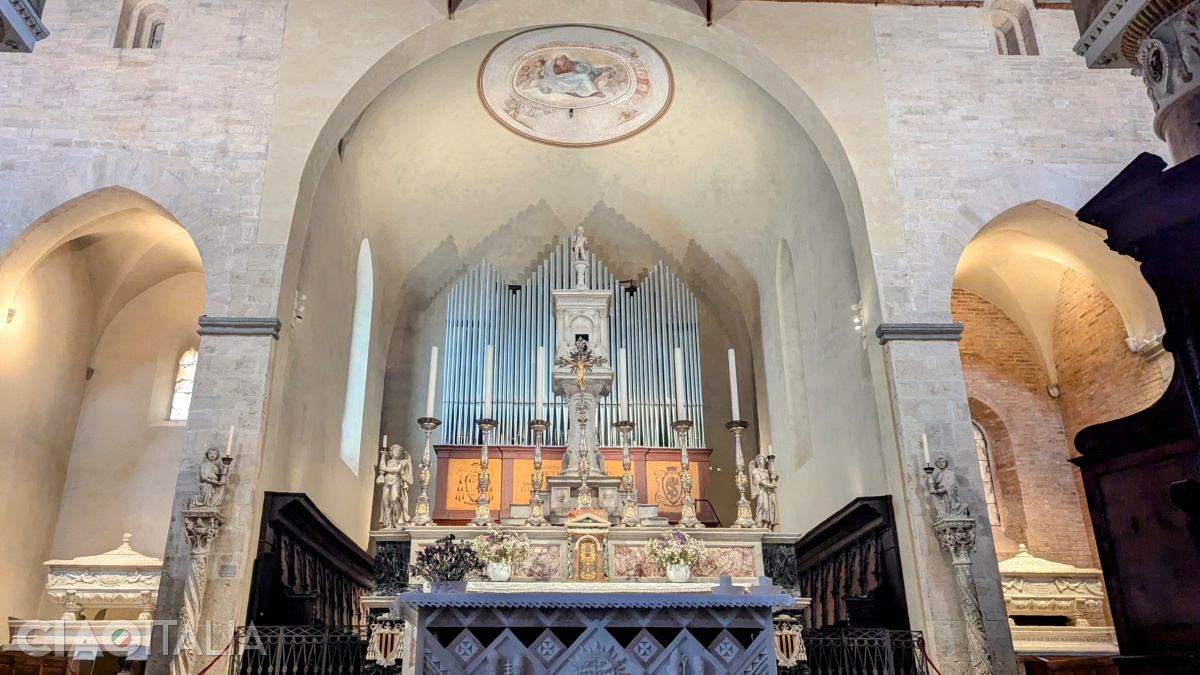
The interior, divided by 22 columns into three naves, is adorned with a sumptuous gilded coffered ceiling. The side chapels contain altars with paintings dating from the second half of the 16th century.
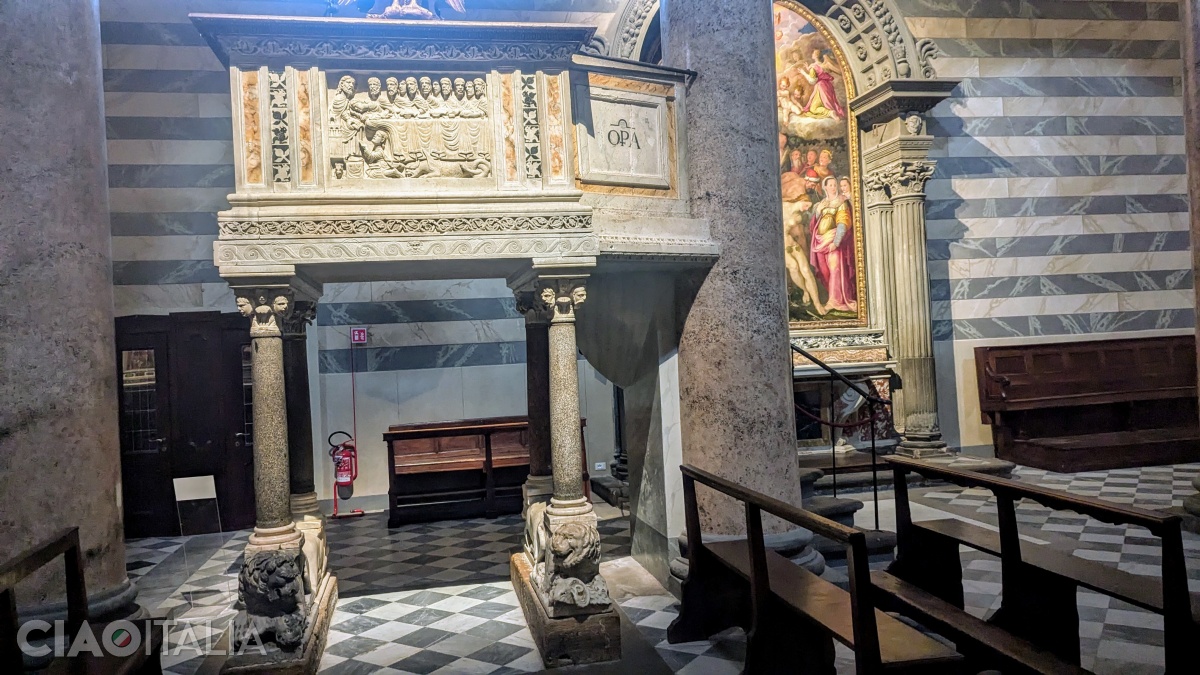
The bas-reliefs on the pulpit date back to the 12th century, while the ciborium (the canopy-like structure above the altar) was created by Mino da Fiesole in 1471.
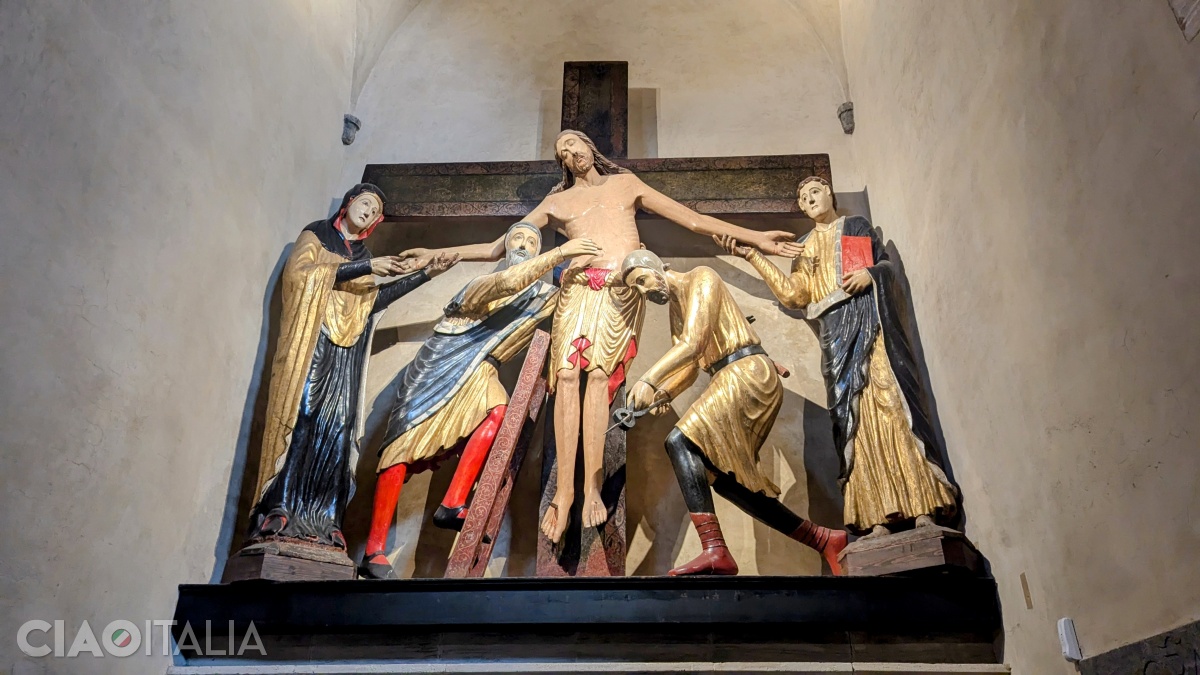
Don't miss, to the right of the altar, the sculptural group "The Descent from the Cross" - a masterpiece of medieval sculpture, made of painted wood in 1228. The five larger than life-size figures represent Jesus, being taken down from the cross; Joseph of Arimathea, standing on a ladder and supporting him from the left; Nicodemus on the right, shown removing the nail from Jesus' left foot with pliers; and Mary and St. John the Evangelist on either side of the cross, holding Jesus' hands.
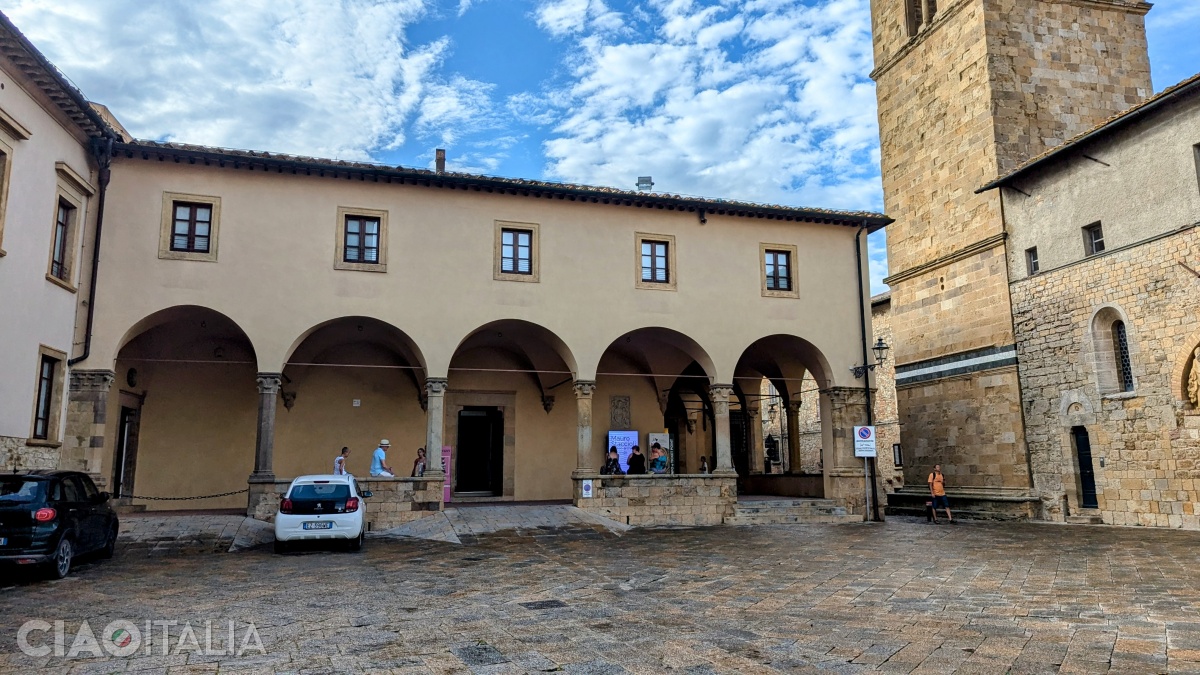
During the summer, tickets for visiting the Cathedral and the Baptistery are purchased from the Santa Maria Maddalena Exhibition Center - the arched building on one side of the square, which once housed the city's hospital, documented since the 12th century.
Volterra Cathedral
Opening Hours:
May 28 - September 27, 2026:
- Monday-Sunday: 10:00 AM - 1:30 PM, 2:00 PM - 6:00 PM
Last admission is 30 minutes before closing.
Ticket Prices:
Anima Pass (valid for 2 days, includes entry to the Cathedral, Baptistery, and the exhibitions at the Santa Maria Maddalena Center):
- Adult: €8
- Over 65: €6
- Child 6-17: €6
- Child under 6: free
5. The Baptistery
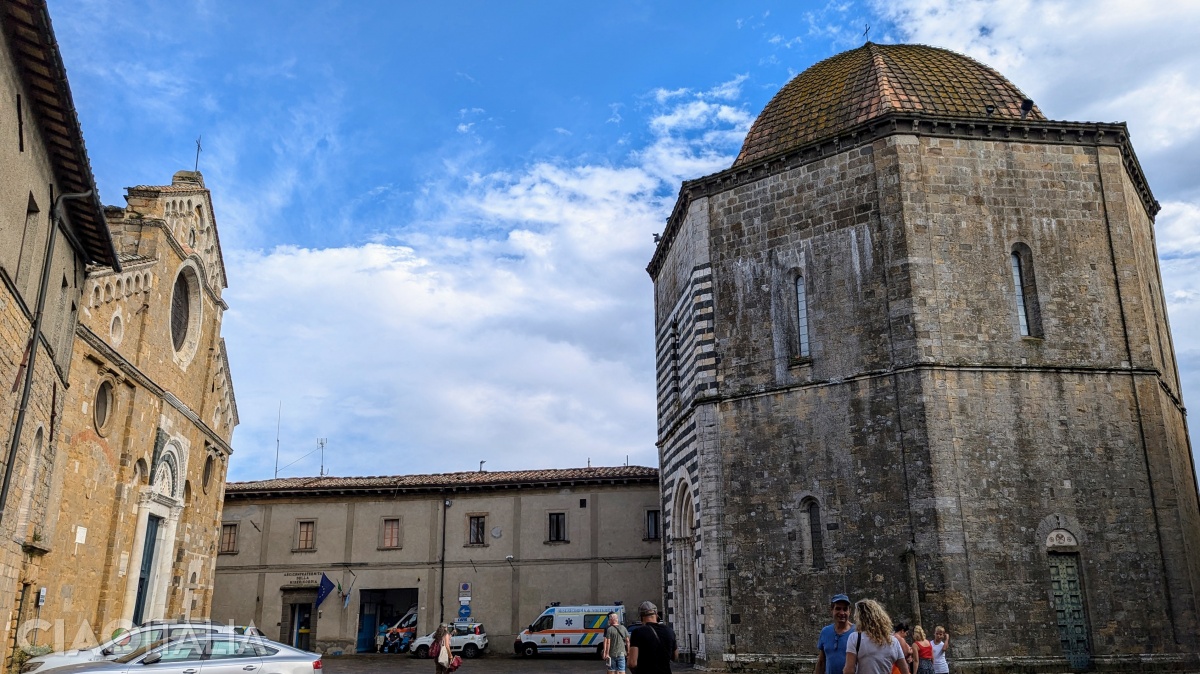
Opposite the cathedral stands the octagonal baptistery, dating from the 13th century. It is said to have been built on the site of a former pagan temple, though there are no documents to confirm this.
The façade is partially clad in alternating rows of white and dark green marble.
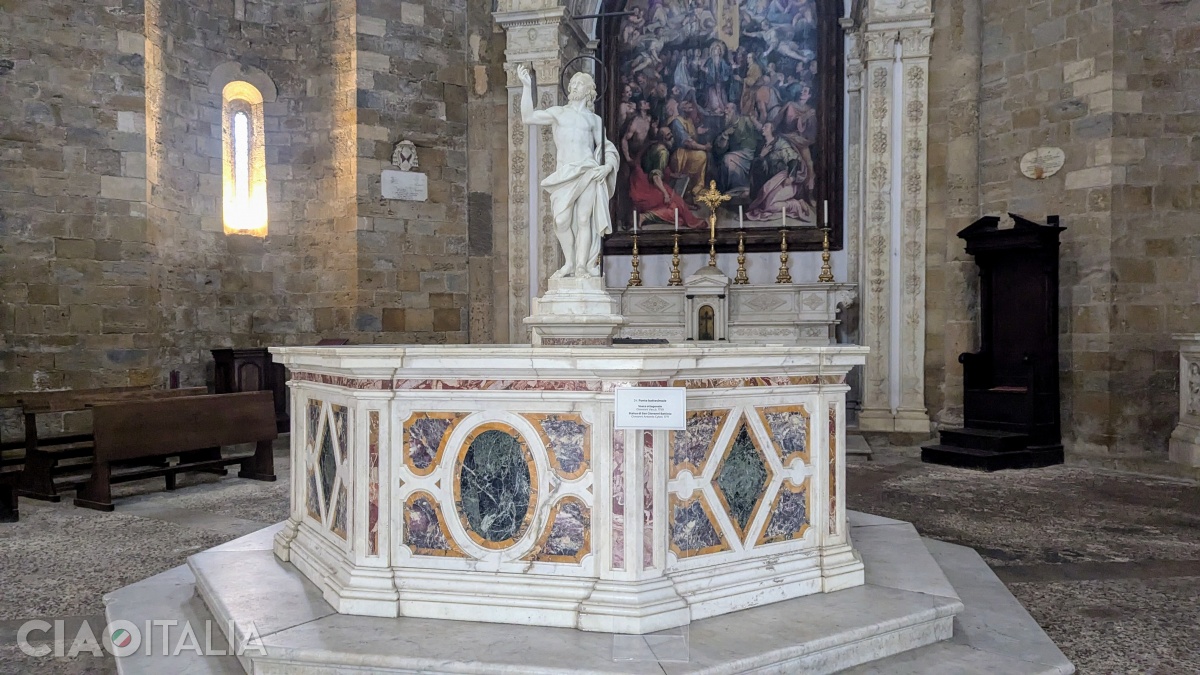
The interior is simple. In the center stands a large marble baptismal font, created in 1759 by the sculptor Giovanni Vaccà from Carrara. The statue depicts St. John the Baptist and dates from 1771.
Above the 18th-century altar hangs the painting "The Ascension of Christ", a work by Pomarancio from 1591.
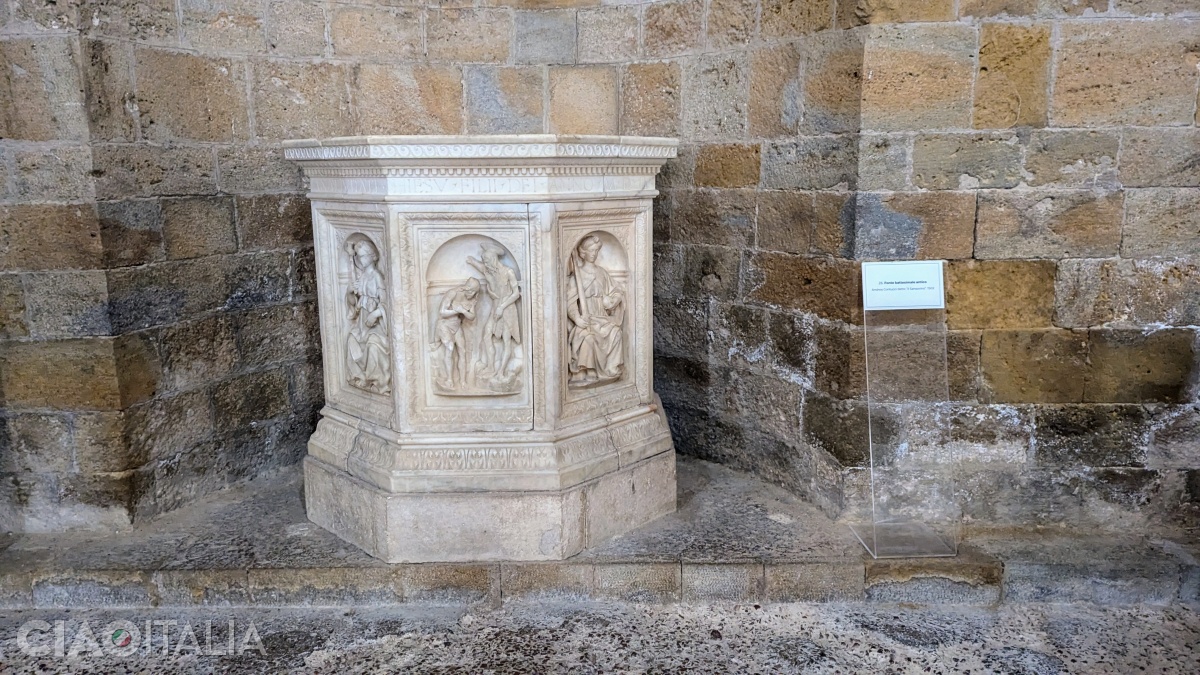
To the right, near the wall, stands the old baptismal font, created by the sculptor Andrea Sansovino in 1502. It depicts the Baptism of Jesus and four virtues - Faith, Justice, Hope, and Charity.
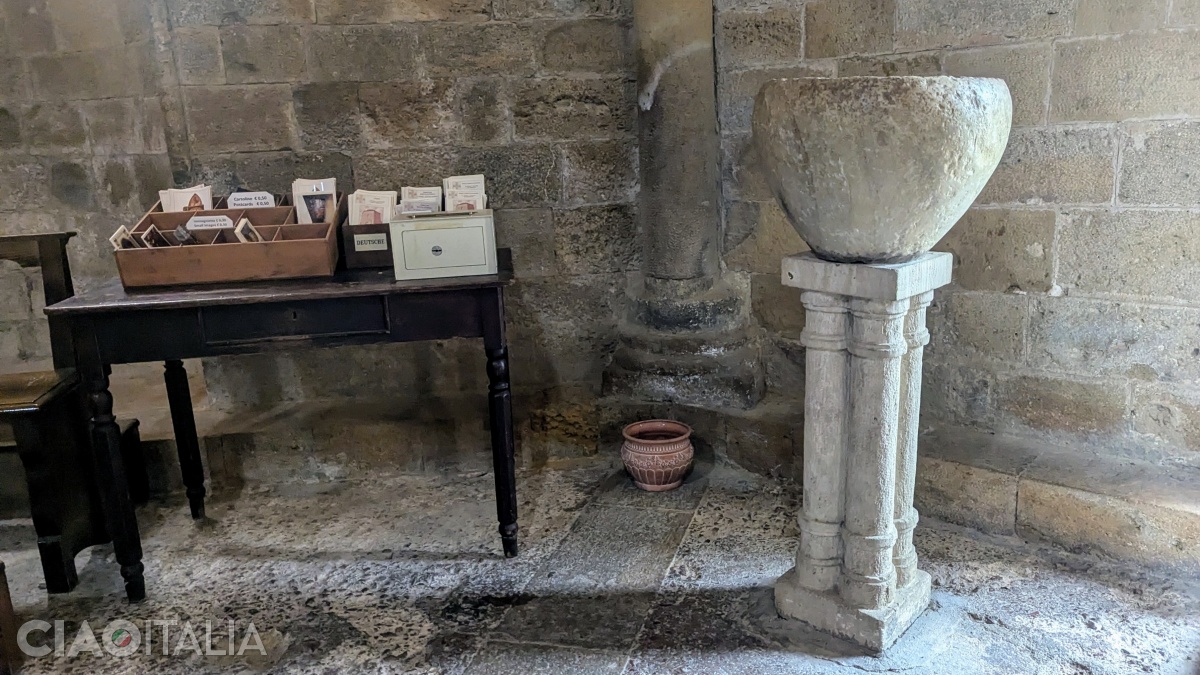
Before leaving the baptistery, notice the holy water font to the left of the door. It is actually an Etruscan marble funerary monument that was turned upside down and hollowed out to give it a new purpose.
The Baptistery
Opening Hours:
May 28 - September 27, 2026:
- Monday-Sunday: 10:00 AM - 1:30 PM, 2:00 PM - 6:00 PM
Last admission is 30 minutes before closing.
Ticket Prices:
Anima Pass (valid for 2 days, includes entry to the Cathedral, Baptistery, and the exhibitions at the Santa Maria Maddalena Center):
- Adult: €8
- Over 65: €6
- Child 6-17: €6
- Child under 6: free
6. The Etruscan Gate
Volterra was one of the most important city-states of ancient Etruria, which stretched across what are now the regions of Tuscany, Lazio, and Umbria. In the 4th century BC, the city was surrounded by powerful defensive walls over 7 kilometers long. During the Middle Ages, the fortifications were rebuilt, and only a few traces of the Etruscan construction remain. Among them, Porta all'Arco is the main testimony to the city's ancient past.
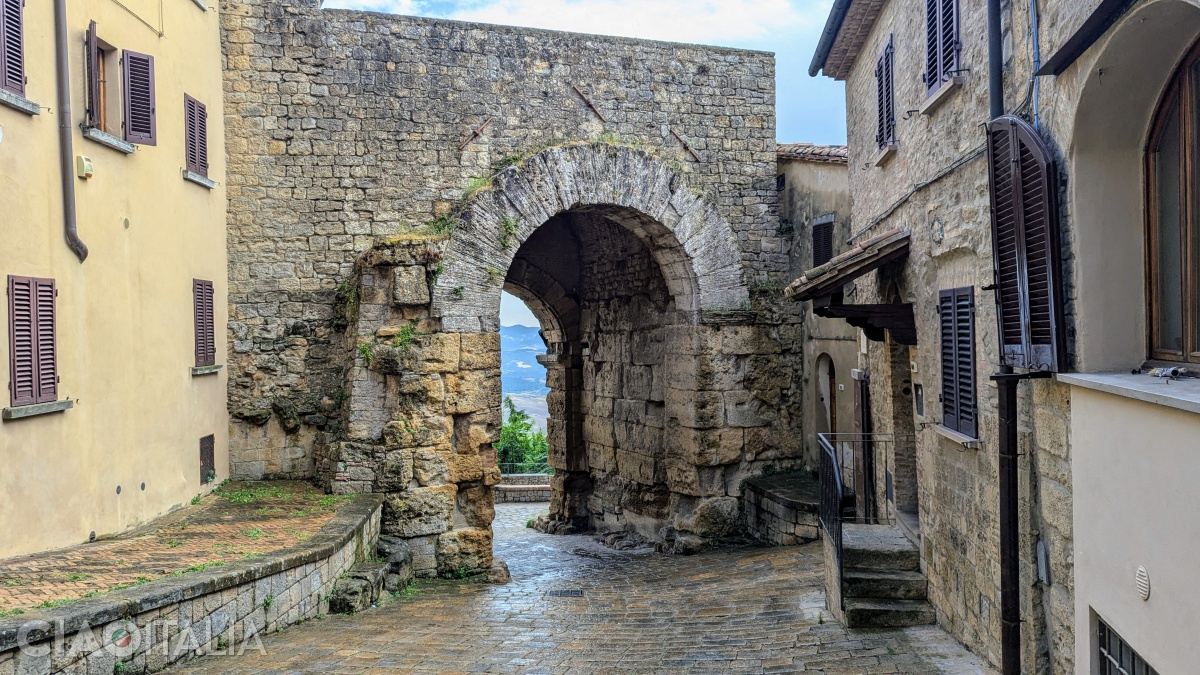
The gate, which largely preserves its original appearance, once served as the main southern entrance. The three sculpted heads that decorate it were probably added during the Roman period. They are so eroded by time that it is impossible to determine with certainty what they represent. The most plausible hypothesis is that they depict the city's protective deities. According to other interpretations, they could represent Jupiter and the Dioscuri, or Jupiter, Juno, and Minerva.
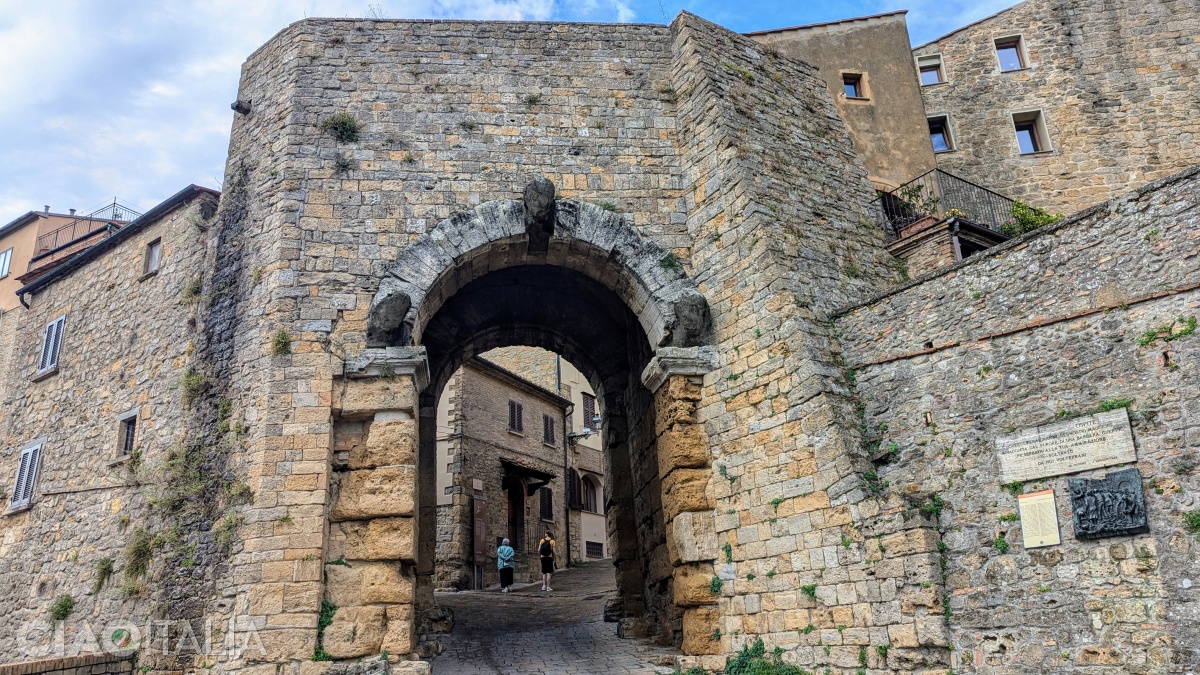
According to tradition, the tyrant Bocchino Belforti, who in the 14th century attempted to sell Volterra to the people of Pisa, was imprisoned within this gate. After a brief trial, he was beheaded near the Torre del Porcellino.
This same gate is also linked to an event from modern history. During World War II, on June 30, 1944, the Nazis planned to blow up Porta all'Arco to prevent Allied tanks from entering and liberating the city. The people of Volterra strongly opposed this and managed to obtain a promise from the German commander that the gate would remain intact if the citizens could seal it off within 48 hours. People of all ages and social classes mobilized, and using the stones that once paved the street, they blocked the entrance in less than 24 hours, thus saving the ancient gate. At the end of the war, the Italian government awarded the city a medal of merit.
Once you've reached Porta all'Arco, climb a few more steps along Via Lungo le Mura (by the city walls) to the panoramic viewpoint in Piazzetta dei Fornelli.
7. Torre Toscano
Torre Toscano ("The Toscano Tower"), located at the intersection of Via Matteotti and Piazzetta San Michele, is one of the oldest residential towers in Volterra. In fact, it consists of two structures - a slightly taller and older tower, whose exact construction date cannot be determined, and a slightly shorter tower, built in 1250 by Giovanni Toscano, as indicated by the inscription on the façade.
Giovanni Toscano was the treasurer of King Enzo of Sardinia - the king who was imprisoned and held captive until his death in the palace that bears his name in Piazza Maggiore, Bologna.
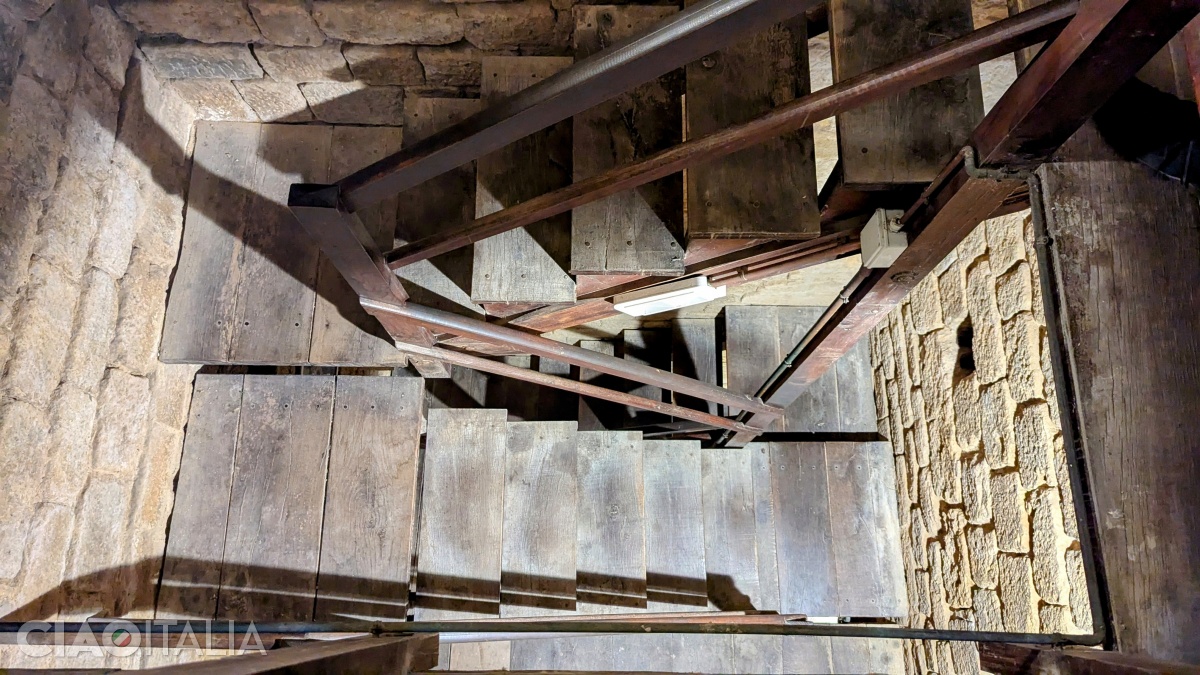
The tower can be climbed, and the view from its terrace is wonderful.
Torre Toscano
Opening Hours:
- September 1 - October 31, 2026: 11:00 AM - 6:00 PM
- November to April: Closed
Ticket Prices:
- Adult: €3
- Child under 8: free
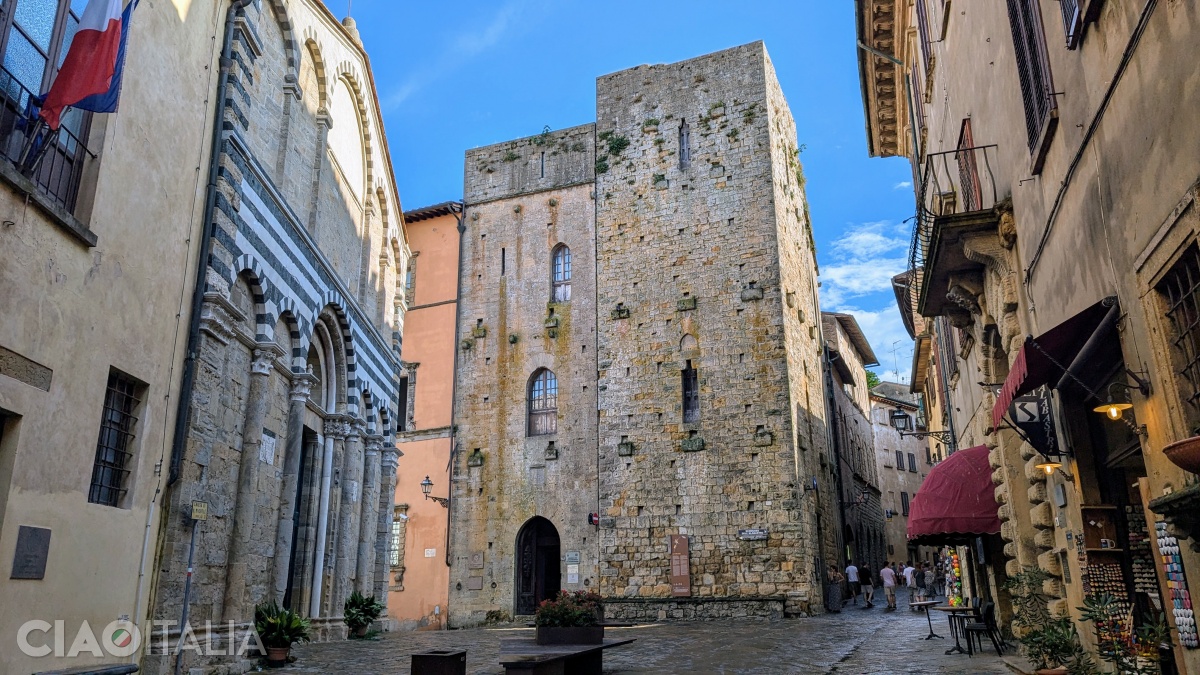
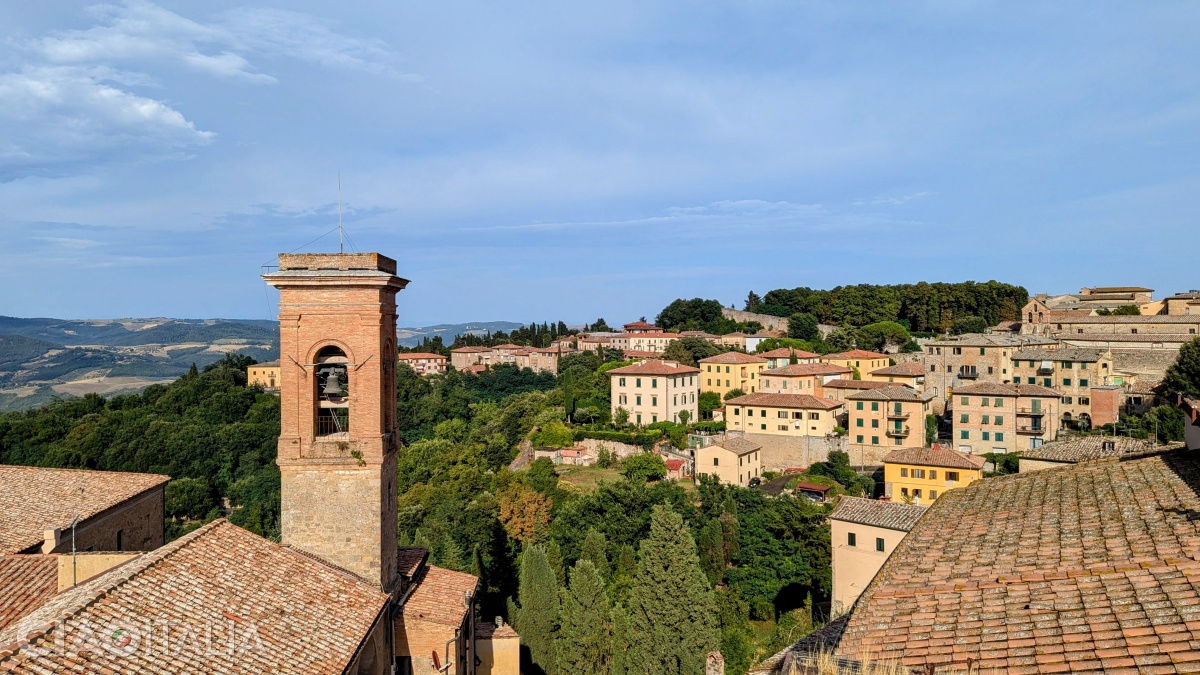
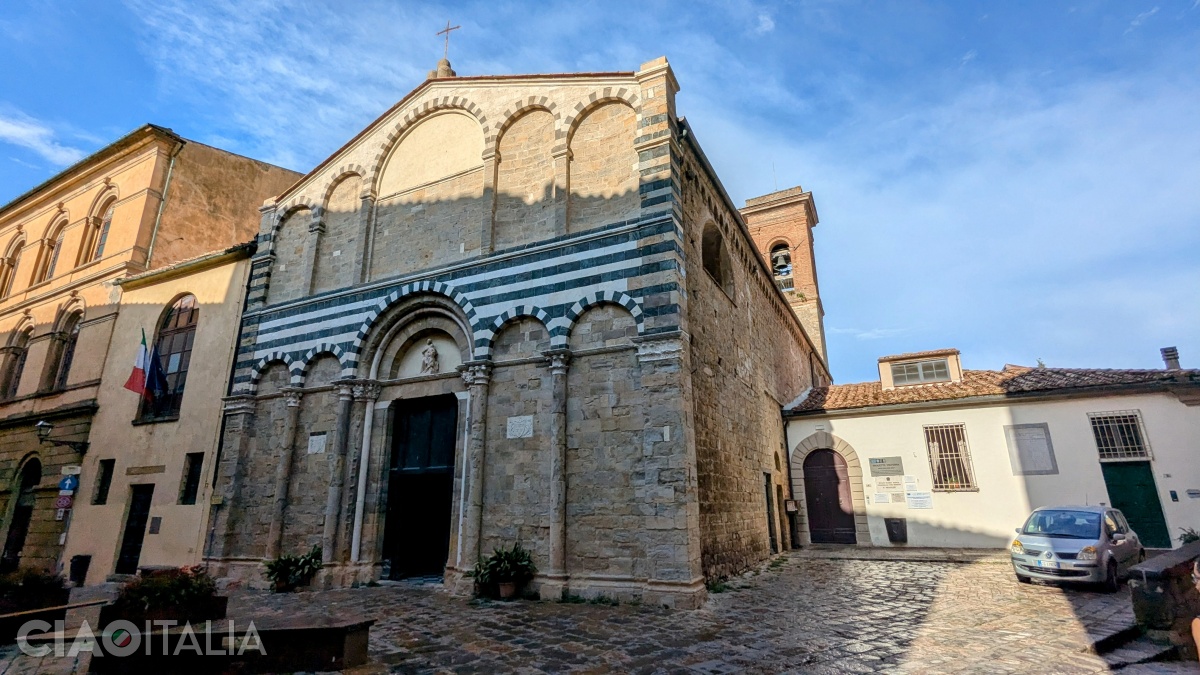
If you've reached this point, also visit the Church of San Michele Arcangelo, located right next to the tower. It dates back to the 13th century and stands on the site of the former Roman forum.
8. The Guarnacci Etruscan Museum
The Etruscan Museum of Volterra (Museo Etrusco Guarnacci) is one of the oldest in Europe. It was opened in 1761, when the Mario Guarnacci donated his extensive archaeological collection and library of over 50,000 volumes. It is also the third most important Etruscan museum in Italy, after those in Rome and Florence.
The museum is situated in the Desideri Tangassi Palace. Its most important exhibit is the votive statue Ombra della Sera ("Shadow of the Evening") from the 3rd century BC - a long, slender bronze figure that has become a symbol of Volterra. The poetic name is believed to have been given by the writer Gabriele d'Annunzio, who was reminded of the long shadows cast by the setting sun.
Another valuable exhibit is the Urna degli Sposi ("The Spouses' Urn"), a sculpture depicting an elderly couple lying side by side.
The Etruscan Museum of Volterra
Opening Hours:
March 10 - November 2, 2026:
- Monday-Sunday: 10:00 AM - 6:30 PM
Ticket Price (included in the Volterra Card:
- Adult: €10
- Over 60: €8
- 6-18 years: €8
- Child under 6: free
9. The Alabaster Museum
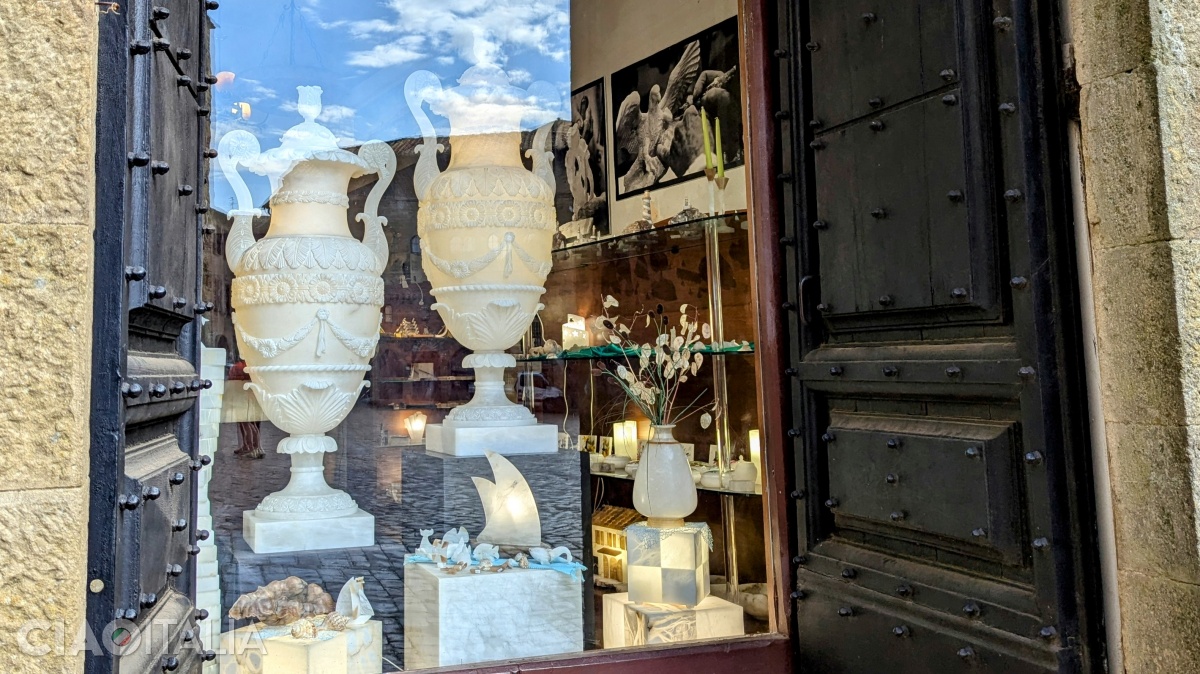
Volterra is famous for alabaster, a mineral that has been mined since Etruscan times. The city's shops are full of alabaster jewelry and souvenirs. In Piazza dei Priori, the Cooperativa Artieri Alabastro displays and sells items created by local artisans.
The Minucci Tower houses the Alabaster Museum (Ecomuseo dell'Alabastro), where you can admire objects from different periods - from the Etruscan era to contemporary times - as well as a reconstruction of an alabaster workshop.
The Alabaster Museum
Opening Hours:
March 10 - November 2, 2026:
- Monday-Sunday: 10:00 AM - 6:30 PM
Ticket Price (included in the Volterra Card:
- Adult: €10
- Over 60: €8
- 6-18 years: €8
- Child under 6: free
10. The Pinacoteca and Civic Museum
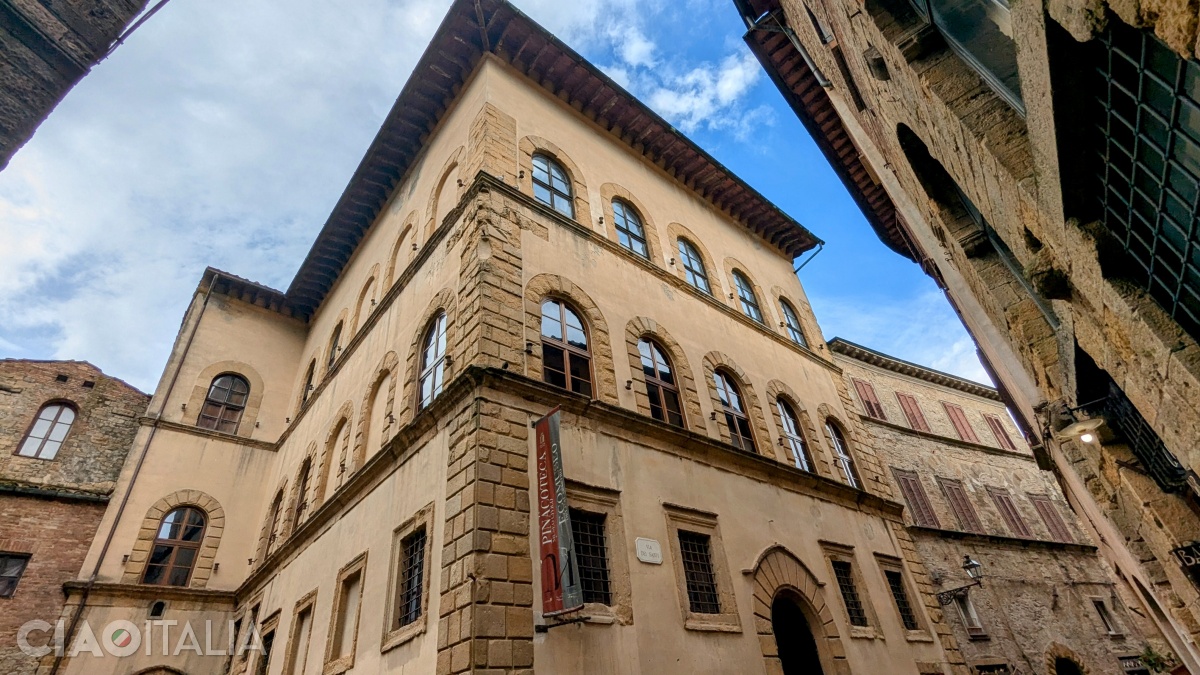
Right next to the Alabaster Museum is the Pinacoteca. It is housed in Palazzo Minucci-Solaini, built toward the end of the 15th century by the architect Antonio da Sangallo the Elder, the only palace in Volterra that has preserved its Renaissance appearance almost unchanged.
The most important paintings in the Pinacoteca are "The Descent from the Cross" (1521) by Rosso Fiorentino and "Madonna with Child and Saints" by Luca Signorelli.
Pinacoteca
Opening Hours:
March 10 - November 2, 2026:
- Monday-Sunday: 10:00 AM - 6:30 PM
Ticket Price (included in the Volterra Card:
- Adult: €10
- Over 60: €8
- 6-18 years: €8
- Child under 6: free
11. The Roman Theatre
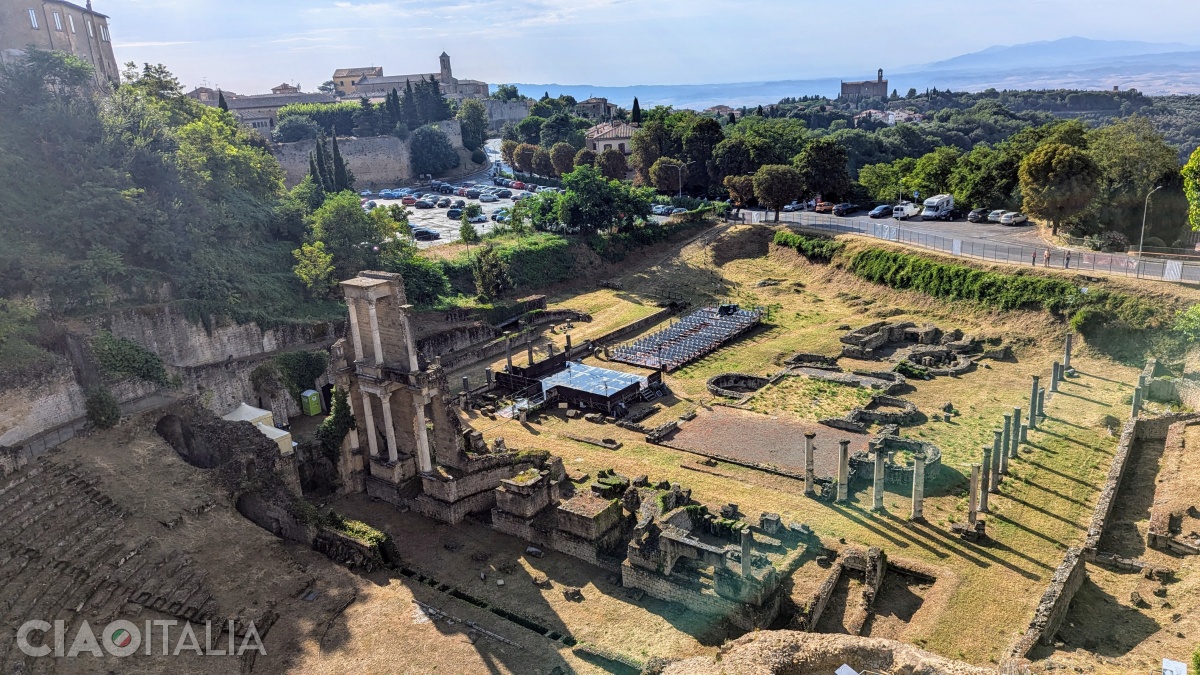
Just a few minutes' walk from Piazza dei Priori, outside the city walls, are the ruins of the Roman theatre. It was built at the end of the 1st century BC by order of the wealthy Caecina family, but its remains were only uncovered around the 1950s. An interesting fact: the archaeological excavations were carried out with the help of patients from the Volterra Psychiatric Hospital.
The theatre is estimated to have had a capacity of around 3,500 spectators. Like the Colosseum, it had a velarium, a system of canvas sails operated with ropes, used to provide shelter from rain or sun for the audience.
The theatre was abandoned around the 3rd century AD, and in front of it, thermal baths were built, the ruins of which are still visible.
You can admire the Roman theatre from above at the panoramic viewpoint on Via Lungo le Mura del Mandorlo, by slightly climbing to the left before exiting through Porta Fiorentina ("Florentine Gate").
The Roman Theatre
Opening Hours:
August 16 - November 2, 2026:
- Monday-Sunday: 10:00 AM - 5:00 PM
Ticket Price (included in the Volterra Card:
- Adult: €10
- Over 60: €8
- 6-18 years: €8
- Child under 6: free
12. Enrico Fiumi Park and the Etruscan Acropolis
The remains of the Etruscan acropolis can be found in the Archaeological Park named after Enrico Fiumi, the historian from Volterra who also discovered the ruins of the Roman theatre. The park (called il castello - "the castle" - by the locals) is the city's main green area, with the hill containing the Etruscan acropolis on one side and the fortress built by the Medici on the opposite side.
The archaeological site includes Etruscan, Roman, and medieval remains. You can also see the foundations of two temples, dating from the 2nd and 3rd centuries BC, respectively, and the remnants of a large Roman cistern from the 1st century AD, used for collecting rainwater.
The Etruscan Acropolis
Opening Hours:
August 16 - November 2, 2026:
- Monday-Sunday: 10:00 AM - 5:00 PM
Ticket Price (included in the Volterra Card:
- Adult: €10
- Over 60: €8
- 6-18 years: €8
- Child under 6: free
13. The Museum of Torture
Considered one of the best museums of its kind in Italy, the Museum of Torture consists of three large rooms displaying torture instruments used over the centuries. The museum also has branches in San Gimignano, Siena, Lucca, and Montepulciano.
The Torture Museum
Opening Hours:
- Monday-Sunday: 10:00 AM - 7:00 PM (in winter, only Saturday and Sunday)
Ticket Prices:
- Adult: €10
- Reduced: €7
14. Fortezza Medicea
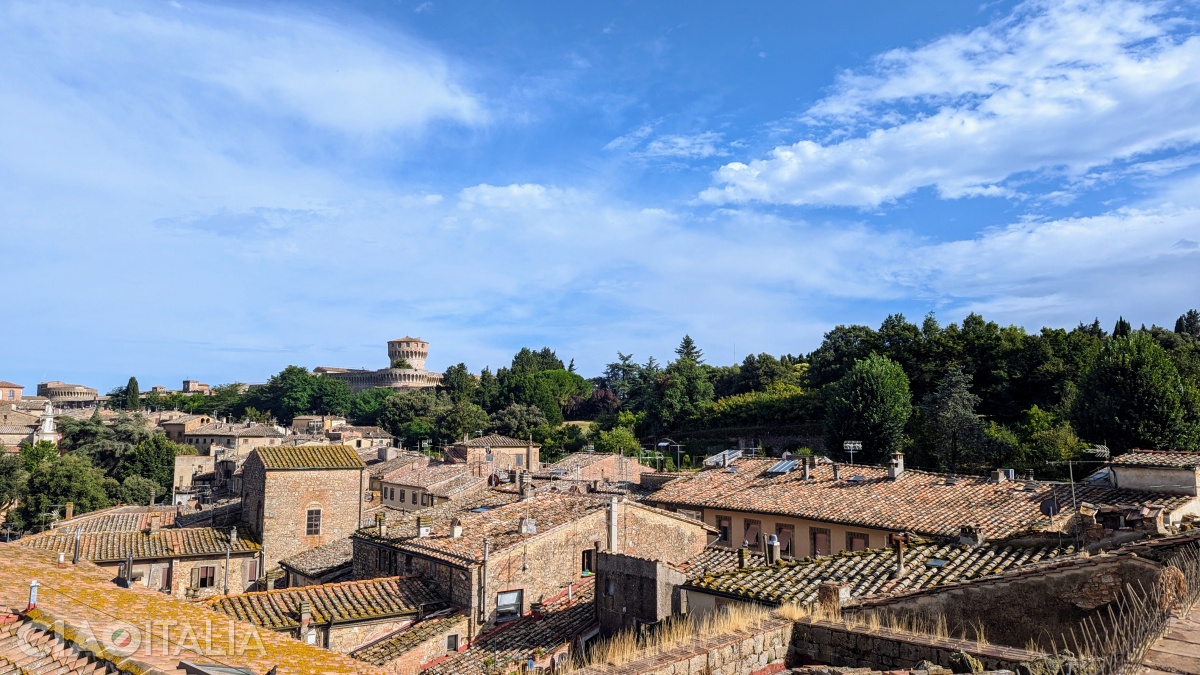
The Fortezza Medicea, the gigantic fortress overlooking the surrounding area, was built on the highest point of the city, atop a hill.
The fortress consists of two parts, connected by walls: Rocca Vecchia, built in 1343 by Duke Gualtieri di Brienne, governor of Florence, on the foundations of an older defensive castle (Cassero), and Fortezza Nuova or Torre Mastio, constructed by Lorenzo de Medici in 1474.
The fortress was built two years after Florence conquered Volterra, following a war for control of the alum mines, a mineral used in fabric processing. The Medici family constructed the fortress not so much to protect the city and its surroundings, but primarily to discourage any attempt by the people of Volterra to revolt against their new rulers.
From the very beginning, in the 15th century, the fortress functioned as a prison. Most of it still serves as a penitentiary today and is inaccessible to the public.
The massive circular tower, called il Mastio (or Torre del Maschio), a fine example of Renaissance military architecture, was open to visitors; however, it is currently closed for maintenance and cannot be visited.
15. Palazzo Viti
Palazzo Viti is a historic residence in Volterra, considered one of the most beautiful private residences in Italy.
The palace was built at the end of the 16th century by the nobleman Attilio Incontri and is, from an architectural standpoint, an example of the transitional style from Renaissance to Baroque.
In 1850, it was purchased by Giuseppe Viti, an alabaster merchant, who fully restored it.
Inside, the 12 rooms preserve the original furniture, alabaster objects, paintings, and other works of art from the 15th-19th centuries. Over time, Palazzo Viti has hosted famous personalities, and in 1964, director Luchino Visconti chose it to film several scenes for Vaghe stelle dell'Orsa.
Palazzo Vitti
Opening Hours:
- March 29 - November 1, 2026: Monday-Sunday, 10:30 AM - 5:00 PM
- December 5 - December 8, 2026: 10:30 AM - 5:00 PM
- December 27, 2026 - January 6, 2027: 10:30 AM - 5:00 PM
Ticket Prices:
- Adult: €7
- Over 65: €5
- Child 10-18: €5
- Child under 10: free
- Volterra Card holders: €5