The Pantheon in Rome (2026 Ticket Prices, Opening Hours, and Info)
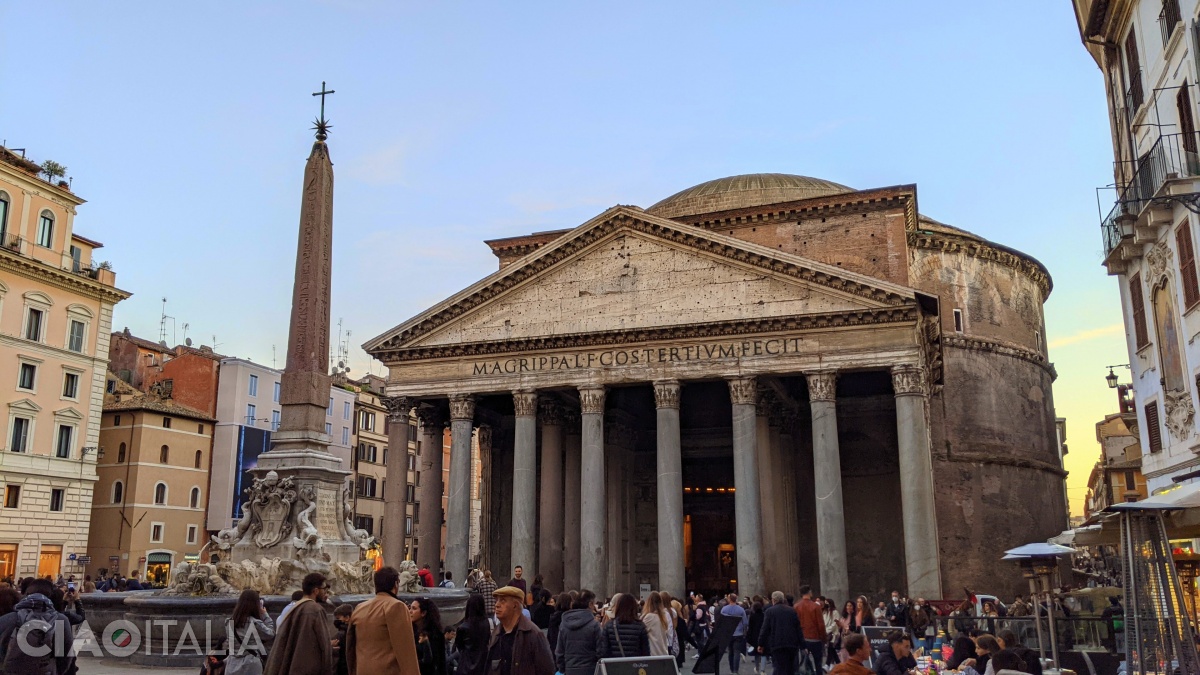
The Pantheon in Rome (il Pantheon) is one of the best-preserved and most impressive monuments of the ancient city. It is a grandiose building located right in the center of Rome, near Piazza Navona and the Church of Santa Maria sopra Minerva.
Tickets and Prices
Access to the Rome Pantheon is granted only with an entrance ticket.
For 2026, ticket prices are as follows:
- Adult: €5
- UE citizens aged 18-25: €2
- Children under 18: Free
You can buy tickets for the Pantheon on-site or online from the Musei Italiani website, by choosing a specific time slot for your visit.
Tip: Before joining a line, check which queue is for card payments (usually on the right, right at the entrance to the Pantheon) and which is for cash (usually to the left of the entrance).
Entrance to the Pantheon is free on the first Sunday of every month.
Another ticket option costs €15 per person (prices may be reduced depending on the day and time). This includes the official audio guide (available in several languages) featuring narrations by famous Italian actors and musical performances by the Teatro La Fenice orchestra from Venice. These tickets must first be picked up from the OhMyGuide - Roma Museum Store (Via dei Bergamaschi 49), located about a 5-minute walk from the Pantheon.
Book Pantheon Ticket and Audioguide
If you prefer guided tours, this option is also available. Pantheon entry tickets for these tours are also collected from the OhMyGuide office.
Opening Hours
In 2026, the Pantheon in Rome has the following opening hours:
- Monday-Sunday: 9:00 AM - 7:00 PM
The ticket office closes at 6:00 PM, and the last entry is at 6:30 PM.
The Pantheon is closed on December 25th and January 1st.
As the Pantheon is an active church, visiting hours may vary based on religious services. Mass is held every Saturday and on the eve of holidays at 5:00 PM, as well as every Sunday and on holidays at 10:30 AM. Tourist visits are not permitted during these services.
Entry to the Pantheon requires attire appropriate for a church. Please avoid wearing short shorts or short skirts, and ensure that your shoulders are covered.
How to Get to the Pantheon?
The Pantheon is located in the city center, in Piazza della Rotonda. To reach the Pantheon using Rome's public transport, you can take the metro or the bus.
The nearest metro station is Barberini (Line A), located approximately 700m from the Pantheon.
If taking the bus is more convenient, you can use lines 30, 40, 62, 64, 81, 87, or 492. Get off at the Largo di Torre Argentina stop, which is just 400 meters from the Pantheon.
History of the Pantheon in Rome
The first building constructed on this site was a temple erected in 27 BC by Marcus Agrippa, the son-in-law, friend, and trusted general of Emperor Octavian Augustus. Agrippa dedicated the temple to the seven planetary deities and named it the Pantheon (a word derived from Greek meaning "of all gods").
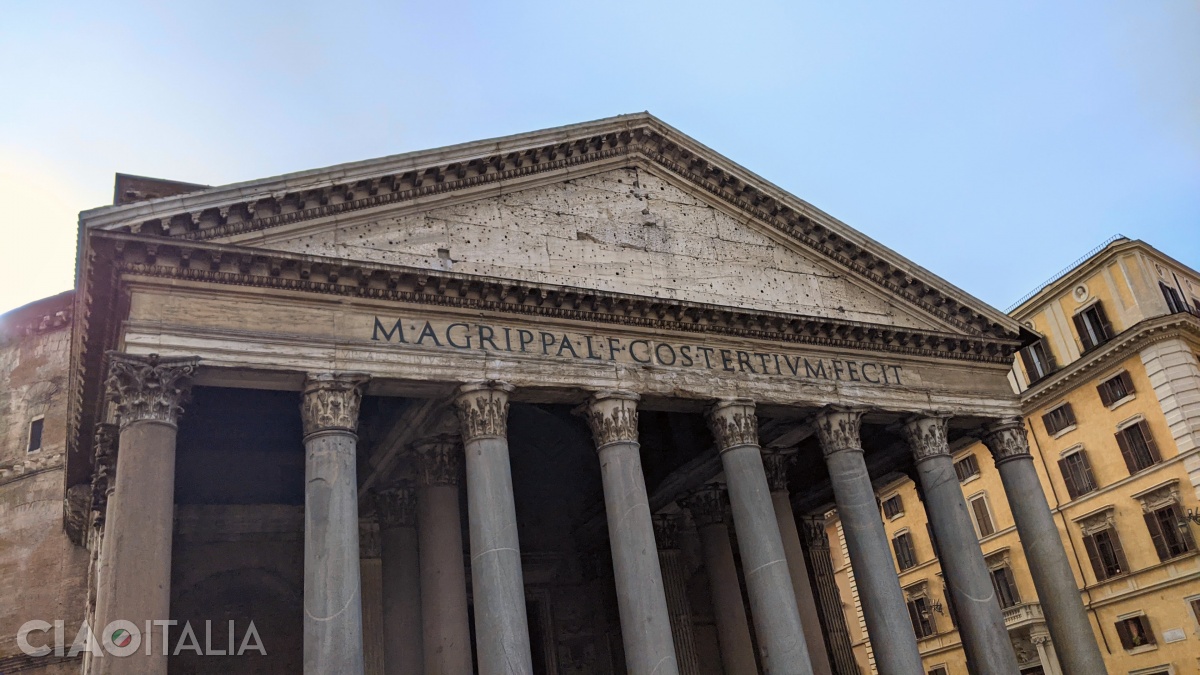
More than 100 years later, between 118-125 AD, Emperor Hadrian rebuilt Agrippa's temple - which had been partially destroyed by fire - according to his own sketches. Hadrian changed the building's orientation by 180 degrees and built a large square in front of it. However, he kept the old inscription, which you can still see on the facade today: M. Agrippa L. F. Cos. Tertium fecit ("Marcus Agrippa, son of Lucius, consul for the third time, built this").
The spread of Christianity led to the abandonment of the temple, which, over the following centuries, was looted by barbarians who stripped away the beautiful gold decorations that adorned its interior.
In 608, the Pantheon was donated to Pope Boniface IV by the Byzantine Emperor Phocas. In 609, the Pope transformed the former Roman temple into a Christian church, naming it Santa Maria ad Martyres ("Saint Mary and all Martyrs"). Twenty-eight carts of bones belonging to anonymous martyrs were transferred from the catacombs of Rome to the main altar of the newly consecrated church to erase the memory of the pagan gods to whom the temple was originally dedicated. Its conversion into a church was likely the primary reason the Pantheon has been so well preserved.
The Dome of the Pantheon
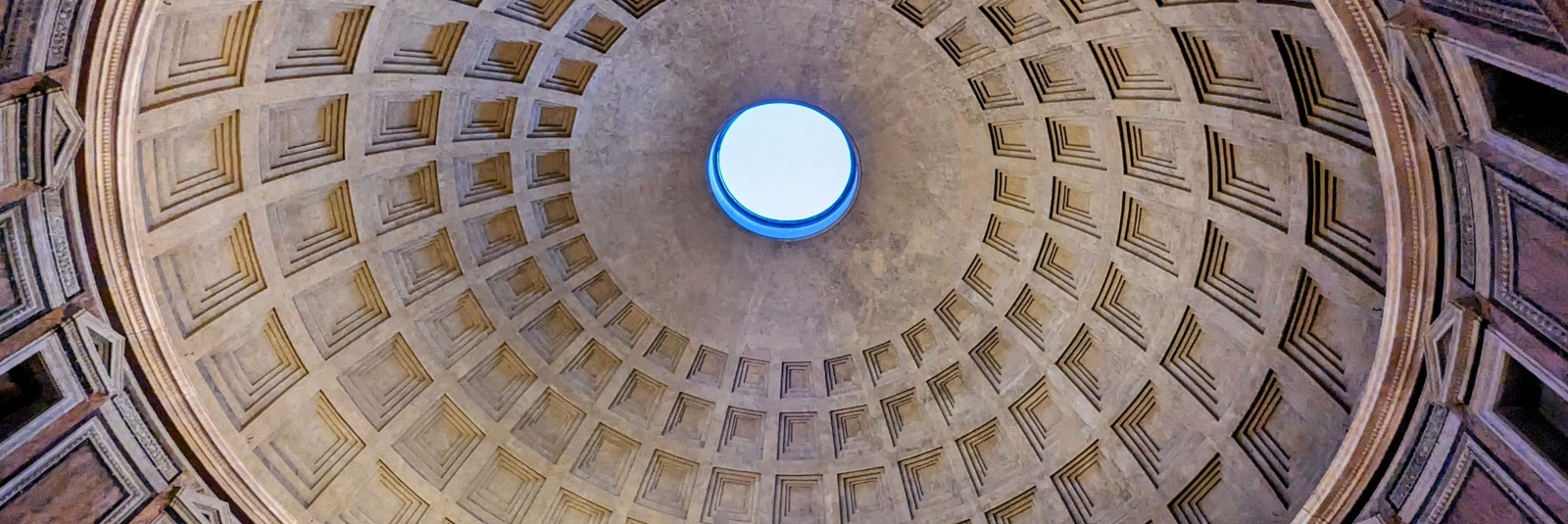
The dome of the Roman Pantheon is an architectural masterpiece and a marvel of ancient engineering.
The hemispherical dome is made entirely of concrete and has no supporting structure. Emperor Hadrian's solution was ingenious: the weight of the dome decreases as its height increases. On one hand, the thickness of the walls decreases from 6m at the base to nearly 2m near the central opening. On the other hand, heavier materials (such as travertine) were mixed with the concrete at the base, while lighter materials (such as pumice stone) were used toward the top.
Until 1960, the Pantheon's dome was the most imposing concrete construction and the largest unreinforced dome ever built in the world.
The circular opening in the middle of the dome, nearly 9m in diameter, is called the oculus ("the eye of the dome") and was an essential element in Hadrian's plans. The oculus does not only provide interior lighting (being the Pantheon's only window) and lighten the vault, but it also carries a symbolic meaning of spiritual enlightenment and direct contemplation of the sky. Additionally, it functions as a sundial.
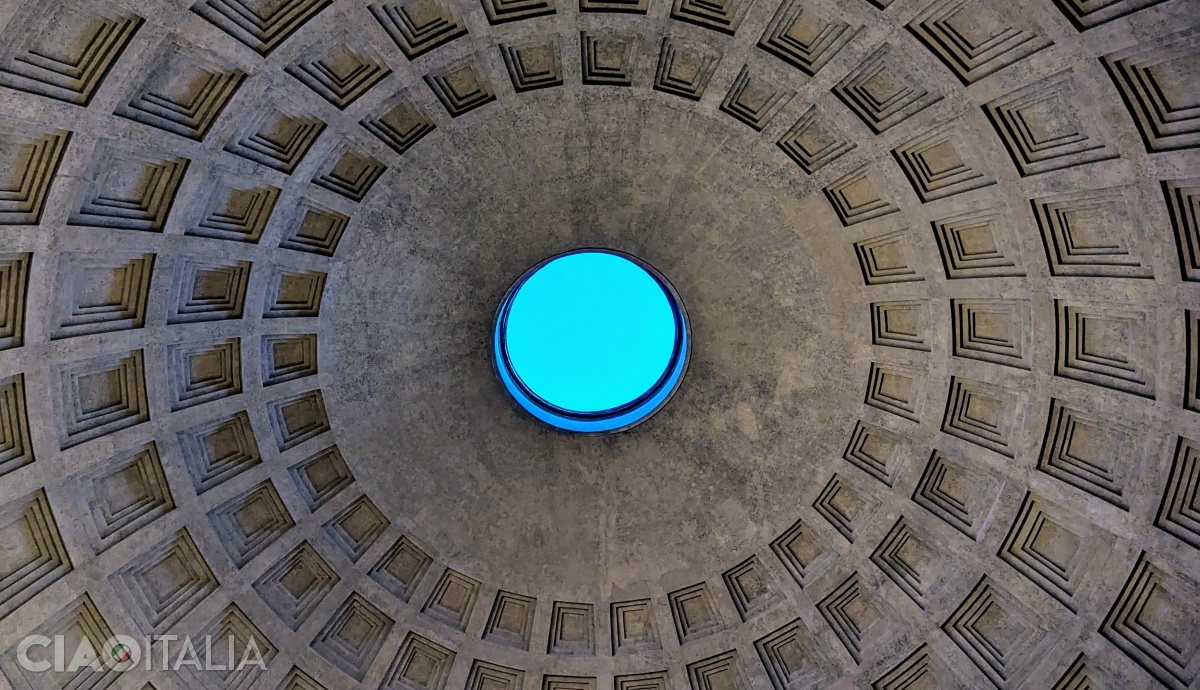
The dome is decorated with five rows of 28 coffers each, which decrease in size as they ascend. The number 28 was considered a symbol of perfection, as it is the sum of the numbers from 1 to 7 (with 7 being the "perfect number" in ancient thought).
The architectural balance and harmony of the Pantheon served as a primary model for the great Renaissance architects, influencing many churches and buildings throughout Italy and beyond.
Inside the Pantheon
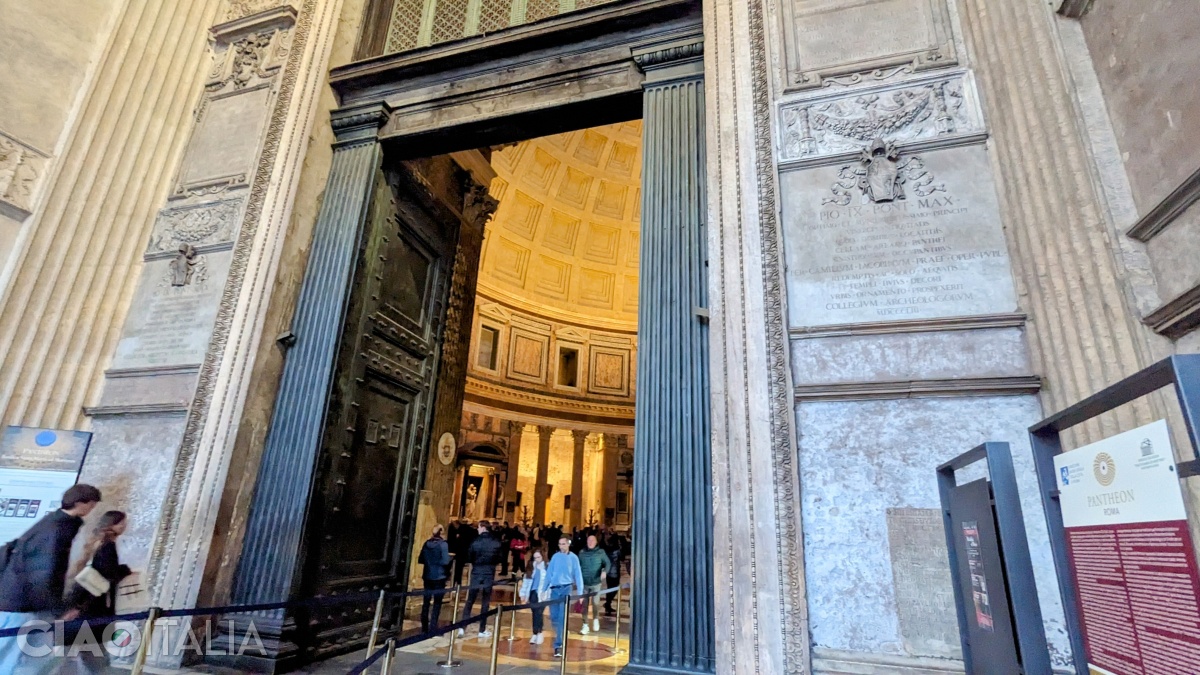
Before entering the Pantheon, take a moment to observe the immense bronze doors. Although they are not the originals, they date back to antiquity; they stand 7m tall and each weighs 20 tons. They are considered the largest ancient bronze gates preserved to this day.
The floor of the Pantheon features intricate geometric patterns. Although it was restored in 1872, the design remains faithful to the original, incorporating marbles of various colors, porphyry, and Egyptian granite.
Inside the Pantheon are several chapels, some of which contain the tombs of Kings Victor Emmanuel II (the first king of a unified Italy) and Umberto I, as well as the tomb of the renowned Renaissance painter Raphael.
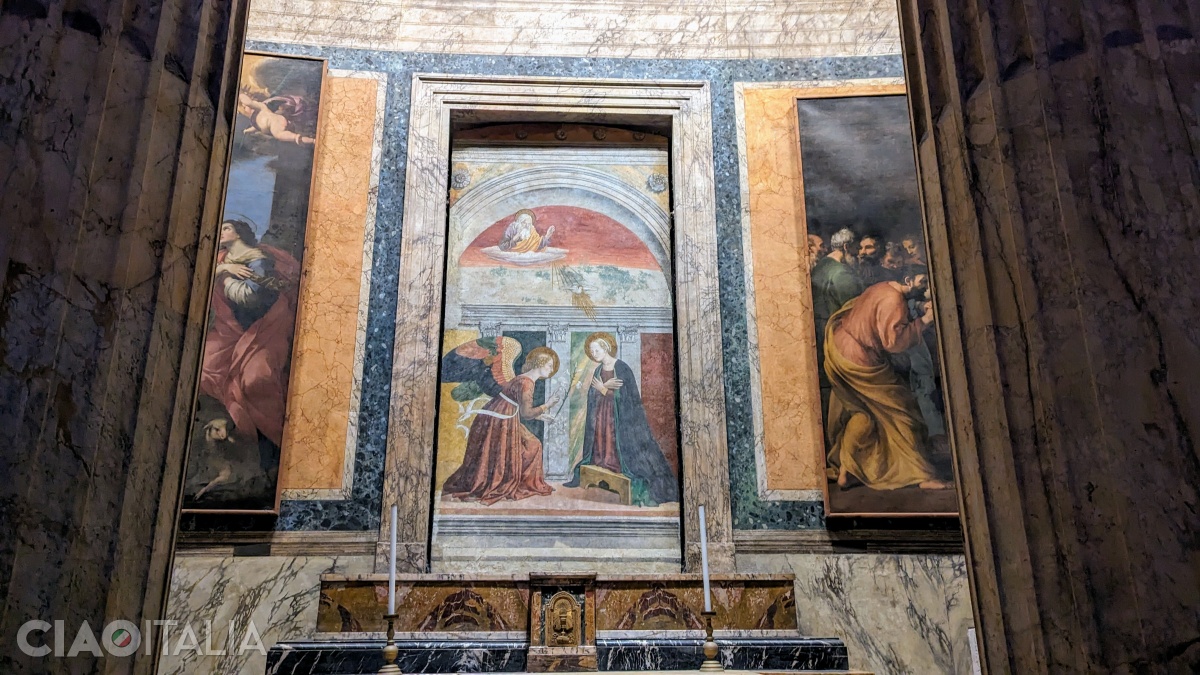
The first chapel on the right is the Chapel of the Annunciation, named after the 15th-century fresco by Melozzo da Forlì at its center. To the left, a painting depicts St. Lawrence and St. Agnes. To the right, you can see the 17th-century painting "The Incredulity of St. Thomas". Until 1824, this chapel housed the baptismal font where local children were baptized.
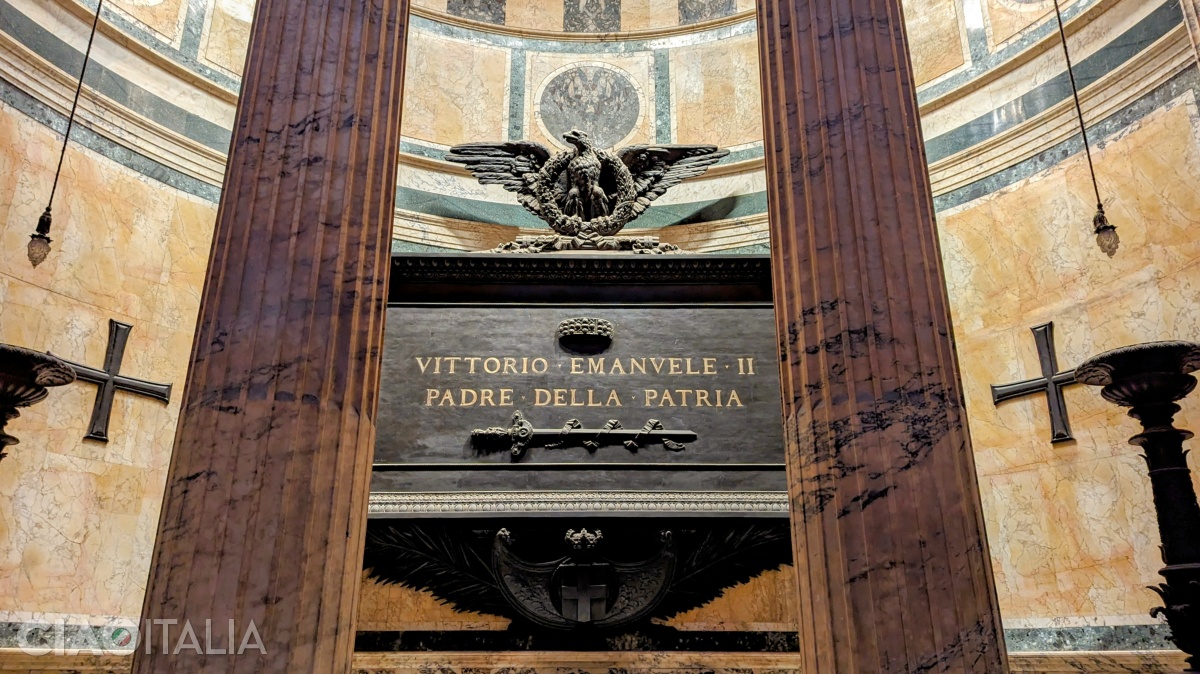
The tomb of Victor Emmanuel II is located in the central chapel on the right side of the Pantheon. The king died in 1878 at the age of 57 due to pneumonia. Although he was a member of the House of Savoy - whose members were traditionally buried in the Basilica of Superga in Turin - it was decided that the king should be laid to rest in the Pantheon following an impressive funeral ceremony.
A large bronze plaque bears the inscription Vittorio Emanuele II Padre della Patria ("Father of the Fatherland"). Above the plaque sits a bronze eagle, and below it is the coat of arms of the House of Savoy resting on two palm fronds.
In the past, to commemorate the anniversary of the king's death, solemn ceremonies were held at his tomb, and the Oculus (the hole in the Pantheon's dome) was covered. In the upper section, in front of the monument, there is a lamp lit in honor of King Victor Emmanuel III, who died in 1947.
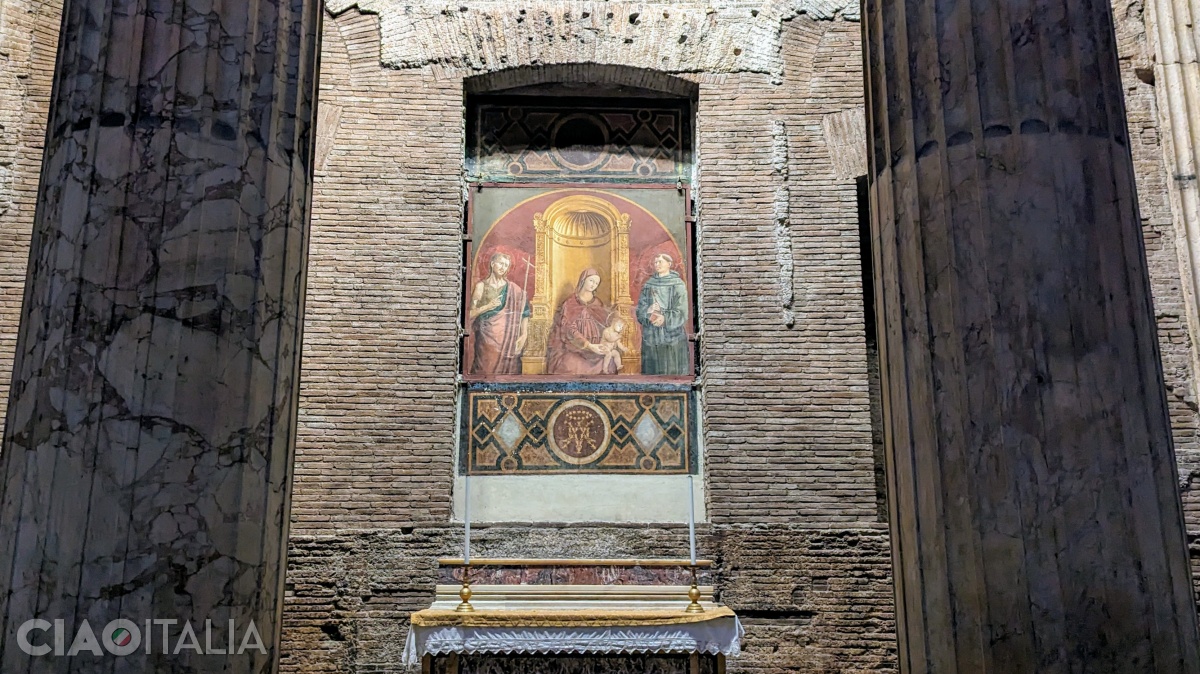
The next chapel is named Madonna della Clemenza ("Our Lady of Mercy"), after the 15th-century fresco located on the altar. This fresco, which depicts the Virgin Mary between St. Francis and St. John the Baptist, was originally located outside the Pantheon in a niche within the portico. It was first moved to the Chapel of the Annunciation and then, in 1837, to its current location.
On the left wall of the chapel, a bronze plaque commemorates the restoration of the high altar, commissioned by Pope Clement XI. On the right wall, a canvas painting depicts the Byzantine Emperor Phocas donating the Pantheon to Pope Boniface IV.
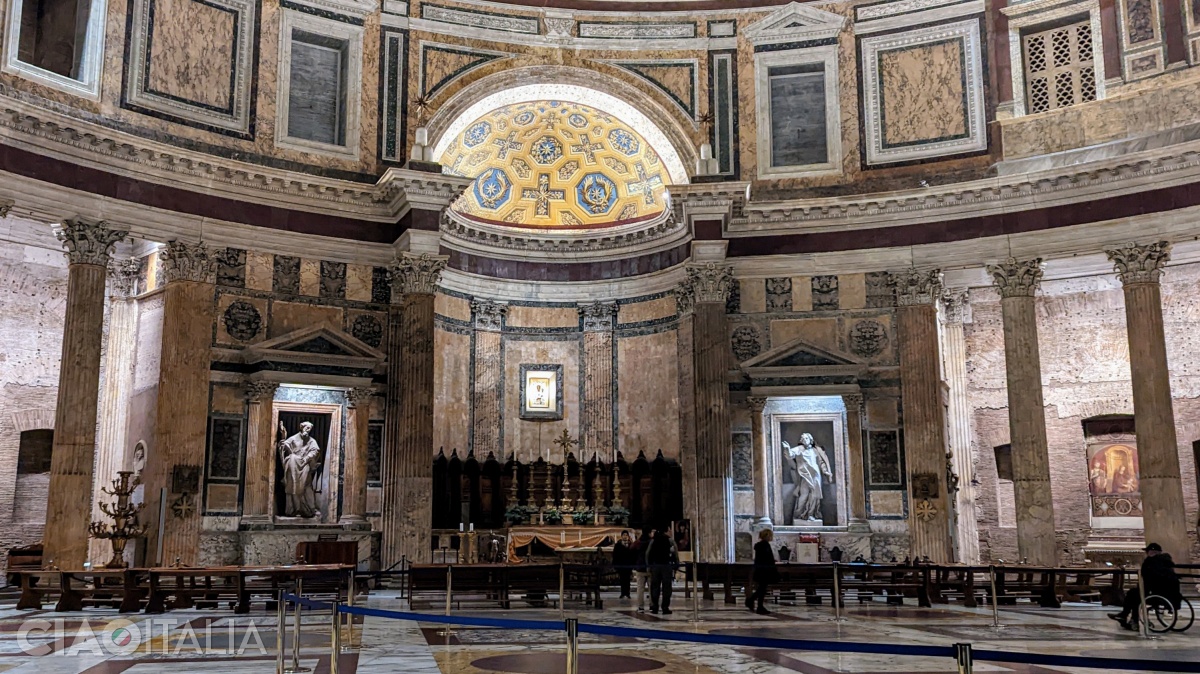
In the area diametrically opposite the Pantheon's entrance, where a colossal statue of Jupiter stood during Roman times, you will now find the basilica;s high altar. It was created in the 18th century to replace an older medieval altar.
Behind it, an apse with a mosaic-decorated vault houses a 7th-century copy of a Byzantine icon of the Virgin Mary, which tradition says was painted by Saint Luke the Apostle. The wooden choir dates back to the mid-19th century.
To the left of the main altar stands the statue of St. Rasius, and to the right, the statue of St. Anastasius. The relics of these two saints were discovered about 40 years prior to the 18th-century restoration of the altar.
To mark the 1,400th anniversary of the Pantheon's conversion into a church, several modern artworks were added, including a Via Crucis (Stations of the Cross) bas-relief, a pulpit, and a bronze altar.
The next chapel is the chapel of the Crucifix, which takes its name from the 15th-century wooden crucifix located above the altar.
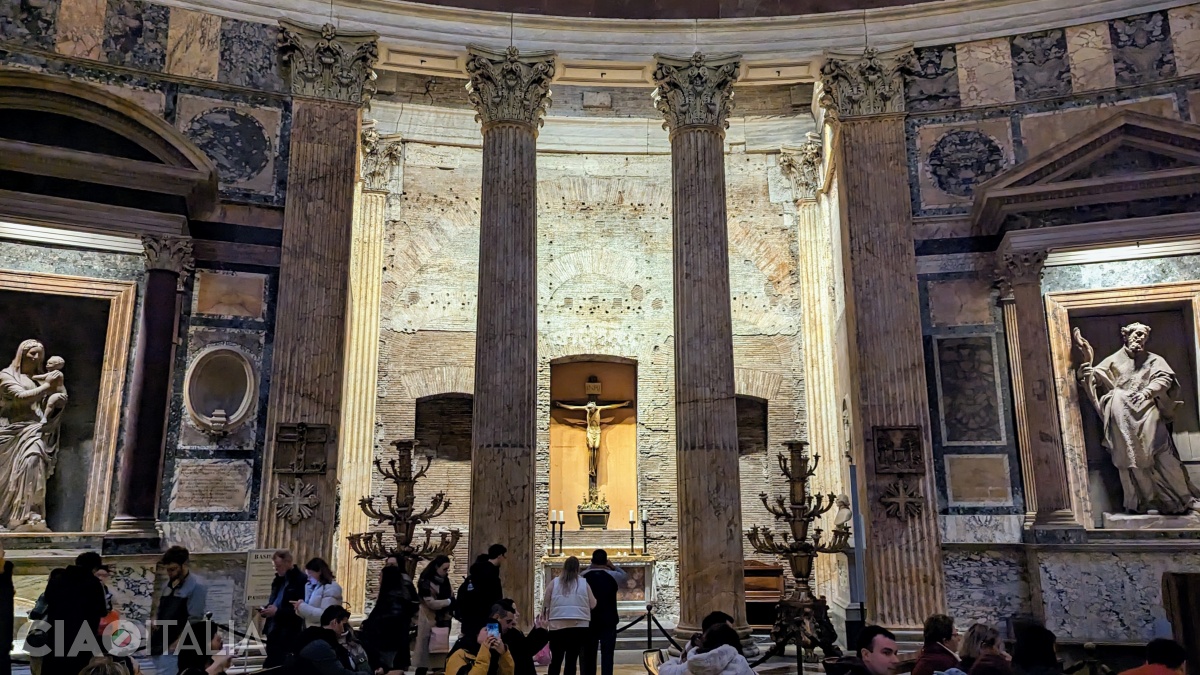
As you turn from the altar back toward the entrance, on the side opposite the monument of Victor Emmanuel II, you will find the tomb of his son - King Umberto I - and Queen Margherita of Savoy. The King's name is inscribed on an alabaster plaque framed by statues representing Goodness and Generosity. The sarcophagus is made of porphyry and bears the royal insignia. In 1926, the King's tomb was opened to place alongside him the remains of Queen Margherita, whose name is inscribed in the panel at the bottom of the wall.
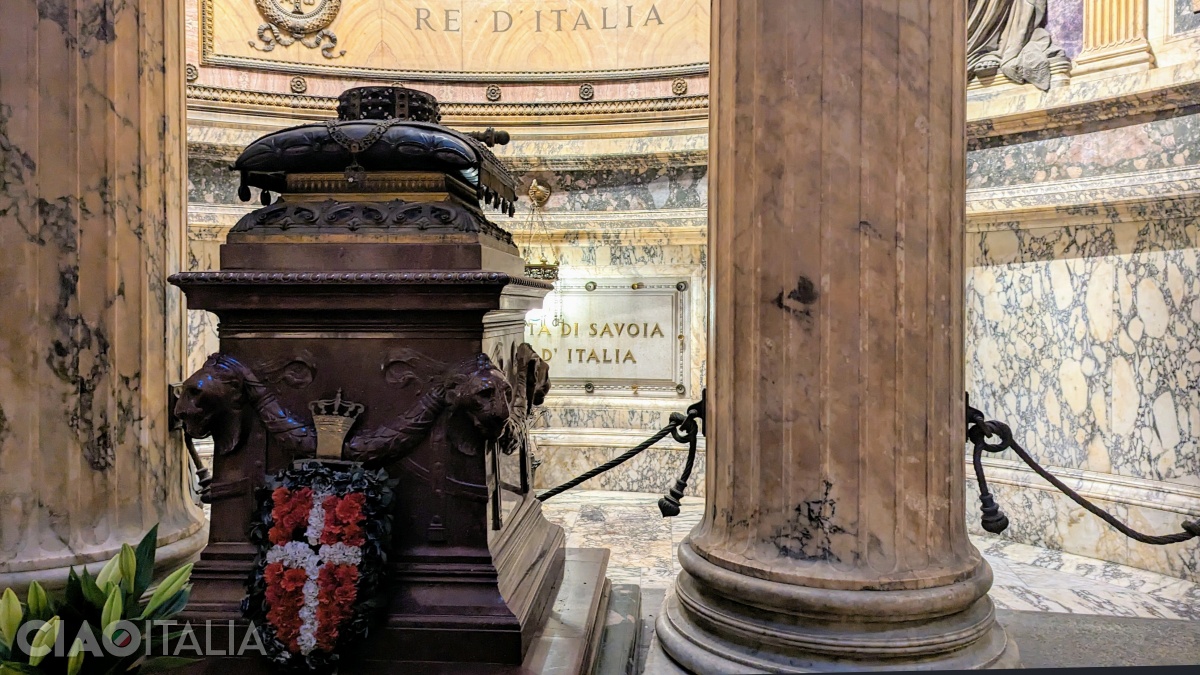
The Pantheon serves as the final resting place not only for kings but also for some of Italy's most renowned artists: the painters Raphael Sanzio and Annibale Carracci, the architect Baldassare Peruzzi, and the composer Arcangelo Corelli.
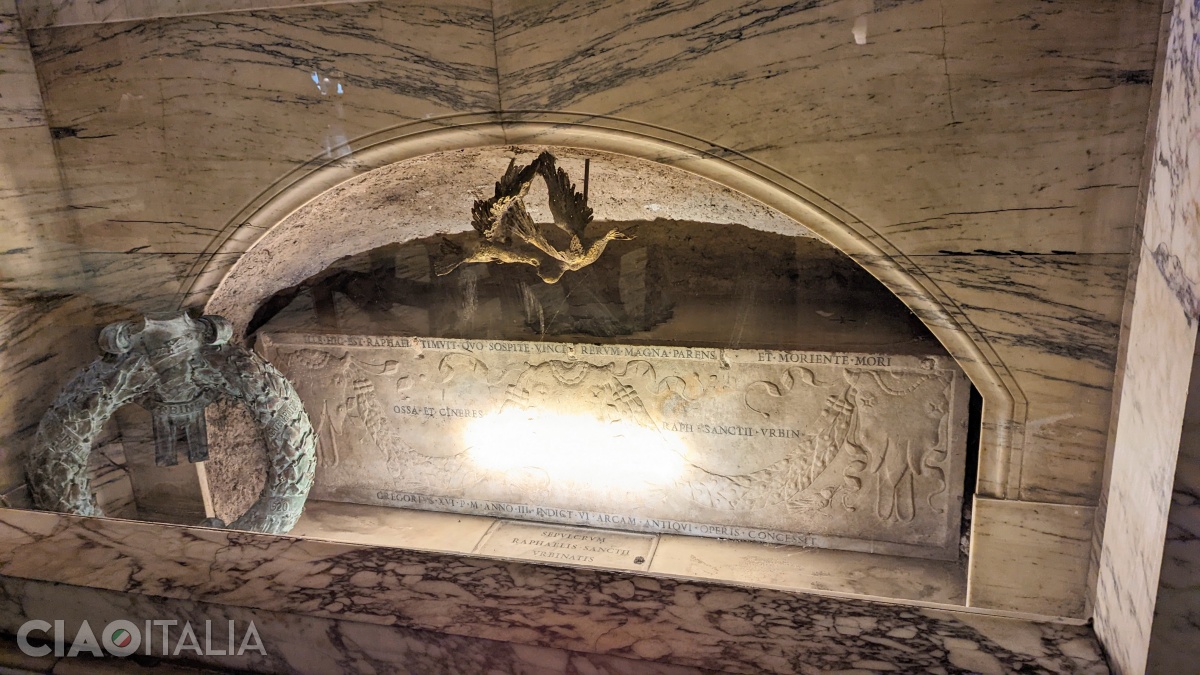
Before his death, Raphael expressed a specific desire to be buried in the Pantheon. His remains lie in an ancient sarcophagus beneath the altar of the Madonna del Sasso ("Madonna of the Stone"). The statue, depicting the Virgin holding the Christ Child with her left foot resting on a stone, was sculpted by Lorenzetto at Raphael's request to decorate his own tomb.
Raphael passed away on April 6, 1520, on Good Friday, at the young age of 37. He had specifically chosen this spot in the Pantheon because it is where the final ray of sunlight from the Oculus strikes at the end of the day.
In 1833, due to doubts about whether the artist was truly buried there, the tomb was reopened. His remains were then transferred into the Roman marble sarcophagus donated by Pope Gregory XVI. Inside this marble casing is a lead coffin containing a pine chest that holds the painter's bones.
The marble sarcophagus bears a Latin epitaph attributed to the humanist Cardinal Pietro Bembo: "Here lies Raphael. While he lived, Mother Nature feared to be outdone by him. Now that he is dead, she fears she herself will die with him."
Facts About the Pantheon in Rome
- For over 1,400 years, the Pantheon has been a Christian church (Basilica of Santa Maria ad Martyres), even though its exterior appearance does not immediately suggest it.
- Since ancient times, the inhabitants of Rome have given the Pantheon the nickname La Rotonda, which is where the name of the square it stands in (Piazza della Rotonda) originates.
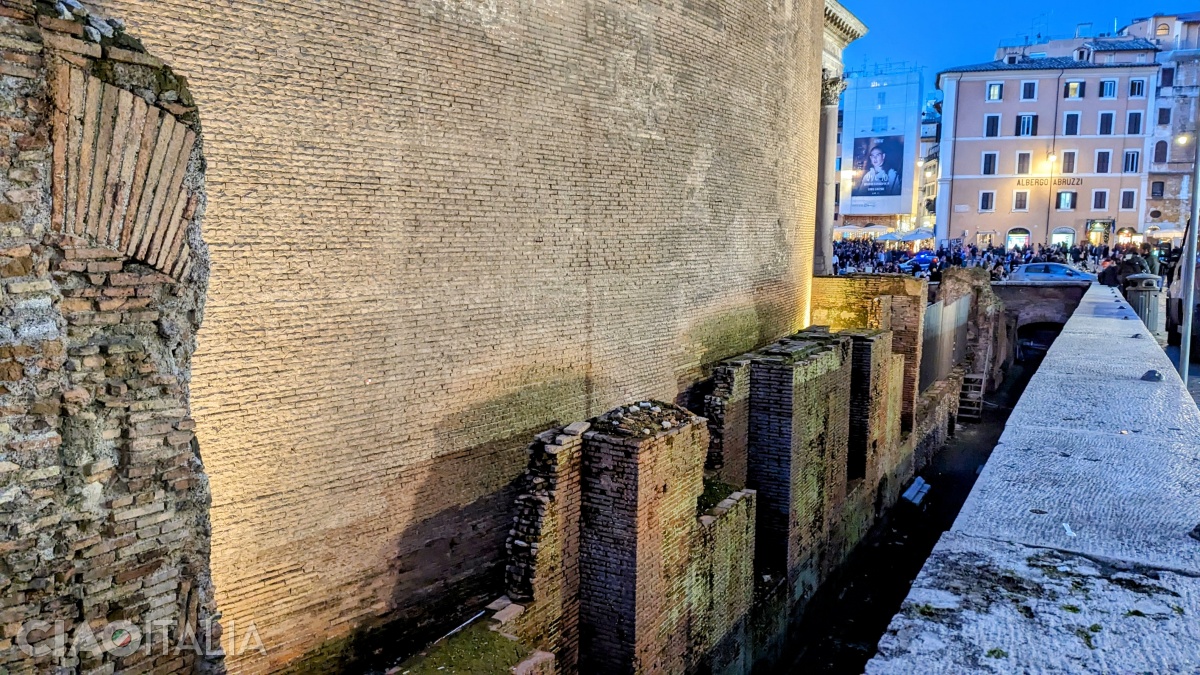
- Have you noticed the trench surrounding the Pantheon? In local tradition, it is called "The Devil's Trench". One local legend says it was created by the Devil, who was enraged at Pope Boniface IV for daring to Christianize a temple dedicated to pagan gods, thus barring his entry. In another version, the Devil made a deal with Pietro Bailardo, a famous sorcerer in Rome, offering him the "Book of Power" - the ultimate manual of black magic - in exchange for his soul. Regretting this evil pact, the sorcerer used the knowledge from the book to complete a pilgrimage to Jerusalem and return to Rome on the very same day. When the Devil waited at the Pantheon to claim his soul, Pietro saved himself by taking refuge inside the temple to pray (some legends even say the sorcerer offered the Devil four walnuts as a reward instead of his soul). Infuriated at being cheated, the Devil began pacing around the Pantheon, digging a trench with his hooves before disappearing into the depths of the earth. In truth, this trench was excavated during works in 1881, when the Pantheon was cleared of various medieval structures to reveal the original base level of Agrippa's temple.
- Another fascinating legend tells that on the day the Pantheon was transformed from a pagan temple into a Christian church, seven demons (exactly the number of deities to whom the temple had been dedicated) took flight, fleeing from the interior. One of these demons, while trying to escape through the roof, supposedly tossed the gilded bronze pine cone that sat atop the Pantheon's dome into the air with its horns, thus creating the opening called the Oculus. The pine cone is said to have fallen in a nearby square, which has since been named Piazza della Pigna ("Pine Cone Square"). Some say this is the very same large bronze pine cone now located in the Pinecone Courtyard (Cortile della Pigna) of the Vatican Museums.
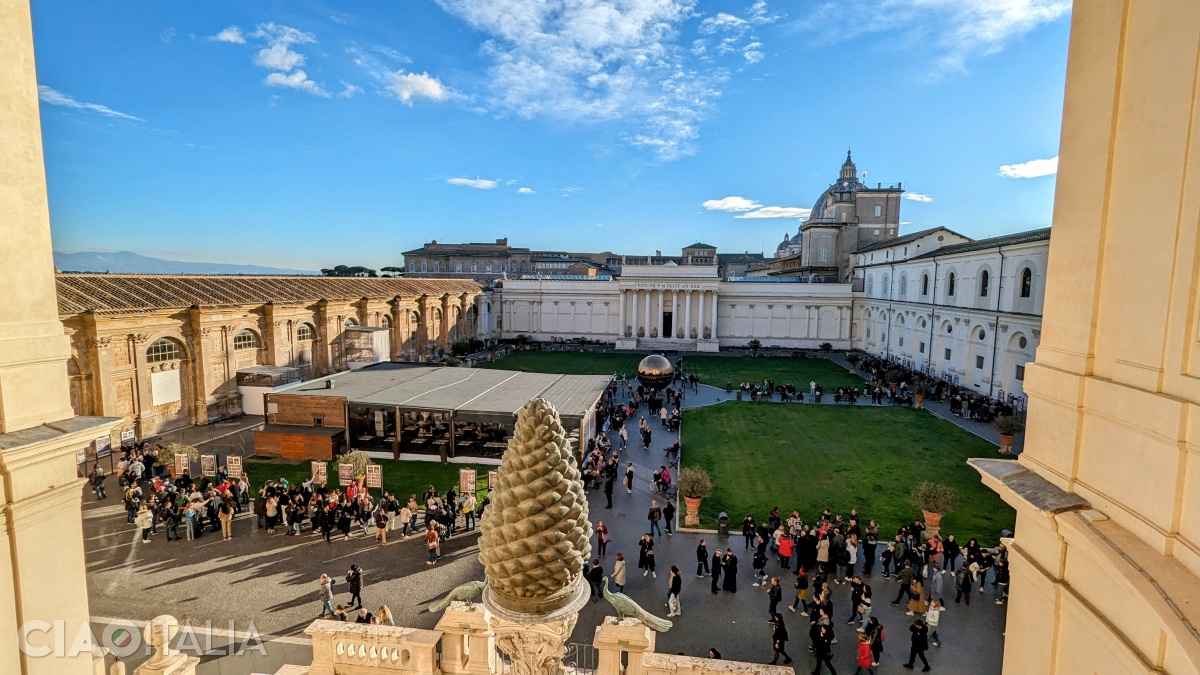
- According to some historians, the Pantheon project may have been initiated by the famous architect Apollodorus of Damascus (the same man who built the bridge over the Danube), who entered Hadrian's service upon the death of Traian. In reality, Hadrian - who was himself passionate about architecture - did not like Apollodorus, who had dared to criticize one of the Emperor's projects by telling him he "understood nothing". Hadrian likely never forgot this offense; a few years later, he reportedly ordered the execution of Apollodorus.
- The geometry and balance of the Pantheon's forms are perfect. The height of the dome is exactly the same as the diameter of the interior circular space (43 meters and 44 centimeters), such that a perfect sphere could fit precisely inside it.
- It is said that, to support the structure of the Pantheon during construction, Hadrian ordered it to be filled with earth mixed with gold coins. Once the building was completed, he called upon the Roman citizens to remove the earth, allowing them to keep any coins they found. The thirst for gold supposedly led to the rapid emptying of the interior.
- It does rain inside the Pantheon; however, the floor is designed in such a way that it does not allow rainwater to accumulate in the interior. The center is slightly convex, the sides are gently sloped, and the water is collected through 22 drainage holes into a complex system of underground channels.
- The Pantheon also functions as a sundial. Sunlight enters through the Oculus and is projected differently depending on the time of year. At noon, the beam of light aligns perfectly with the Pantheon's grand entrance doors. During the winter solstice the light illuminates the highest part of the dome. During the summer solstice, the light strikes the floor directly in front of the entrance, with the projection of the beam having the exact same diameter as the Oculus itself. On April 21st (the legendary date of Rome's founding in 753 BC), exactly at noon, the rays of light perfectly frame the entrance gates. It is said that by designing the building this way, Emperor Hadrian wanted to pay a spectacular tribute to the grandeur of Rome.
- The bronze used to build the massive Baroque baldachin in St. Peter's Basilica in the Vatican actually comes from the roof of the Pantheon's portico. That same bronze was also used to cast 80 cannons for Castel Sant'Angelo. The Pope who issued this order was Pope Urban VIII Barberini, and his actions gave rise to a famous saying that remains popular to this day: Quod non fecerunt barbari, fecerunt Barberini ("What the barbarians did not do, the Barberini did").
- During the same Baroque era, two bell towers were erected on either side of the Pantheon's pediment. The people of Rome were not at all pleased with the contrast between these towers and the building's classic ancient architecture, mockingly nicknaming them "the donkey ears" (orecchie d'asino). The towers were eventually demolished in 1883 as part of a major restoration project to return the Pantheon to its original, majestic appearance.
- Impressed by the beauty of the Pantheon, Stendhal called it "The most beautiful remnant of Roman antiquity. A temple that has suffered so little that today it appears to us exactly as the Romans must have seen it in their own time."
- It is believed that ghosts make appearances from time to time in the Pantheon. The ghost of King Umberto I, who was assassinated in Monza in 1900, is said to have appeared several times to the Carabinieri guarding his tomb. Additionally, the ghost of the Fornarina - Raphael's beloved mistress and model - is said to visit to place flowers on the painter's grave.
- Every year, following the Mass on Pentecost Sunday, Roman firefighters climb to the top of the dome and drop thousands of red rose petals through the Oculus. This tradition commemorates the descent of the Holy Spirit upon the Apostles fifty days after Easter, appearing in the form of "tongues of fire".
- The obelisk located in the square in front of the monument stands over 6m tall. It originates from Egypt and was created during the reign of Pharaoh Ramses II. The Emperor Domitian brought it to Rome and used it to decorate the Temple of Isis. In 1711, it was placed in its current position in Piazza della Rotonda, right in front of the Pantheon, atop the fountain designed by Giacomo della Porta.