The Olympic Theatre (Teatro Olimpico) in Vicenza
The Olympic Theatre (Teatro Olimpico) in Vicenza, designed by architect Andrea Palladio and built in 1583, is the oldest indoor theatre in Europe still in operation. Along with other tourist attractions in Vicenza and Palladio's villas in the Veneto region, it is part of the UNESCO World Heritage list. Goethe, who visited the theatre in 1786, wrote in his book, "Italian Journey": "The Olympic Theatre is a theatre from other times, realized in small proportions and of indescribable beauty".
Tickets
Tickets for visiting the Olympic Theatre in Vicenza have the following prices:
- Adults: €12
- Students under 25: €9
- Children under 17: Free
Opening Hours
The Olympic Theatre is situated in Piazza Matteotti, at one end of the main street crossing the historic center, which bears the name of the architect Palladio.
The visiting hours for the theatre are as follows:
September 1 - December 30, 2026:
- Monday: Closed
- Tuesday-Sunday: 9:00 AM - 5:00 PM
Last entry is 30 minutes before closing.
The theatre is closed on December 25 and January 1.
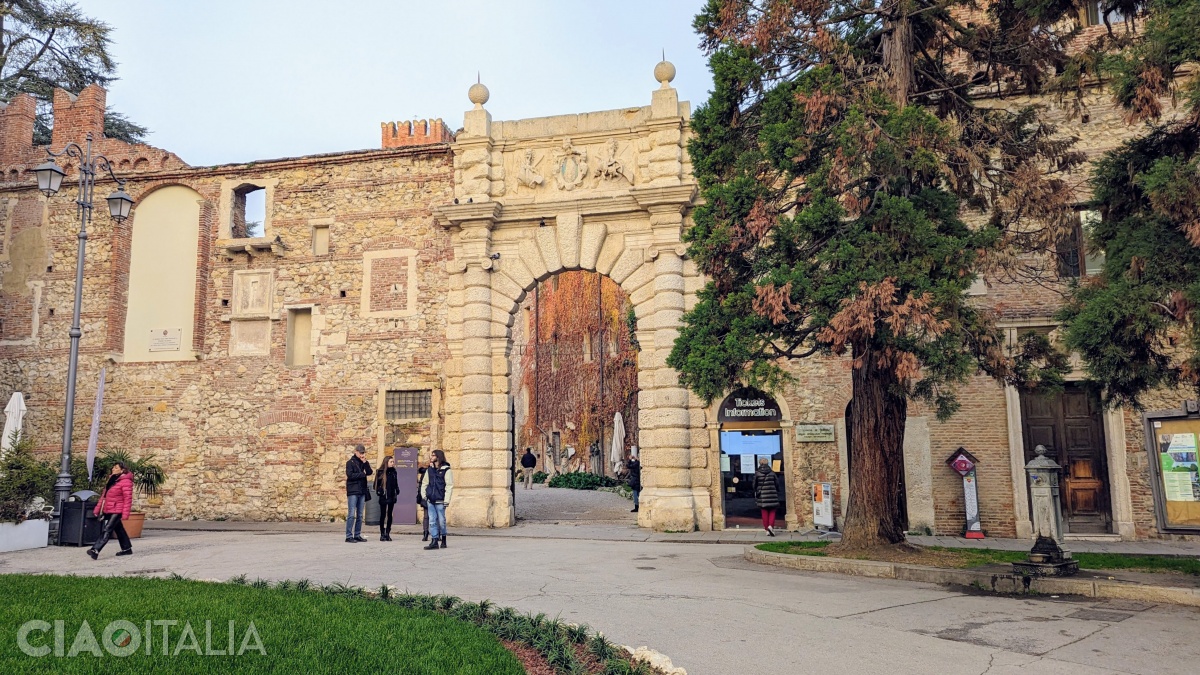
History of the Theatre
The Olympic Theatre was the last, and perhaps the most interesting, work of Andrea Palladio. The architect, born in Padua, left a powerful mark on the architecture of Vicenza, which is home to no fewer than 23 monuments designed by him.
In February 1580, at the age of 72, Palladio was commissioned by the cultural association Accademia Olimpica (of which he was a founding member) to create a theatre inside a complex dating back to the medieval period. It was a unique initiative, arising in an era when theatrical performances were held in various locations, but no theatre had its own permanent home.
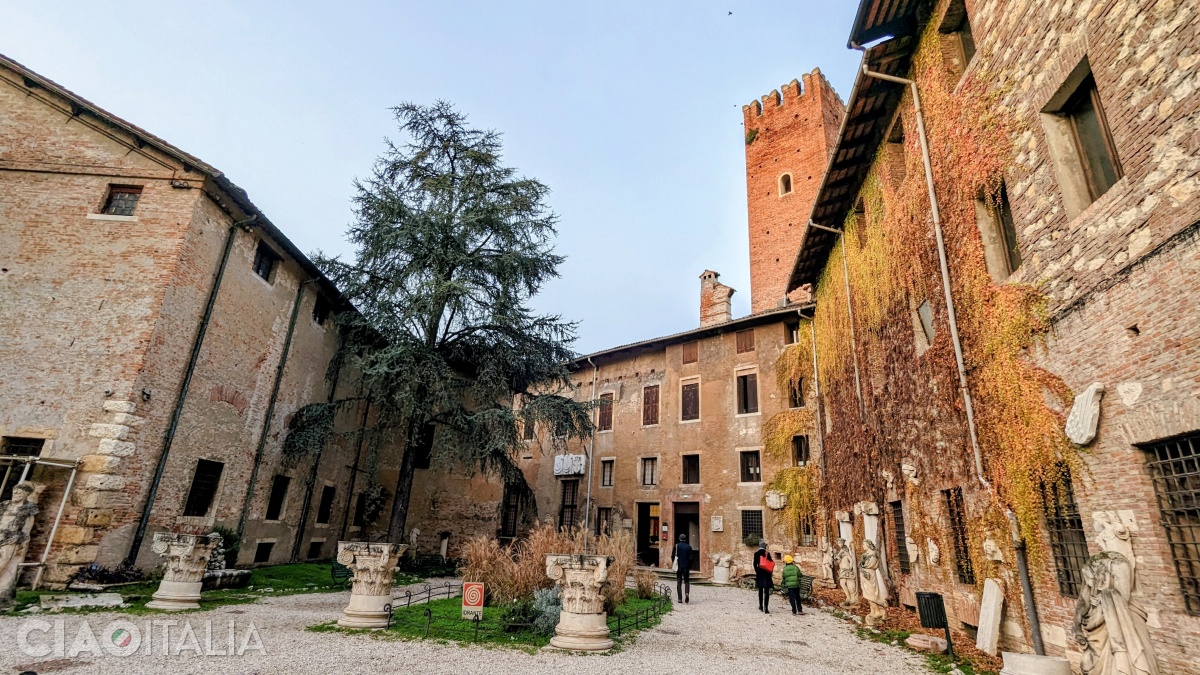
For his project, Palladio drew inspiration from ancient Roman theatres. However, he died three months after finishing the design, in August 1580, and did not live to see it built. His work was continued by one of his sons, Silla, who completed the construction in 1583. The wooden stage with perspective effects, for which Palladio had not left sketches, was created by architect Vincenzo Scamozzi, a former student of his (he also designed the Procuratie Nuove in St. Mark's Square in Venice). Scamozzi also built the two ante-rooms - the Odeo and Antiodeo. A few years later, he would build another smaller theatre in Sabbioneta, near Mantua (Teatro all'Antica) - the first in modern history for which a building was specifically constructed.
The inauguration of the Olympic Theatre in Vicenza took place in 1585 with Sophocles' ancient tragedy "Oedipus Rex". The spectators were impressed: through the openings of the proscenium, the seven streets of the city of Thebes could be seen in the background, created using wooden structures and ingenious plays of light and perspective. The scenery, which looked more like the architecture of a Renaissance Italian city than an ancient Greek one, became permanent and is preserved to this day.
The fame of the new theatre first reached Venice and from there spread throughout Italy, fueled by enthusiasm for the revival of classical art. Later, due to the censorship imposed by the Counter-Reformation, the theatre was transformed into a simple venue for protocol. Theatrical performances resumed occasionally only in the 19th century and later, in a permanent form, after World War II.
The Olympic Theatre in Vicenza has appeared in several films, the most well-known being Ripley's Game and Casanova.
The theatre, with a capacity of about 400 seats and remarkable acoustics, can be visited year-round, but hosts performances only in May and June (classical music) and in September (theatre). To protect it, it has been equipped with neither heating nor air conditioning.
Visiting the Olympic Theatre
We begin the visit to the Olympic Theatre in Vicenza with the two rooms - the Odeo and Antiodeo.
Antiodeo (the vestibule) is decorated in its upper part with monochrome panels representing "The Noblest Actions of the Academy". These were created in 1596 by Alessandro Maganza.
Odeo was the hall intended for the meetings of the members of the Olympic Academy - meetings that continue to be held today, more than 440 years after the theatre's construction. The frescoes on the walls, in shades of ochre yellow, were created by Francesco Maffei between 1647 and 1648. Painted with plant-based colors, they were affected by the floods of 1962 and the humidity caused by the proximity of the rivers. In the lower part, gods of Olympus are represented, symbolizing the planets known at that time. In the upper part are commemorative plaques and allegories of the months of the year and their corresponding zodiac signs.
Entering the theatre hall, you can sit on the wooden tiers, which are the originals from the 16th century. The theatre consists of three parts: the cavea, the orchestra, and the stage.
The cavea is the area intended for the audience, containing the 13 tiers. In Roman theatre, it had a semicircular shape, but in this case, Palladio had to adapt it to a pre-existing space, so he gave it a semi-elliptical shape.
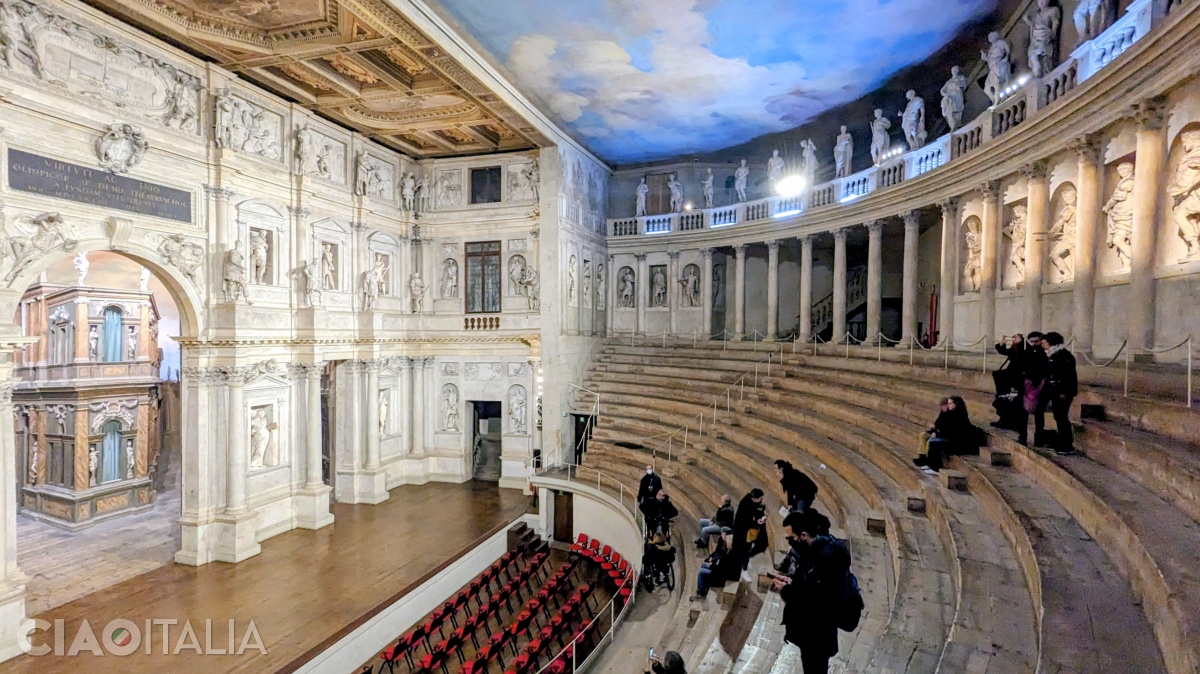
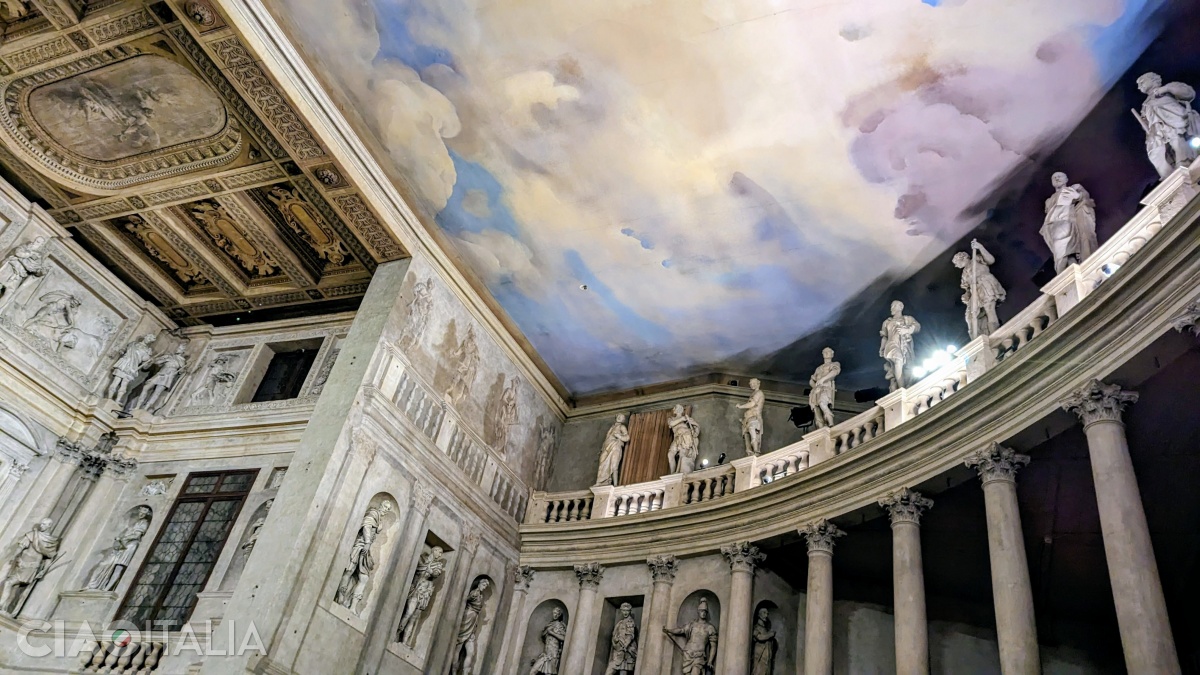
All around, above the tiers, is a colonnade with statues. At first glance, they appear to be Roman warriors, but they actually represent members of the Olympic Academy who were involved in building the Olympic Theatre. Among them, in the central part of the colonnade, is the architect Andrea Palladio himself.
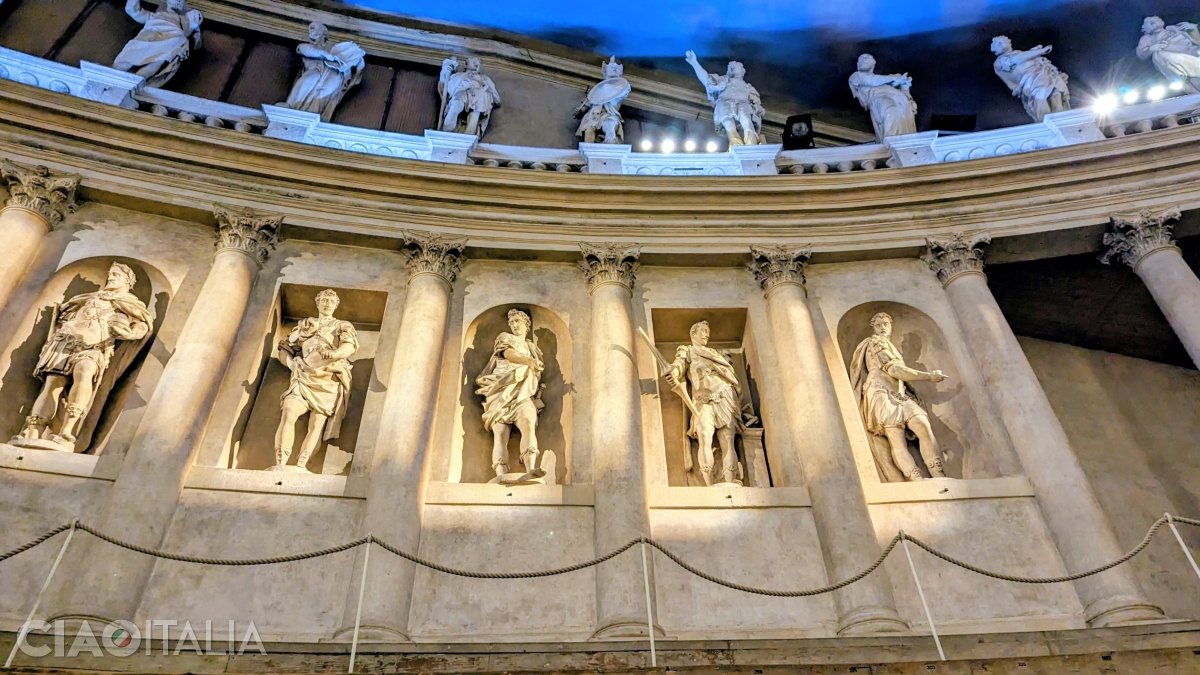
In the 19th century, the ceiling was painted with the image of a sky with clouds, a reference to the fact that Roman theatres were open-air.
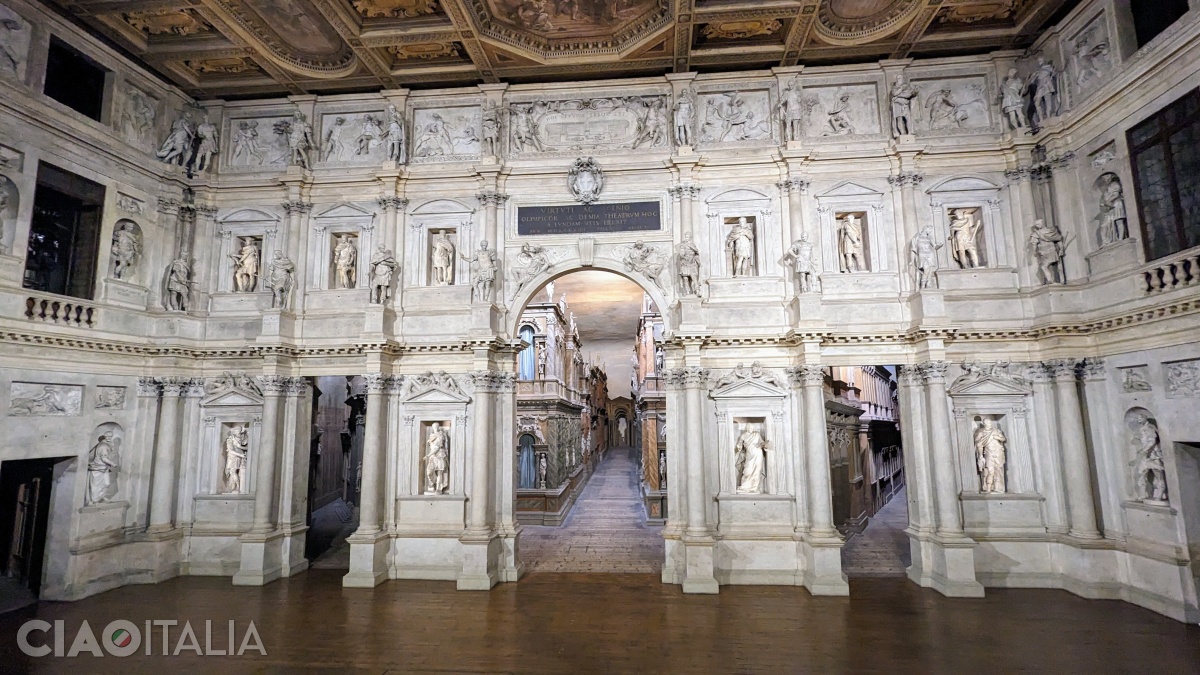
The stage, consisting of the proscenium and the fixed stage behind it, is also original.
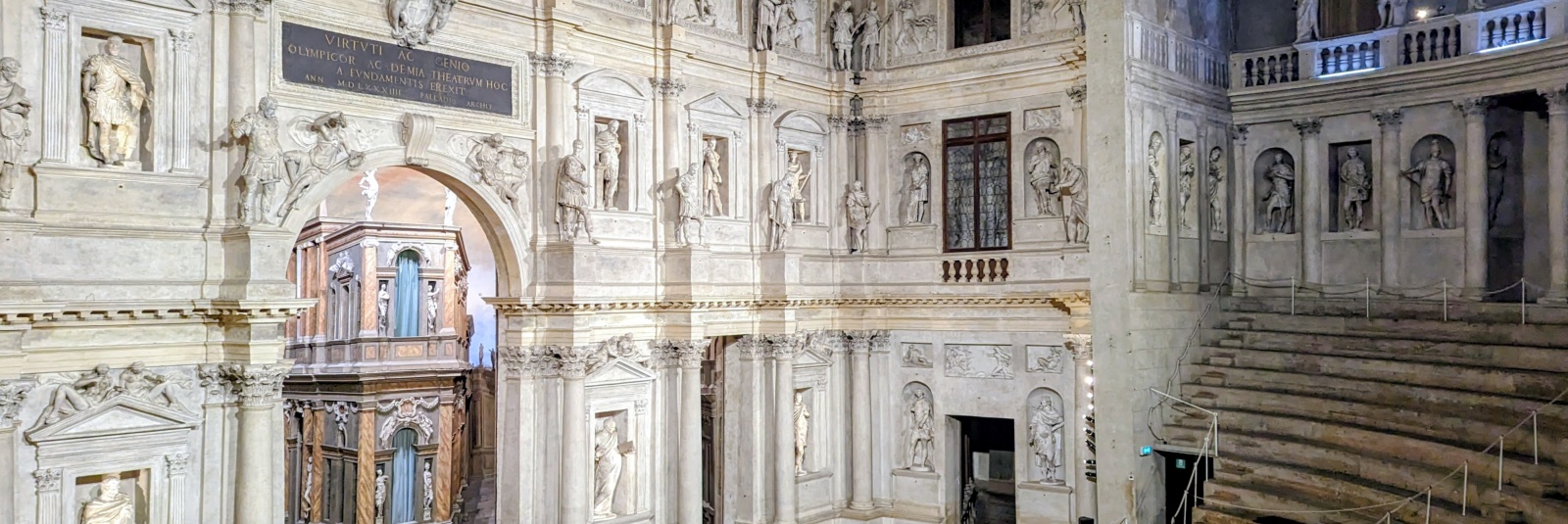
The imposing proscenium, in Renaissance style, is inspired by the shape of triumphal arches and is built of brick masonry covered with plaster. Above the central arch is written the Latin motto of the Olympic Academy: "On the foundations of virtue and Olympic genius, the Academy raised this theatre".
In the niches are statues representing members of the Academy. It is believed that the bearded figure in the second niche from the right in the central register represents Palladio himself.
The bas-reliefs in the upper register depict the twelve labors of Hercules. The hero, who embodied the man who acquires glory through virtue, was the symbol of the Academy. The central panel, framed by two reliefs of Fame with trumpets, represents the stadium where the chariot races took place during the Olympic Games. Above are the words from Virgil's "Aeneid": Hoc opus, hic labor est ("This is the task, this is the hard toil"), and below is the coat of arms of the city of Vicenza.
Behind the proscenium is the fixed stage, with the original wooden scenery built by Vincenzo Scamozzi for the inaugural performance in 1585. These represent the seven streets of Thebes (the ancient city where the play's action took place). In fact, you can only see five - you will spot the other two only if you move from one side of the theatre to the other. The stage uses perspective tricks. For example, the central street, called Via Reggia, is only 12 meters long but appears much longer. Additionally, to enhance the optical illusion, Scamozzi used lamps and people of different sizes during the first performance.
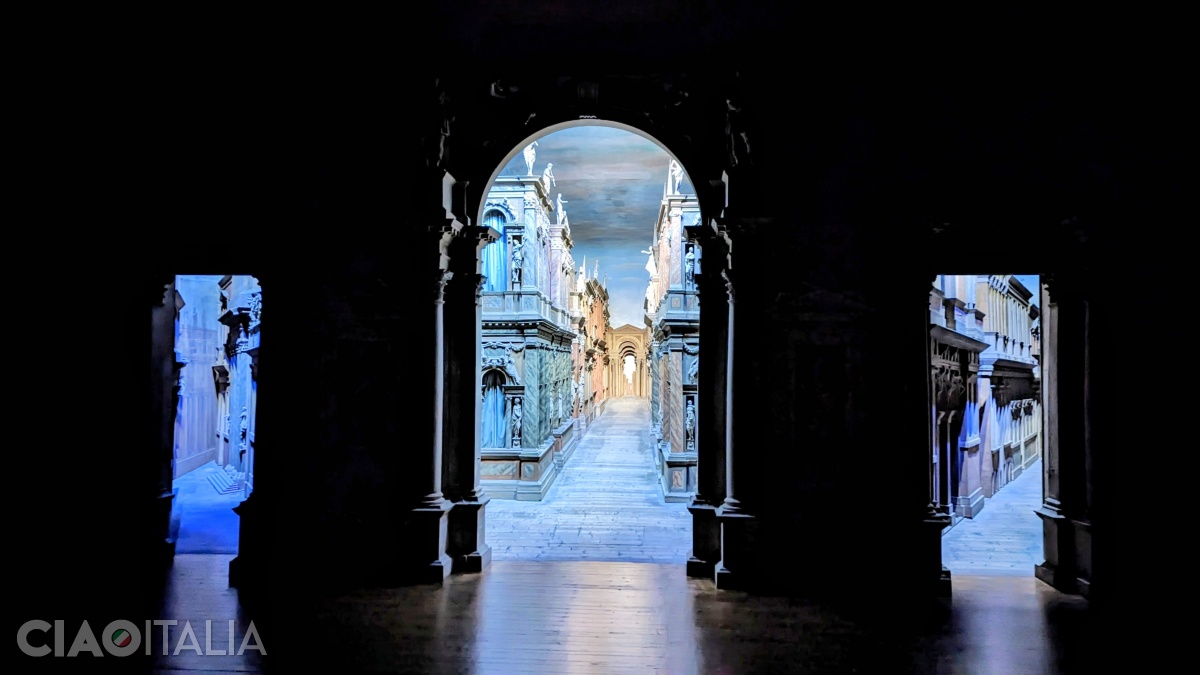
Throughout the theatre's history, the stage has been dismantled only once, during World War II. At that time, the scenery was hidden under the Basilica Palladiana to protect it from bombings.