The Shroud of Turin
Who hasn't heard of the Shroud of Turin? As famous as it is, it is equally controversial. The story of Jesus' shroud is closely tied to the House of Savoy and the city of Turin.
The Shroud (La Sacra Sindone) is a linen cloth measuring approximately 4.4 by 1.1 meters, in which the body of Jesus is believed to have been wrapped after the crucifixion. On the cloth, two full-length images (one front and one back) of a bearded, long-haired man can be seen, bearing marks that appear to be the result of crucifixion.
History of the Shroud
What is known for certain is that the first historical records of the Shroud currently held in Turin date back to the 14th century. In 1353, the knight Geoffroy de Charny built a church in Lirey, France, and donated to it a cloth he claimed to be the Shroud of Jesus. Geoffroy was the first known owner of the Shroud, but documents do not reveal how he came into possession of it. This fact is supported by a votive medallion, found in the 19th century in the Seine River, which depicts the Shroud alongside the coats of arms of the Charny and Vergy families - the latter being his wife’s family.
The first public display of the Shroud took place in Lirey in 1355 (or 1357, according to some historians) and is documented in a 1389 letter from Bishop d'Arcis to Pope Clement VII. The letter questions the authenticity of the relic.
In the early 15th century, the Shroud was taken by the husband of Geoffroy's granddaughter to protect it from war. The latter, Margherita de Charny, refused to return the cloth to the church to which her grandfather had donated it and organized several public showings across Europe. Despite protests from the church community in Lirey, in 1453 the Shroud was sold to the Dukes of Savoy.
The House of Savoy kept the holy relic in Chambéry, which was at that time the capital of the Duchy of Savoy. A chapel was built to house it, and Pope Julius II approved the public veneration of the Shroud (Pope Julius II is the one who rebuilt St. Peter's Basilica in the Vatican, commissioned Michelangelo to paint the Sistine Chapel ceiling, and founded the Vatican Museums).
The year 1563 marks the relocation of the Duchy's capital to Turin. Fifteen years later, in 1578, Duke Emmanuel Philibert also transferred the Shroud to Turin.
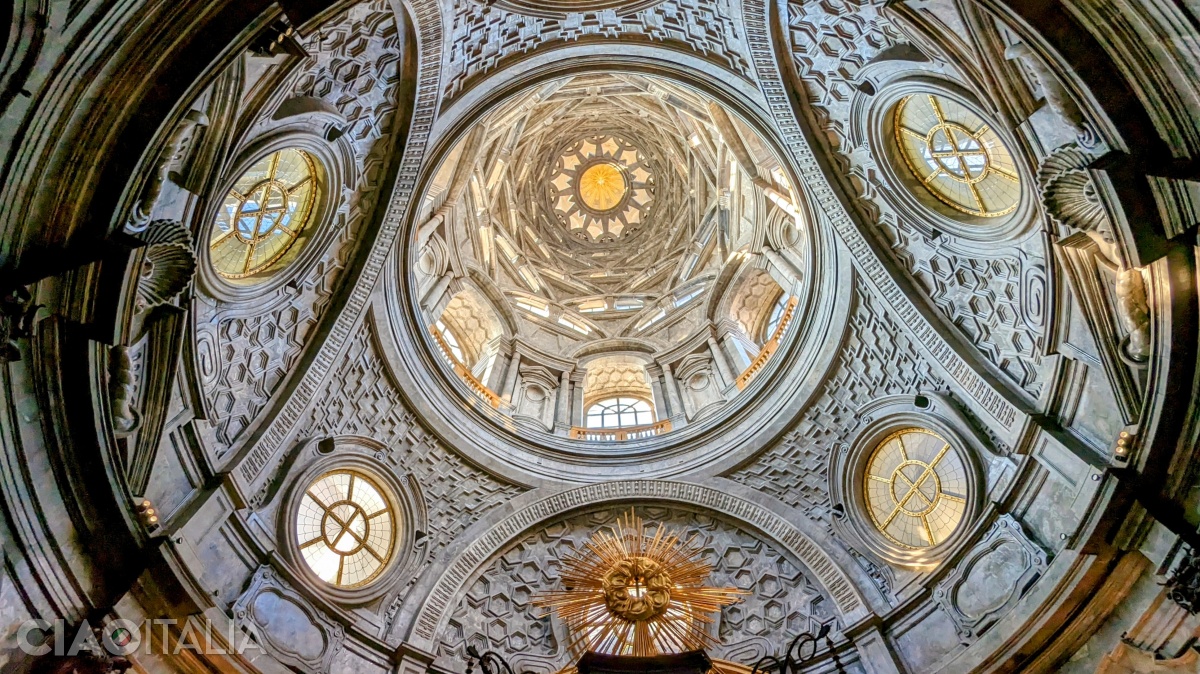
In 1694, the Shroud was placed in the chapel specially built by architect Guarini, between the Cathedral and the Royal Palace.
In 1706, Turin was attacked by the French, and the Shroud was temporarily taken to Genoa for safekeeping. It then remained in Turin until 1939, when, due to the outbreak of World War II, it was moved to Montevergine Monastery in the Campania region, where it stayed until 1946.
In 1983, upon his death, Umberto II of Savoy, the last king of Italy, left the Shroud as a legacy to the Pope. Pope John Paul II decided that it should remain in Turin and appointed the city's archbishop as its custodian.
The Shroud was housed in Guarini's Chapel (Cappella della Sacra Sindone) until 1993, when it was temporarily moved to the choir of the Cathedral, behind the main altar, due to restoration work taking place in the chapel. This relocation made it possible for the Shroud to be saved from the fire that broke out in 1997 and nearly destroyed the chapel.
Where is the Shroud of Turin kept?
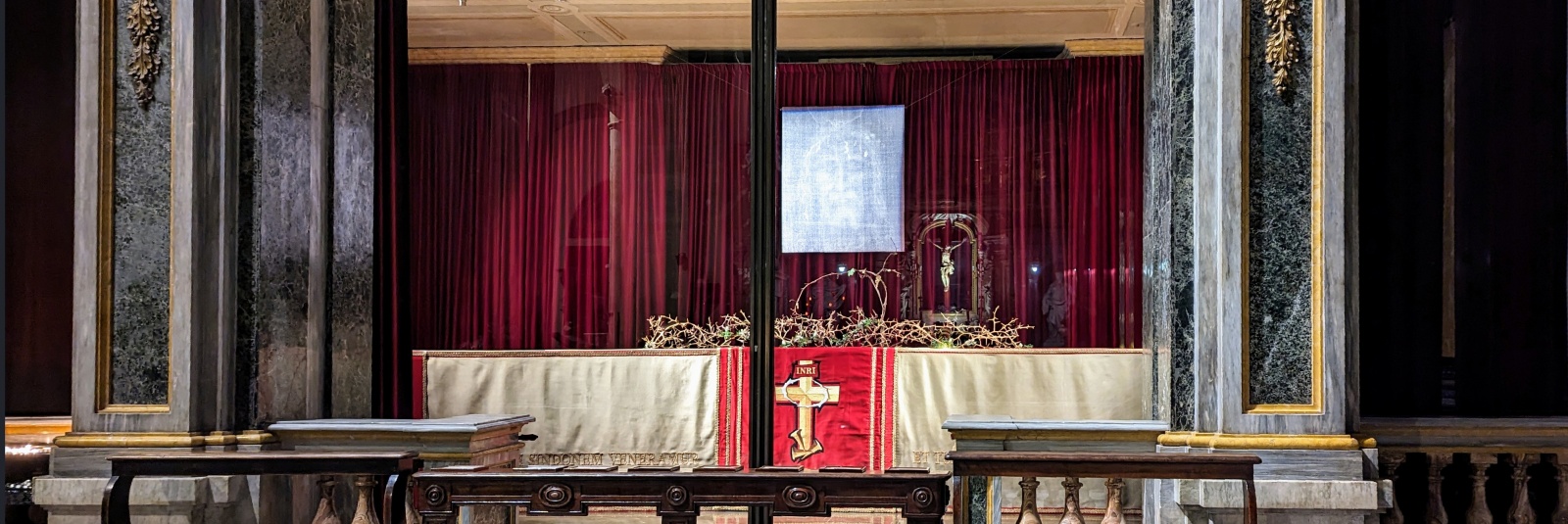
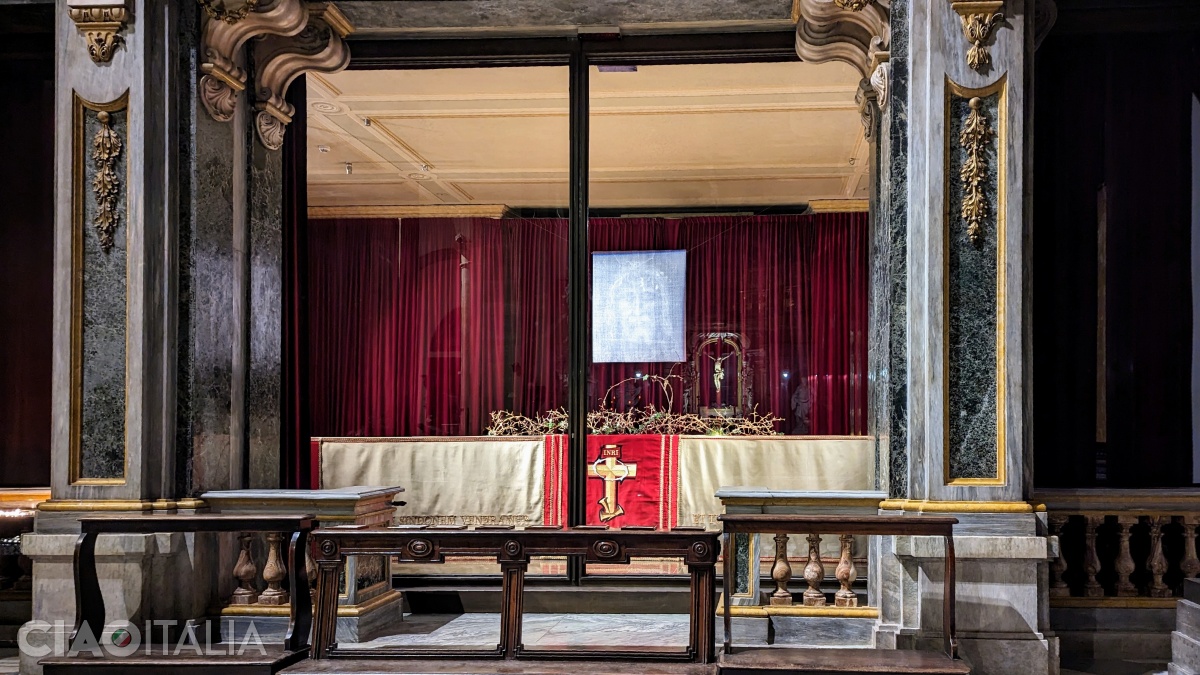
The Shroud is currently located in the Cathedral of Turin, in the last chapel on the left side, beneath the Royal Tribune. It was placed there after the fire in 1998.
The Shroud is laid out horizontally inside a case, which is itself housed in a large metal frame, in an environment protected from external agents that could cause deterioration, behind glass. A crown of thorns rests on the fabric-covered frame, and above it is a reproduction of Jesus' face as it appears on the Shroud.
How can the Shroud of Turin be visited?
Normally, the Shroud cannot be seen. You can visit the Cathedral and see the chapel and the case where it is kept, but you cannot see the Shroud itself. Usually, there are faithful praying in front of the chapel where the Shroud is located.
If you want to learn more, you can visit the Shroud Museum (il Museo della Sindone), located a 10-minute walk from the Duomo, at Via San Domenico 28, in the crypt of the Church of the Holy Sudarium.
The museum's visiting hours are Monday to Sunday, from 3:00 PM to 6:00 PM. Entry is free with the Torino+Piemonte Card. Normally, ticket prices are €8 per adult; €6 for people aged 12-24 and over 65; €3 for children aged 6-12; and free for children under 6.
From time to time, the Shroud is displayed to the public. These public exhibitions are called ostensioni (from the Latin verb ostendere, meaning "to show").
In recent times, public displays took place in 1973 (the first televised exhibition), 1978, 1998, 2000, 2010, 2013 (televised only), 2015, and 2020 (televised only, on Holy Saturday at the start of the COVID-19 pandemic).
Studies and controversies
The Shroud of Turin has been the subject of many studies and research and remains highly controversial. Its authenticity has been questioned since the 14th century.
Scientific interest was sparked by an event at the end of the 19th century. In 1898, one of the public displays of the Shroud took place. Photographs taken on this occasion by the Turin lawyer Secondo Pia revealed a surprising detail: the image on the Shroud is a negative. Thirty years later, a new series of photographs - this time taken in the presence of witnesses and certified by a notary - confirmed this discovery.
In 1959, the Centro Internazionale di Sindonologia was established, now called the Centro Internazionale di studi sulla Sindone (International Center for Shroud Studies).
The most famous scientific research was conducted in 1988, when carbon-14 dating performed by three different laboratories in the USA, the UK, and Switzerland unanimously concluded that the Shroud of Turin dates from the period 1260-1390, which coincides with the time of the earliest reliable historical records. However, some researchers dispute the accuracy of these results.
A recent study, published by a team of Italian scientists in the journal Heritage, shows that it is very possible that the cloth bearing the image of Jesus dates to the time when he lived.
Over time, the Catholic Church has taken contradictory positions regarding the authenticity of the Shroud. However, since the 20th century, it has no longer adopted an official stance, leaving science to make its judgment.
Authentic or not, the Shroud of Turin is considered an object of devotion, an image of Christ's passion.