Trulli, the Mysterious Traditional Houses of Puglia
The Valle d'Itria geographical area, located south of Bari, is famous for the curious conical houses known as trulli. Although their name is usually synonymous with the town of Alberobello, trulli are scattered across this entire expanse of red earth, amidst vineyards, olive groves, and almond orchards, forming one of the key tourist attractions of the Puglia region in southern Italy.
What Are Trulli?
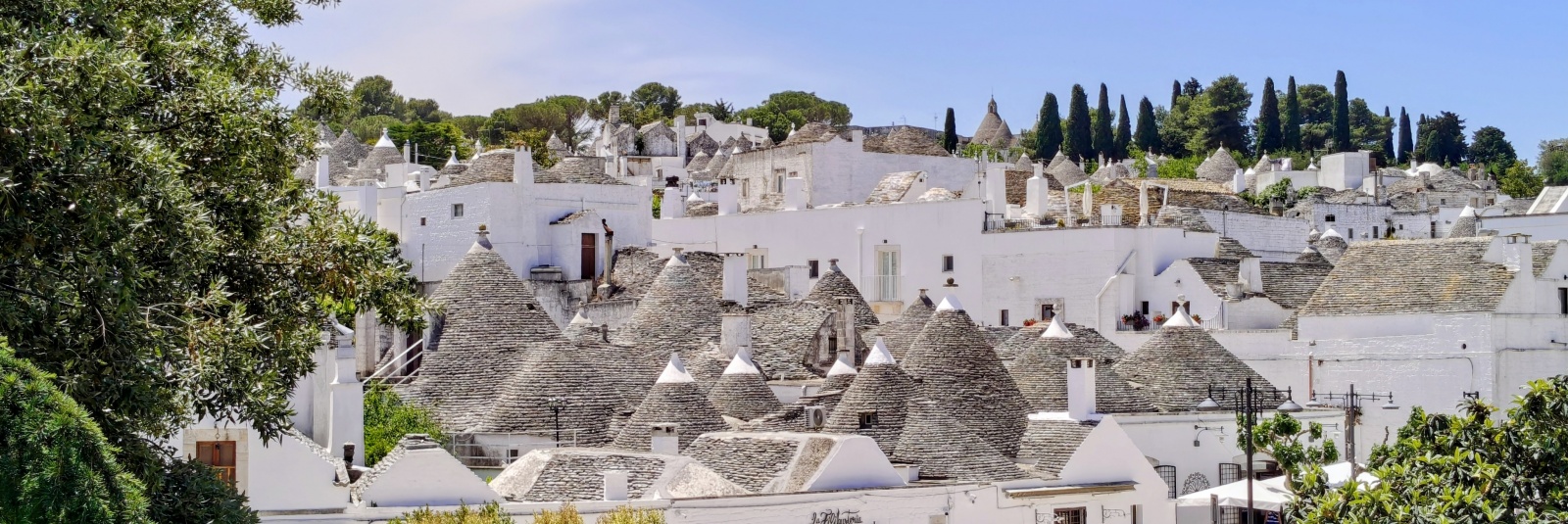
Trulli (singular trullo) are small traditional houses built from limestone, without the use of mortar. They feature thick, whitewashed walls designed to reflect the sun and keep the interior cool in summer and warm in winter.
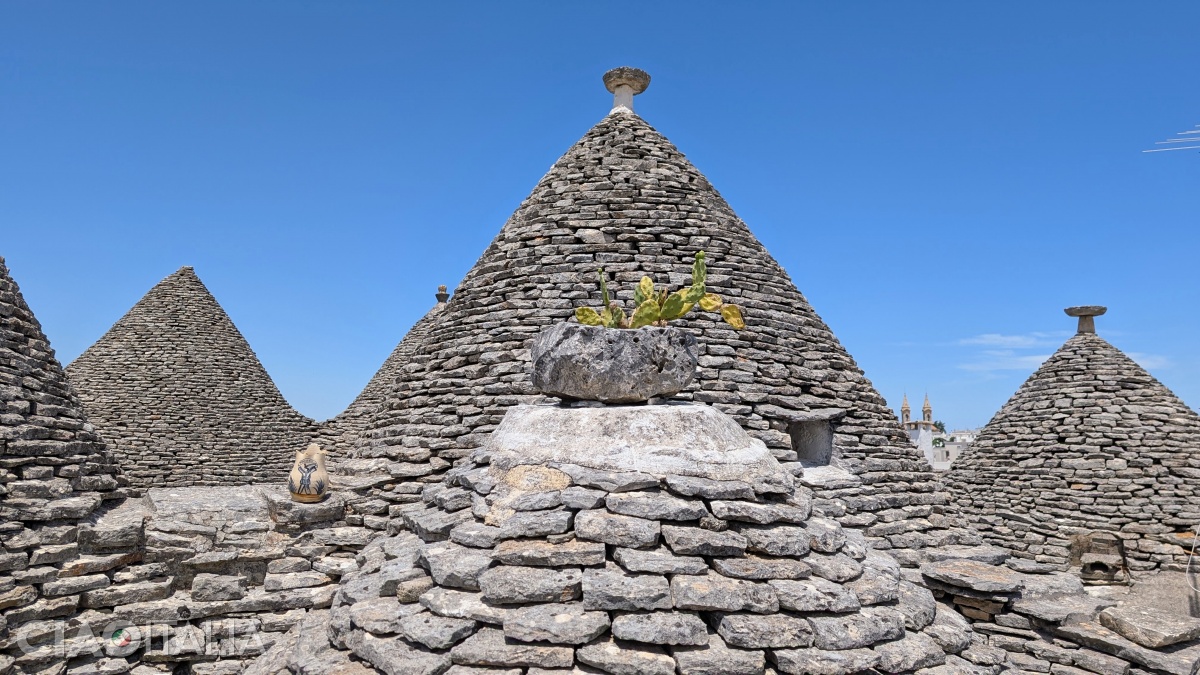
The grey, conical roofs are made of flat limestone slabs called chianche or chiancarelle, arranged in progressively smaller concentric circles. White symbols of religious or pagan origin are sometimes painted on the roofs. At the very top sits a stone ornament (pinnacolo) shaped like a cross, sphere, or disc.
Trulli were generally built by farmers in the fields as storehouses, temporary shelters, or permanent dwellings.
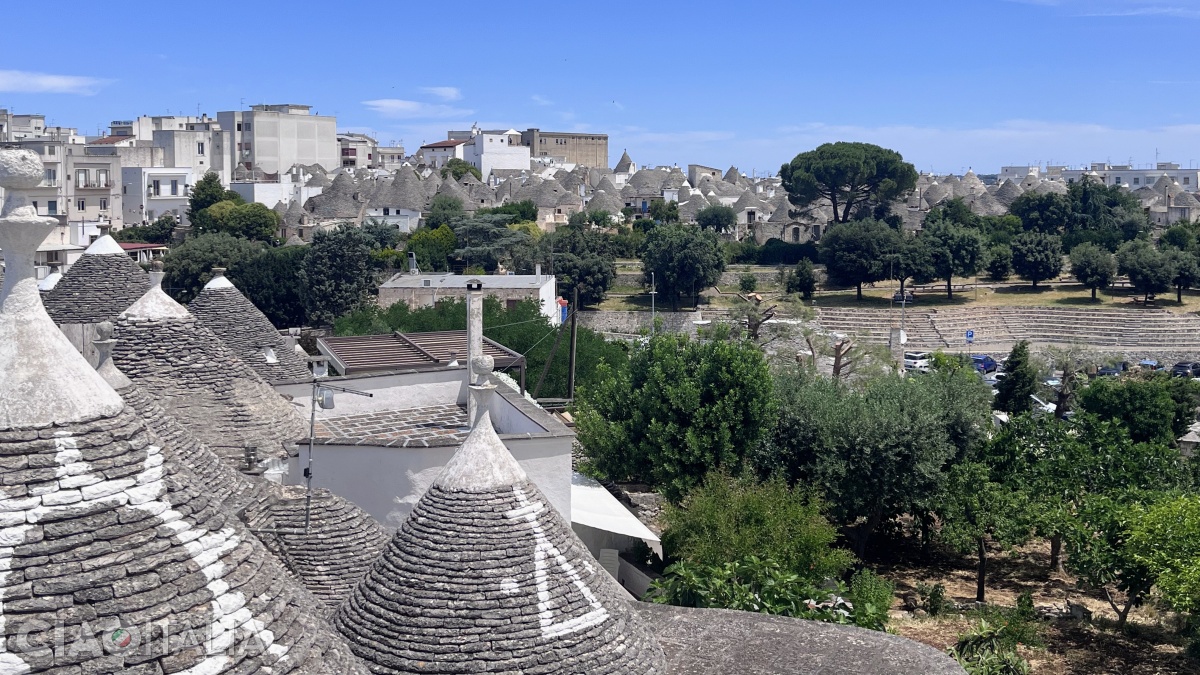
Origin of the Name
The name trullo comes from the Greek word trullos, which means "dome" or "vault". It entered Medieval Latin as trullus or trulla, denoting a structure with a conical or spherical roof.
Interestingly, for a long time, the inhabitants of Puglia did not use the word trullo to describe their homes. In the local dialect, these constructions were called casedde ("little houses"). The term trullo was used primarily by foreign scholars who visited the region and described the unusual shape of the conical roofs.
The widespread adoption of the word trullo occurred only in the second half of the 19th century, as the study of Valle d'Itria's rural architecture began.
Where Are the Trulli Houses in Puglia?
Trulli are found in southern Italy, in the region of Puglia. Their geographical area coincides with the Valle d'Itria (Itria Valley) - the lower part of the Murgia Plateau.
The highest concentration and best-preserved trulli (over 1,500) are located in the town of Alberobello, where they are grouped into two main districts: Rione Monti and Rione Aia Piccola (see also the article about the tourist attractions in Alberobello).
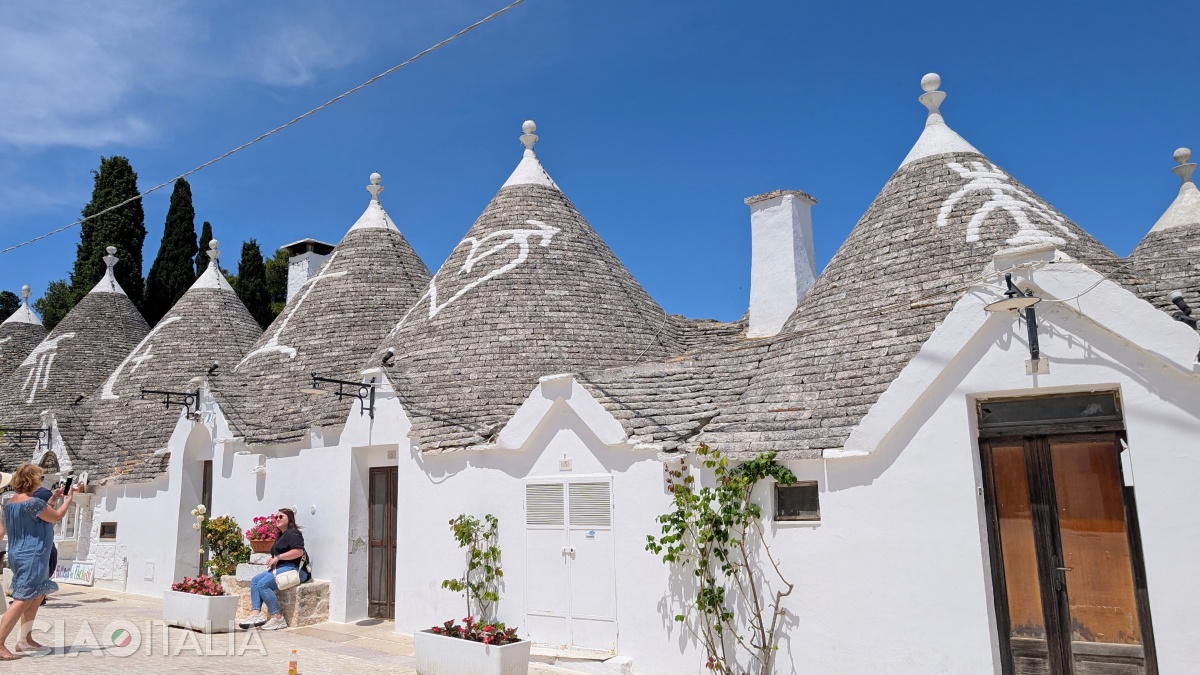
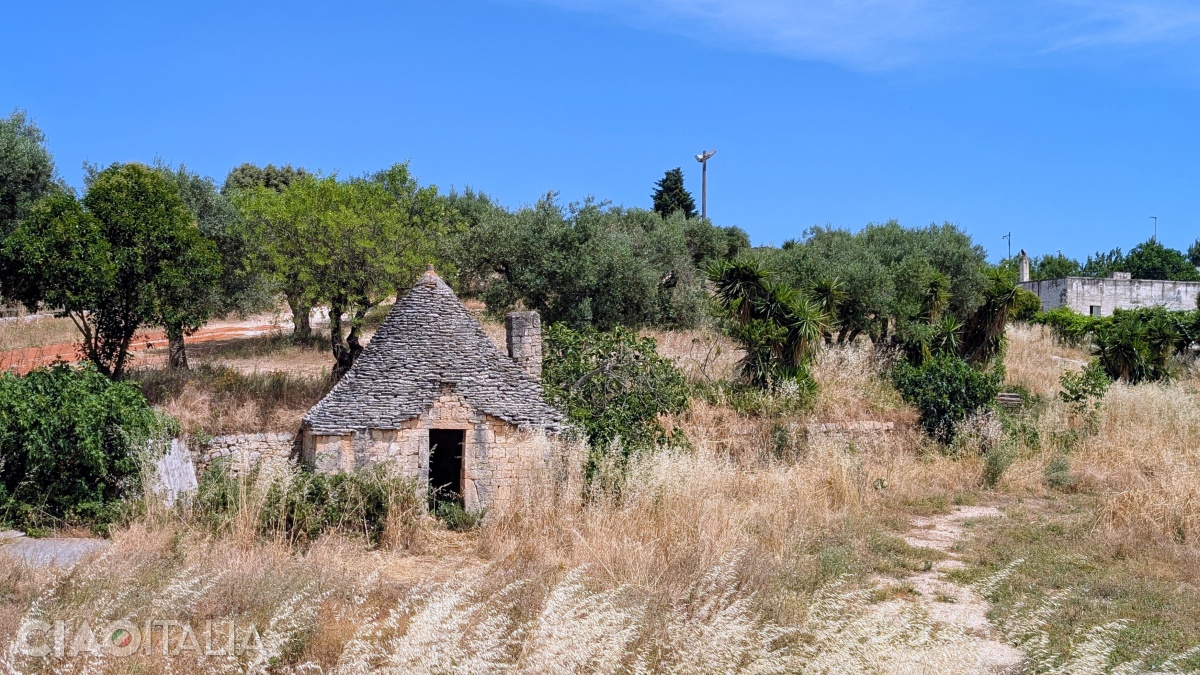
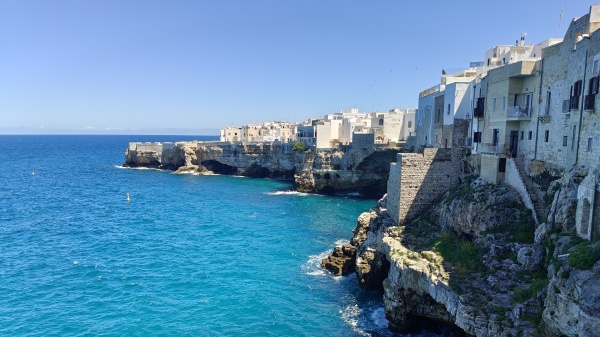
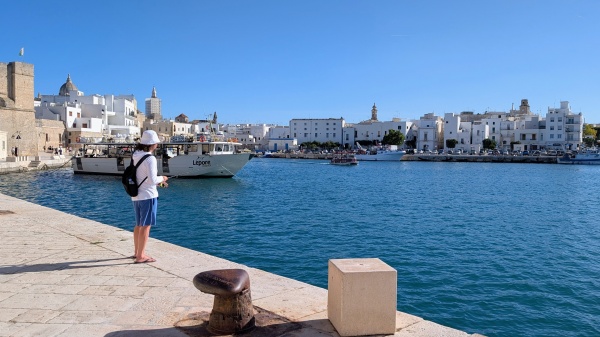
However, the most picturesque trulli are found outside the town, scattered among olive groves along the roads leading from Alberobello to Martina Franca, or from Martina Franca to Locorotondo, as well as in the surroundings of Cisternino, Ceglie Messapica, and Ostuni, or even towards the sea near Monopoli or Polignano a Mare.
Some structures are in ruins, others are well-preserved, and many have been converted into wineries, restaurants, or unique hotels where you can stay overnight.
A variation of trulli with stepped roofs also exists along the coastal areas of the Taranto province and in the southern Salento region (Capo di Leuca). Here, these buildings are called truddi, tròdduri, or pajare, and are primarily used as rural agricultural shelters.
Wherever you encounter them, trulli bring a unique charm to the landscape of this part of southern Italy.
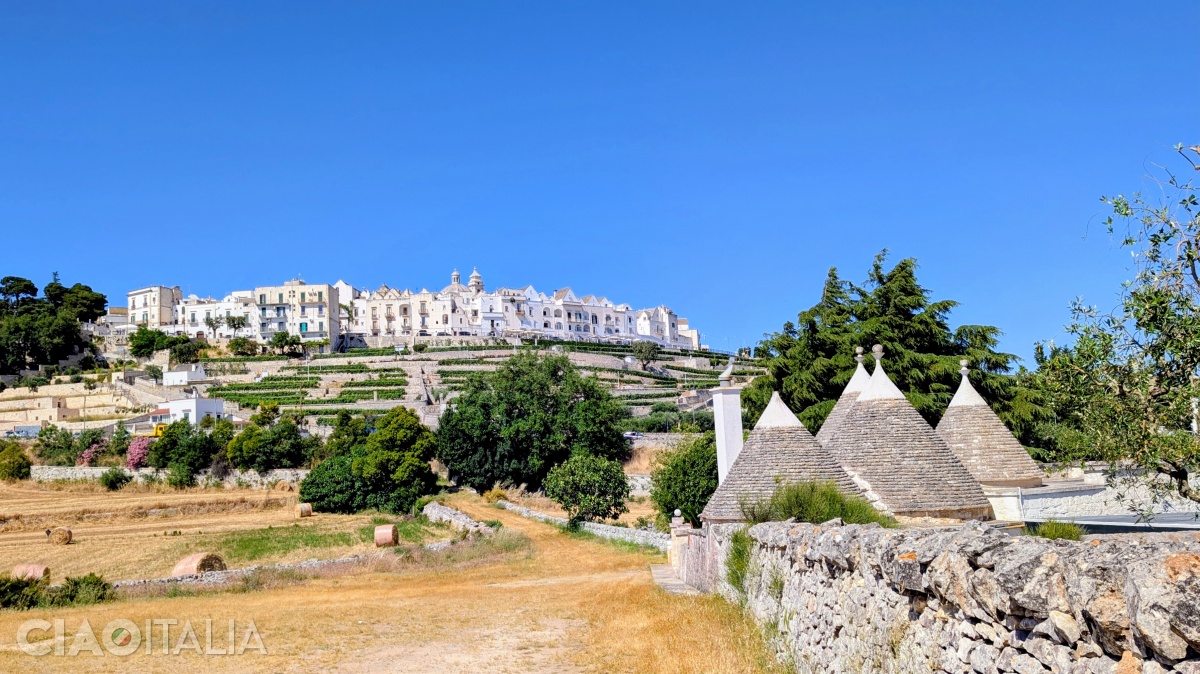
How are Trulli Houses Built?
Trulli are built using the ancient construction technique known as a secco ("dry masonry"), where buildings are assembled without any binding mortar.
The minimally chiselled stones, gathered from the fields or excavated, are stacked on top of one another to form a circular base. The walls are double layered, with the gap between them filled with rubble and gravel, providing excellent thermal insulation. The walls feature an entrance and a few small windows, while the interior houses a hearth.
The conical roofs also feature a double-skin structure, built from overlapping limestone slabs laid in successive steps (chianche or chiancarelle). At the base of the roof (accessible via a narrow flight of steps), eaves collect rainwater and channel it into a cistern situated beneath the house.
Why Were Trulli Built?
The exact origin of Puglia's trulli remains unknown, but the dry-stone construction tradition is thousands of years old and can be found across the Mediterranean region.
Some researchers have linked trulli to certain structures in Mycenae, noting that this area, along with other parts of southern Italy, was once part of Magna Graecia. Its ports were the closest to Greek shores, facilitating cultural exchanges.
Others have noted similarities between trulli and certain buildings in Syria and other Middle Eastern countries. According to this theory, the first trulli were actually cells or tombs built by Eastern monks who arrived around the 10th century, which locals then copied and used as dwellings.
Another hypothesis popular in 19th-century romantic historiography links the origin of trulli to the Crusader Knights who settled in Puglia during the Middle Ages. Returning from the Middle East, they were supposedly impressed by the stone houses with conical domes found there and brought the technique back to Italy to build shelters or rural garrisons. The presence of crosses, Christian monograms, and figures like the chalice on the roofs led some 19th-century authors to attribute them to a secret Templar code.
The most compelling hypothesis regarding the existence of trulli is rooted in tax evasion. The Pragmatica de Baronibus, a law issued in the 15th century by Ferdinand I of Aragon, King of Naples, required feudal lords to pay a substantial tax for every new permanent settlement established on their estates. The decree tightened inspections and penalties for lords who built villages without authorization or attempted to conceal the true number of dwellings on their lands.
In Puglia's Valle d'Itria, the noble Acquaviva family of Conversano had colonized the area where Alberobello later developed with serfs brought in to farm the land and clear the forests. To avoid paying royal taxes, the Count forced the peasants to build their homes exclusively from dry stone, without mortar. That way, whenever royal inspectors approached, the peasants could pull out a single stone serving as a keystone, causing the conical roof to quickly collapse into a pile of stones. Once the inspectors left, the homes could be rebuilt in a matter of days.
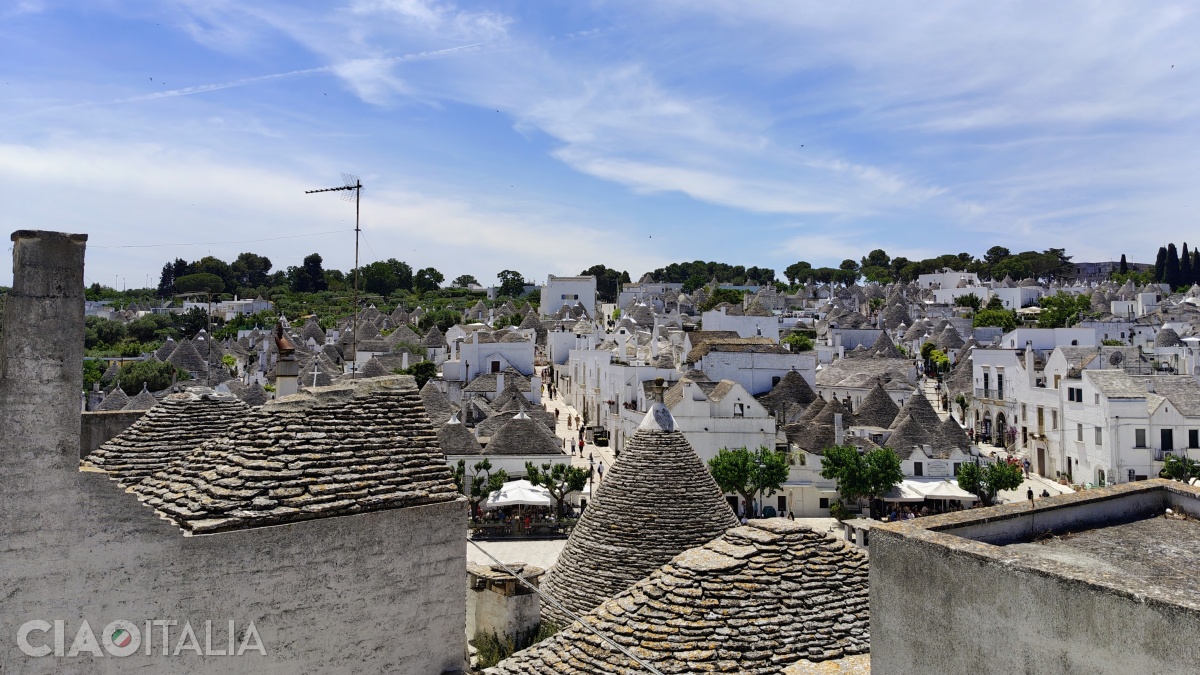
The oldest surviving trulli date back to the 17th century. Today, trulli are protected by law, making their demolition, alteration, or unauthorized reconstruction illegal.
What Do the Symbols on the Trulli Houses Mean?
The conical roofs of trulli often feature white symbols painted with lime wash, the meaning of which is not fully understood. They represent one of the most enigmatic and fascinating features of Puglian rural architecture.
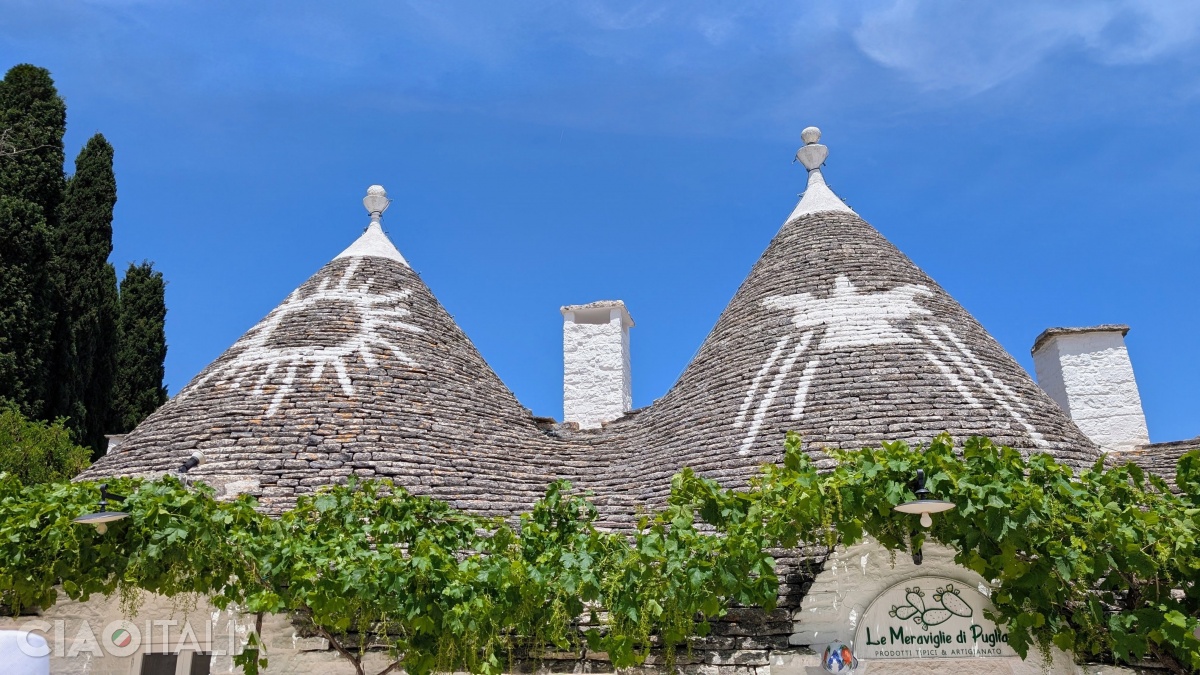
The first attempt to classify these symbols took place in 1940, and by 1954, the five main categories known today were established:
- Religious symbols (various types of crosses, the IHS monogram of Christ, the pierced heart symbolizing the sorrow of the Virgin Mary, the Holy Chalice, the dove, or Alpha and Omega) - the most common category, designed to bless the home and invoke divine protection.
- Pagan and magical symbols (the snake, eye, horseshoe, triangle, sickle, ear of wheat, olive branch) - intended to ward off evil spirits, bad luck, disease, or the evil eye.
- Astrological and cosmic symbols (the sun, moon, stars, or comets) - reflecting the farmers' close connection to the cycles of nature, aimed at attracting bountiful harvests and good weather.
- Zodiac symbols (zodiac signs rendered in simplified, geometric forms) - representing either the astrological signs of the family living in the house or the completion date of the build.
- Ornamental, secular, and ownership symbols (monograms, work tools, numbers, geometric shapes, and simplified coats of arms) - including elements used to identify the owner or craftsman, as well as purely decorative designs without deep symbolic meaning.
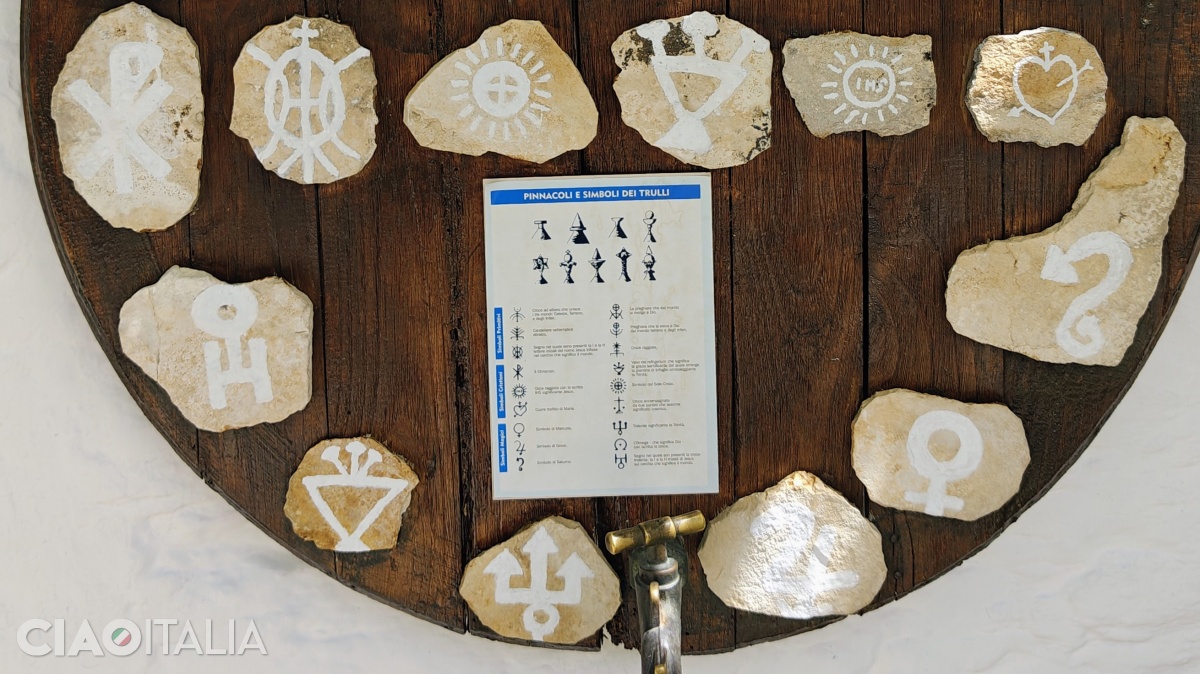
These painted designs are topped by a sculpted element at the apex of the roof known as a pinnacolo. Carved from stone into shapes such as spheres, pyramids, crosses, or discs, these were not merely decorative or symbolic; they served a structural purpose by anchoring the stones at the top of the dome and protecting the roof from water infiltration.