St. Mark's Clock Tower in Venice
The Clock Tower (Torre dell'Orologio) in Venice is located in St. Mark's Square. It stands right next to St. Mark's Basilica, on its left side, where the busy and narrow shopping street, Mercerie, begins.
Built at the end of the 15th century, the Clock Tower is one of Venice's main tourist attractions, even though some visitors are unaware that it can be toured. The view from the roof, which opens up to the entire city and the Venetian lagoon, the chance to see the two statues nicknamed i mori ("the Moors") up close, and the insights gained during the tour make the visit well worth it.
Tickets and Reservations
The Clock Tower can only be visited via guided tours with a reservation made in advance. The tour lasts about one hour, and access is permitted only for persons over 6 years old. Recording videos is not allowed during the tour (except on the terrace). Photography is permitted, but without flash.
The visit involves climbing four floors via narrow and fairly steep stairs; therefore, the tour is not recommended for people with disabilities, those suffering from claustrophobia, vertigo, cardio-respiratory disorders, or pregnant women.
Tours are organized in English, Italian, or French.
Ticket prices:
- Adult: €15
- Over 65: €11
- Students 15-25 years: €11
- Children 6-14 years: €11
Additionally, if you have purchased tickets for the St. Mark's Square Museums or a Museum Pass (which grants access to all civic museums in Venice), or if you have booked one of the tours "Secret Itineraries" or "Hidden Treasures of the Doge" at the Doge's Palace, you are entitled to a discount, bringing the price of the Clock Tower guided tour to €11.
Tickets for the Clock Tower also grant you free entry to the Correr Museum, the National Archaeological Museum, and the Monumental Rooms of the Marciana Library.
Opening Hours
The schedule for guided tours at the Clock Tower in Venice varies depending on the language of the guide.
Guided tours in English:
- Monday: 11:00 AM and 2:00 PM
- Tuesday and Wednesday: 12:00 PM and 2:00 PM
- Thursday: 12:00 PM
- Friday: 11:00 AM, 2:00 PM, and 4:00 PM
- Saturday: 2:00 PM and 4:00 PM
- Sunday: 11:00 AM
Guided tours in French:
- Tuesday and Wednesday: 3:00 PM
- Thursday: 2:00 PM
- Saturday: 11:00 AM
- Sunday: 2:00 PM
Guided tours in Italian:
- Monday, Friday, Saturday, and Sunday: 12:00 PM
- Thursday-Sunday: 3:00 PM
Visiting the Clock Tower in Venice
Reserved tickets must be picked up from the ticket office of the Correr Museum, located on the opposite side of the square from St. Mark's Basilica, which is also the meeting point for the guided tour. It is advisable to arrive 5 minutes early - the guide will collect the group at the scheduled time and will not wait more than 2-3 minutes for latecomers.
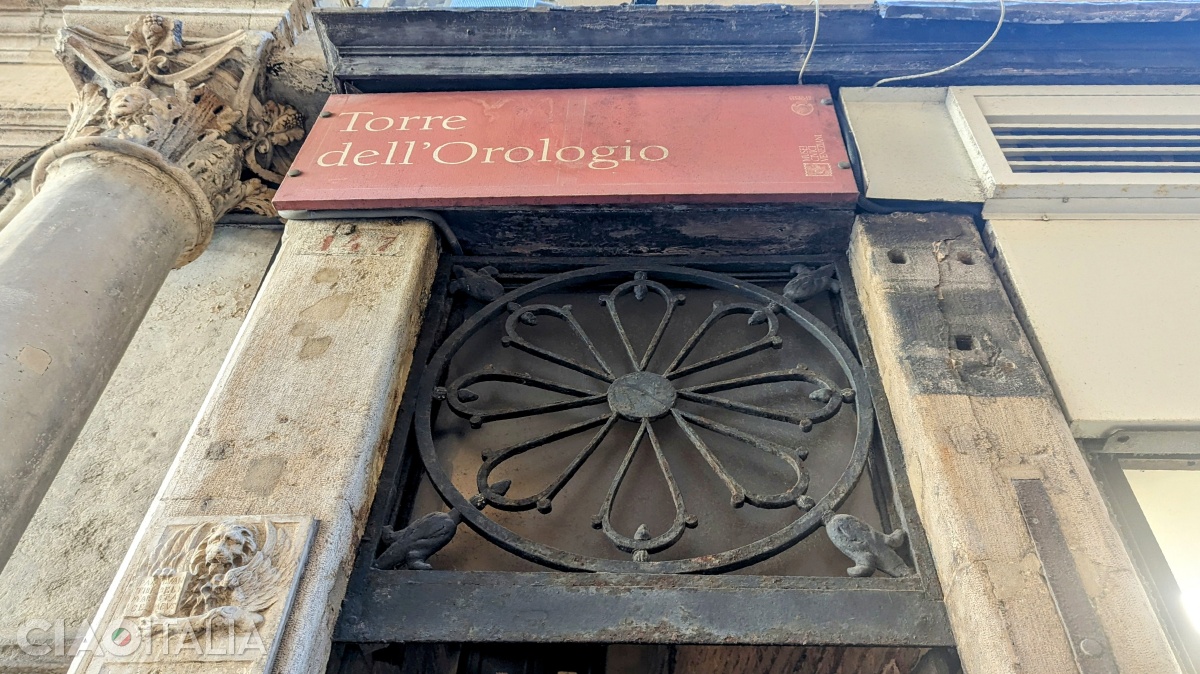
From the Correr Museum, you will be led through St. Mark's Square toward the Clock Tower, which you will enter through the small gate facing Mercerie street.
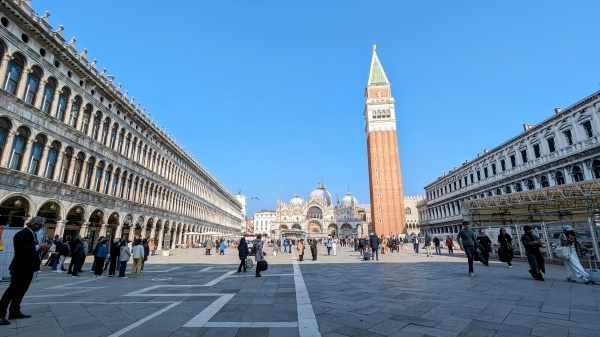
To better understand the information you will receive, we advise you to spend about ten minutes in St. Mark's Square before the meeting time to observe the tower's facade at your leisure.
The Clock Tower was erected between 1496 and 1499 following the Venice Senate's decision to build a new public clock, suited to the technological discoveries of the time. The architect is not known with certainty, but certain elements point to Mauro Codussi, who also built the monastery on San Michele Island. To make room for the tower, several buildings in the square were demolished, and its position was not chosen by chance. The clock, a testament to Venice's progress and power, had to be visible from the sea. The clock mechanism was created by Carlo Zuan Rainieri, a clockmaker from Reggio Emilia (nowadays in the Emilia-Romagna region). By 1506, the two side wings were added, which were later heightened in the 18th century.
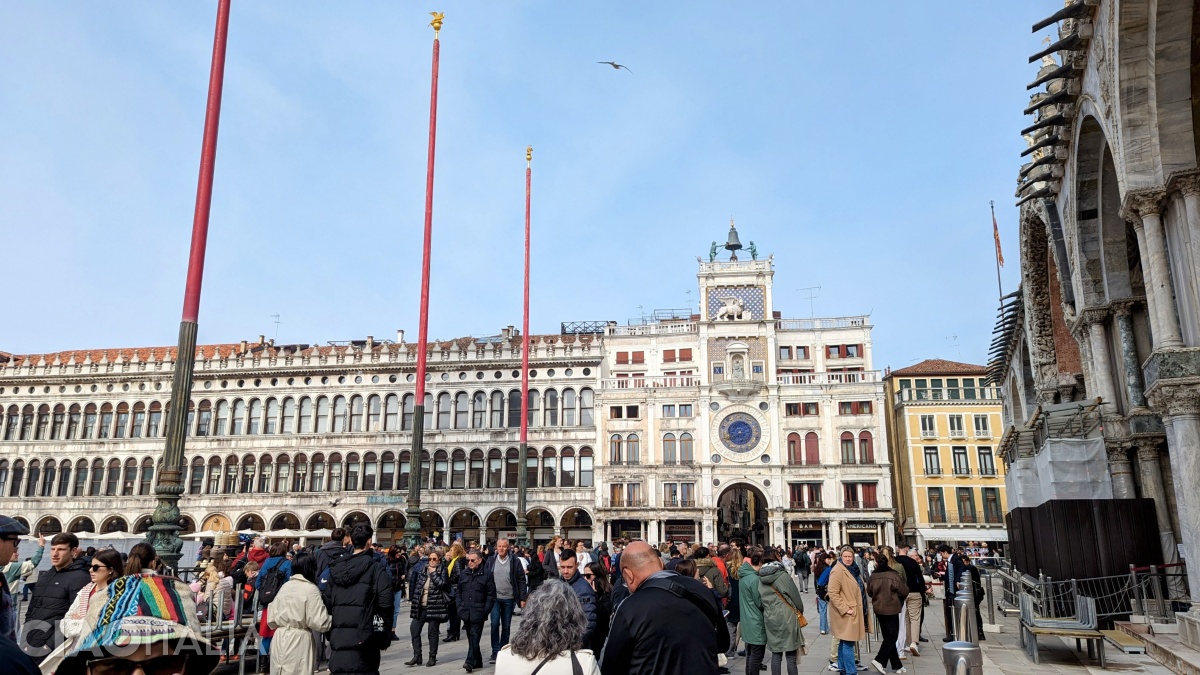
Legend says the Venetians blinded the master who built the clock so he could never build another as beautiful for any other city. This is merely a legend; in reality, he was employed by the Serenissima Republic to maintain the mechanism and lived in the tower with his family. This tradition continued for five centuries. In 1998, the 33rd and final keeper of the mechanism left the small rooms in the tower that had served as his home for a lifetime. With the most recent restoration and automation, his role became obsolete.
The Venetian expression still used today as a threat, Te fasso veder mi che ora che xe! ("I'll show you what time it is!"), is closely linked to the presence of the tower in St. Mark's Square. Condemned prisoners executed between the two columns in the square faced the Clock Tower, making it the last image they ever saw.
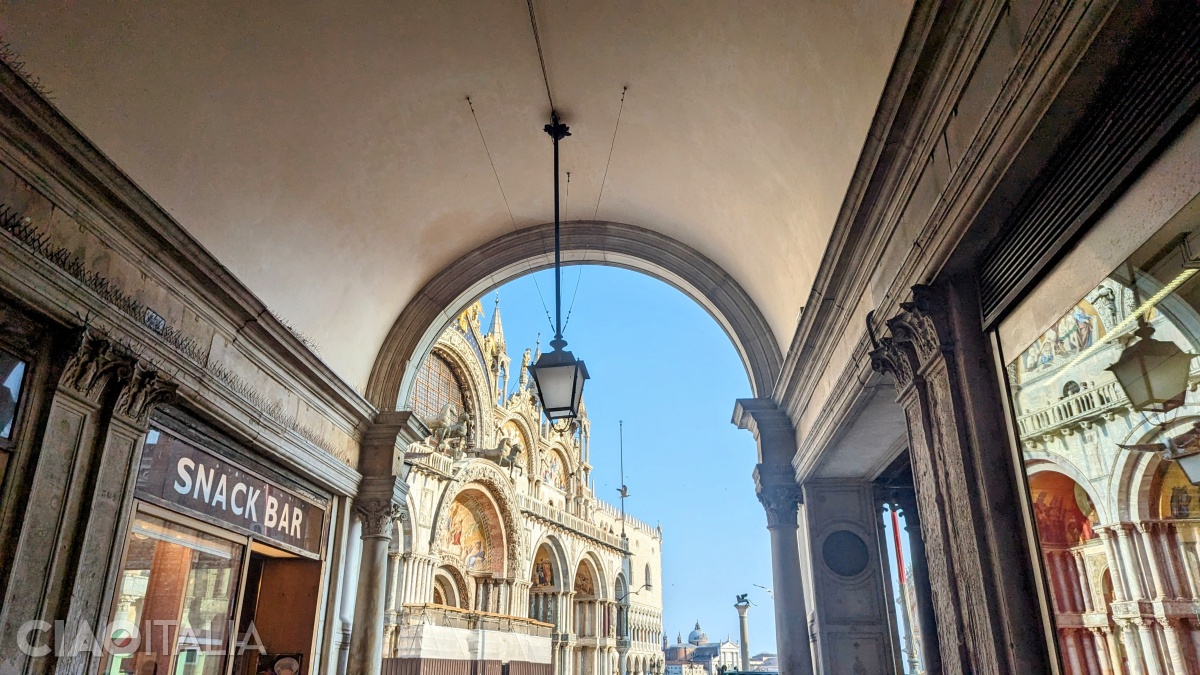
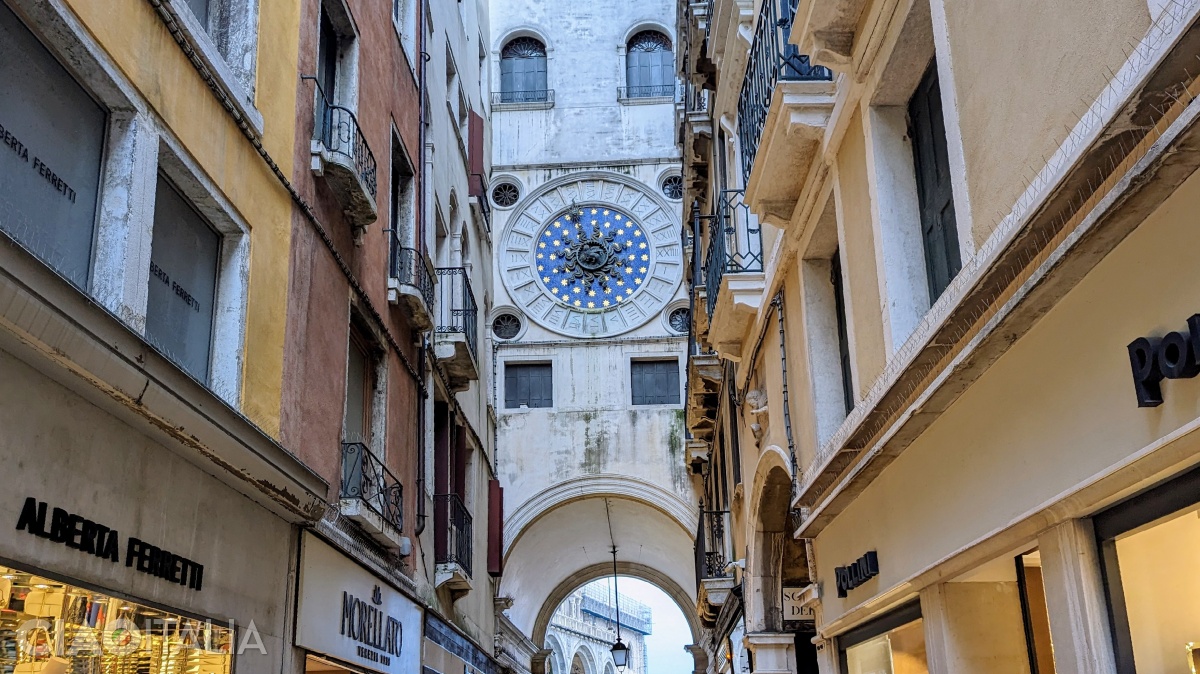
Let’s have a look at the tower from the bottom up: at the lower level is the passage into Mercerie street, linking the city's political and religious center (St. Mark's Square) with the commercial center. Mercerie was the main route to the Rialto Market.
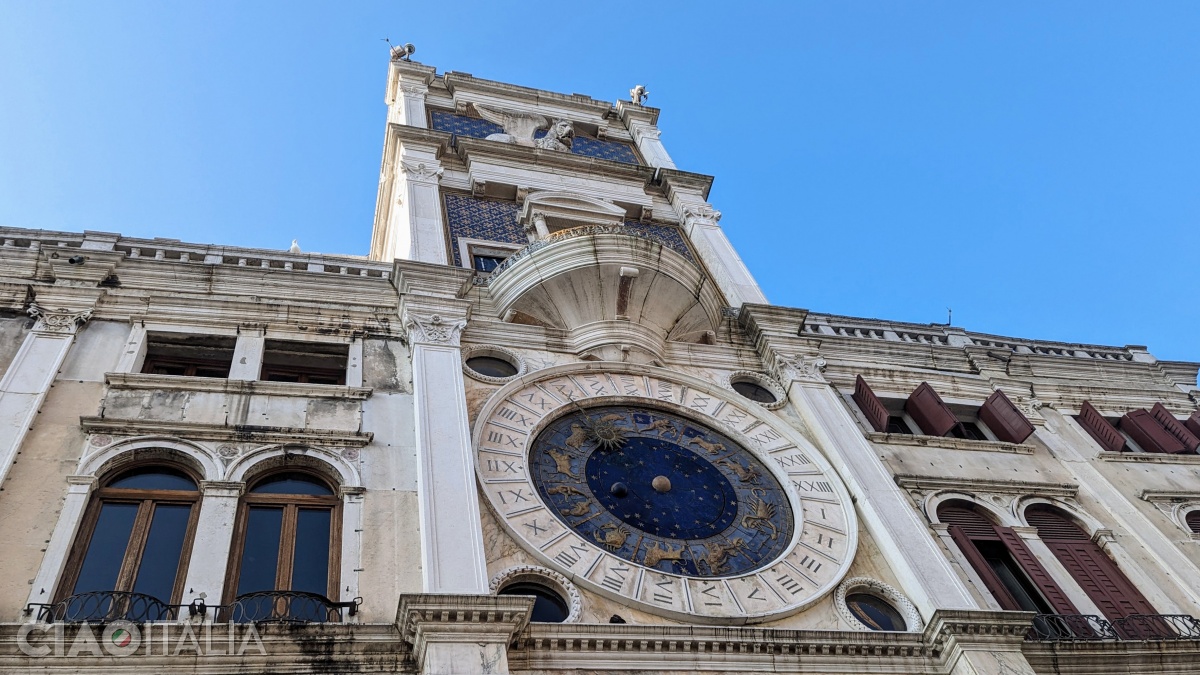
Above the arch is the beautiful astronomical clock, 4.5 meters in diameter, indicating the hours, zodiac signs, and lunar phases. The outer marble dial is fixed and shows 24 hours in Roman numerals, starting from 6:00 PM (sunset, which was considered the start of the day). The middle part, covered in blue enamel, is mobile. Concentric rings represent the days, months, and zodiac signs. The inner ring holds the clock hand in the shape of a Sun, with a long ray pointing to the hour. The center disc features the Earth with the Moon on its side, which rotates on its axis to show lunar phases.
At the corners of the rectangular frame, you can see four round openings. These likely held four astrolabes that have since been lost to history.
A curiosity: Venice features other clocks with 24-hour dials (12-hour dials were introduced only after Napoleon's arrival). You can find them at the Church of San Giacomo di Rialto, the Church of Santi Apostoli, the Fondaco dei Tedeschi, and the Doge's Palace. You will find similar clocks in other Italian cities, and such an example not far away, in the Veneto region, is the one in Piazza dei Signori in Padua.
One level up is the statue of the Virgin and Child. On either side is a semi-digital clock added in the 19th century. Hours are shown in Roman numerals and minutes in Arabic numerals.
On the next floor, you will see the stone sculpture of the Lion of Saint Mark against a blue, star-studded background. Originally, a statue of Doge Agostino Barbarigo (who inaugurated the tower in 1499) kneeling before the lion stood there. It was destroyed in 1797 during Napoleon's conquest, which meant the end of the Venetian Republic.
Finally, on the terrace are the two statues known as i mori ("the Moors"), who mark each hour by striking a bell with hammers.
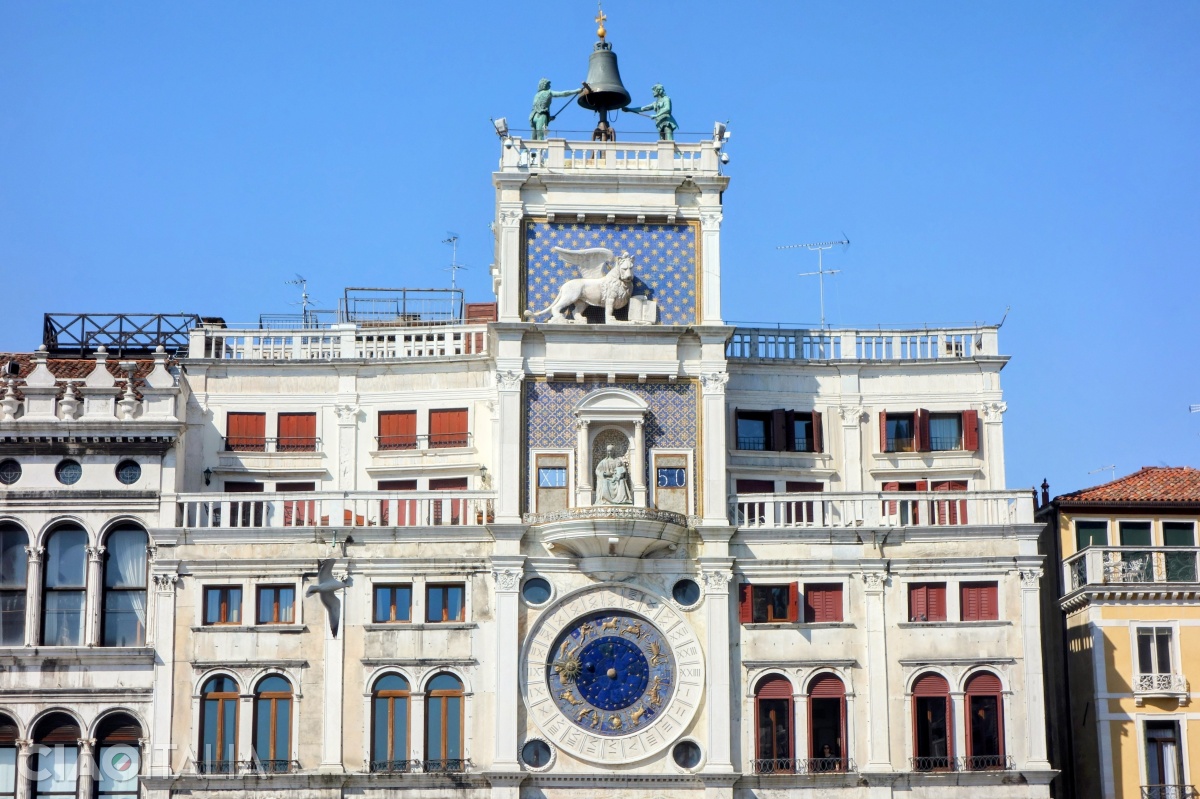
This layering can be read symbolically: in Venice, political power (the Lion) stands above religious power (the Virgin with the Child), science (the clock), and economic power (the Mercerie). Above all else reign the two Moors, as a sign of the relentless passage of time.
Before heading to the meeting point, walk a bit into Mercerie street through the arch to view the tower from the opposite side. This facade features a similar but simplified clock. The outer marble dial indicates the hours in Roman numerals, while the inner mosaic disc is blue with gold stars. Another solar disc featuring the Lion of St. Mark at the center indicates the hours.
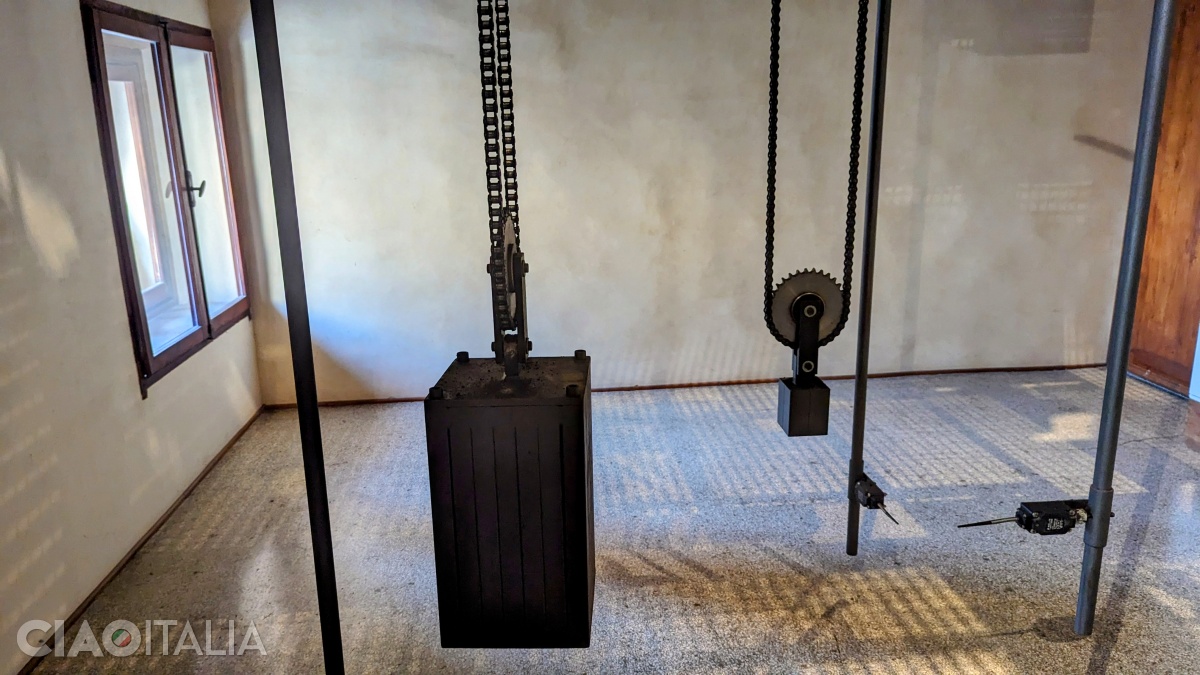
Let us return to the visit of the interior of the Clock Tower. Accompanied by the guide, you will climb a series of stone steps that lead into a room where several images are displayed to help you understand the evolution of the tower. It is also from here that you will see the pulleys, the weights, and the counterweights that rise and fall at regular intervals, activating the clock's mechanism.
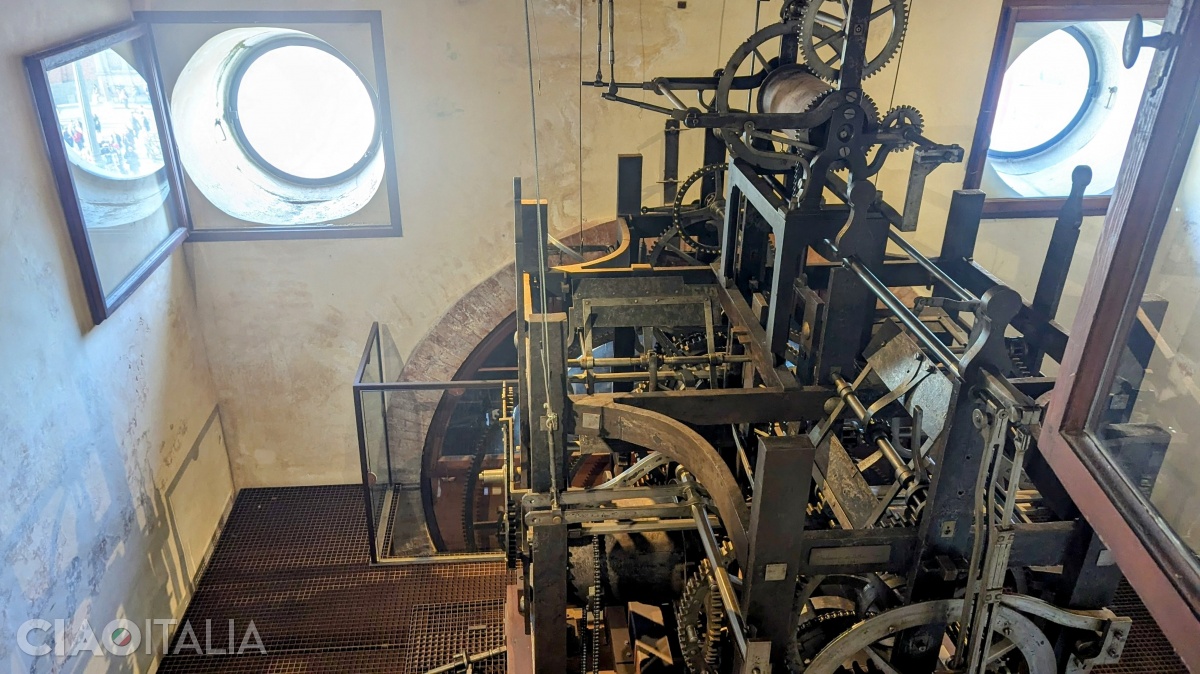
On the next level, you will see the intricate mechanism up close - a masterpiece of technology and engineering for its time.
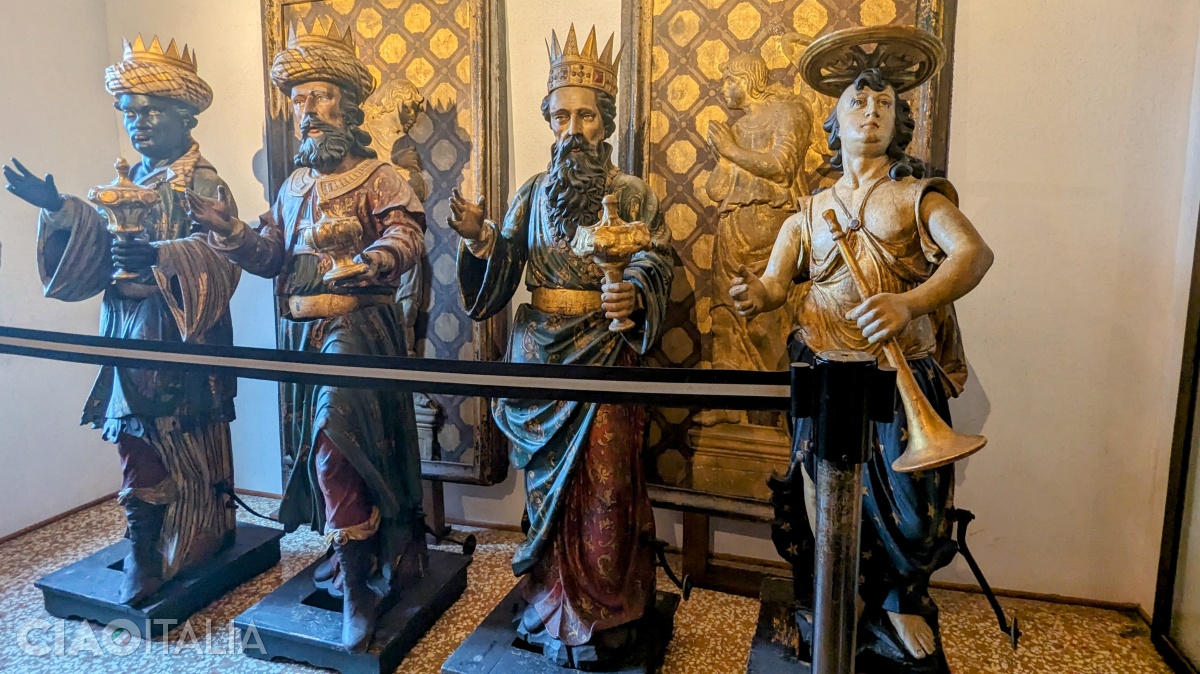
Other stairs take you to the upper floor, where the wooden statues of the three Magi and an angel with a trumpet are located, as well as the old doors. The statues you see now were remade and date from the year 1755. In the past, at the change of every hour, the clock mechanism made the four statues come out of the tower in a kind of procession. The wooden door that was located where you see today the wheel that shows the hours would open, and the three magi, led by the angel sounding the trumpet, would come out and bow before the Virgin, only to then re-enter the tower through the door located on the opposite side. Currently, this happens only twice a year: on Epiphany (January 6th) and on Ascension (40 days after Easter).
From the same level, you can admire, this time from the inside, the digital clock you saw earlier on the tower's facade, above the astronomical clock. When it was created in 1858, it was one of the first public clocks of its kind and was intended to allow people looking from the square to more easily understand what time it was. The two wheels have panels that indicate the hours with Roman numerals and the minutes (every 5 minutes) with Arabic numerals. The first wheel moves at the passage of each hour, and the second moves at the passage of each 5-minute interval.
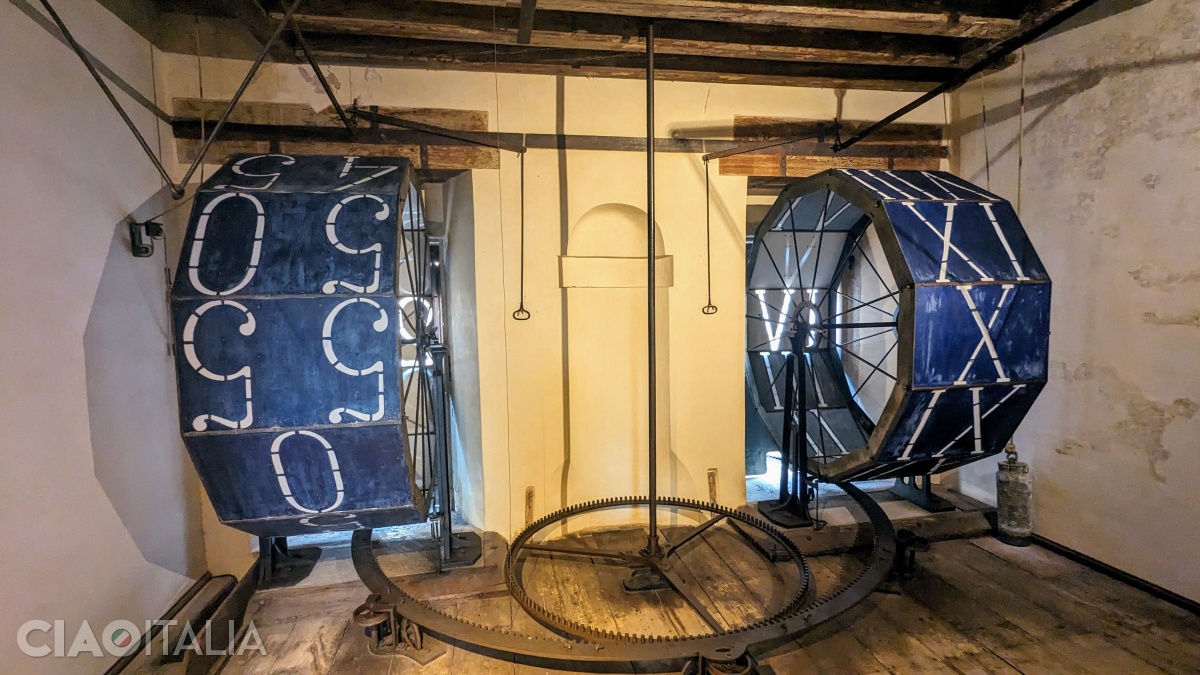
The installation of this clock, however, meant the dismantling of the mechanism that allowed the procession of the Magi Kings. Currently, on the two days of the year when this tradition is resumed, an engineer is specially called to remove the two wheels of the digital clock and to re-mount the old wooden doors and the four statues, so that the procession is possible.
After you climb a few more stairs, you will reach the roof of the Clock Tower, where you can see up close the two large bronze statues that the Venetians call i do' Mori ("the two Moors"). The nickname is due to the color of the metal which, with the passage of time, acquired a dark shade. According to another, more philosophical interpretation, the black color supposedly symbolizes the primordial chaos from before the creation of the world.
The two characters, 2.6 meters tall, are dressed in animal furs, like two shepherds. One is older (the one with the beard), representing past time, and the other is younger, as a symbol of the time to come.
At the passage of each hour, the Moors strike the bell with hammers, the number of strikes being equal to the hour they indicate. The old Moor strikes first, two minutes before the fixed hour, to indicate the time that has passed. The young Moor then strikes, two minutes after the completion of the hour, to mark the time to come.
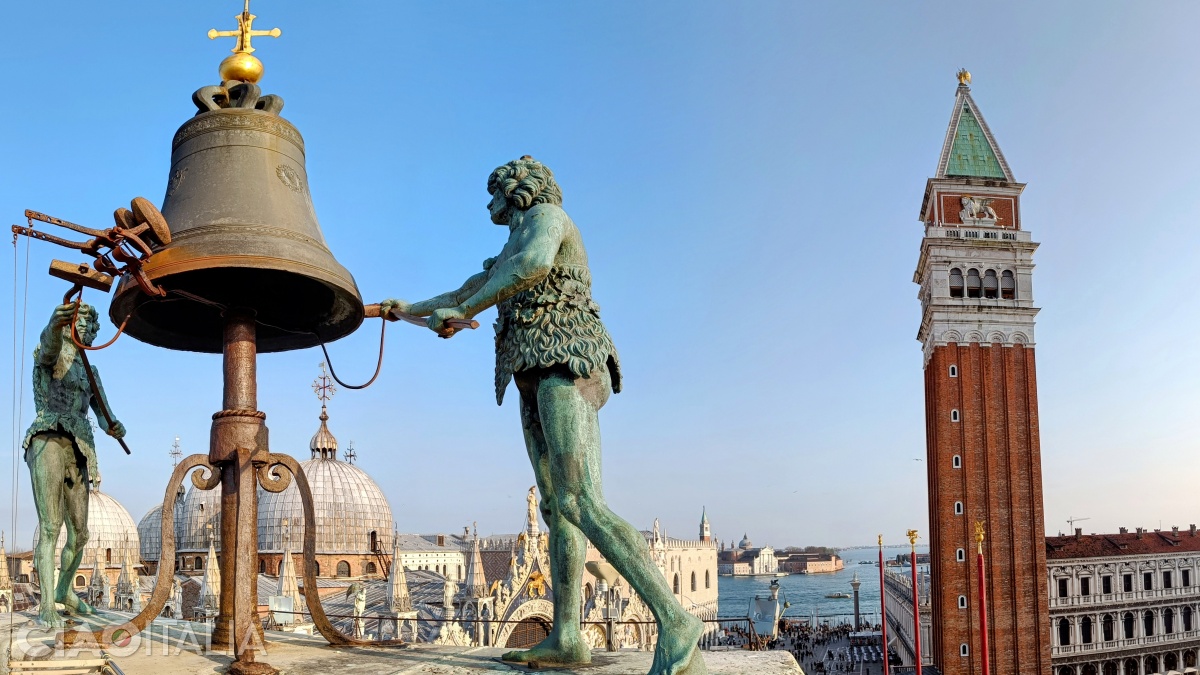
At 12 noon and 12 midnight, before the strikes of the Moors, an additional mechanism is triggered. Two smaller hammers positioned on the bell strike 132 times. The number is not accidental - it is the total number of strikes performed by the Moors during the day, up to that moment - the sum of the hours from 1 to 11, multiplied by two, as each hour is signaled by both Moors. This mechanism is activated at 11:56 AM and 11:56 PM respectively, to have time to finish before the Moors begin to strike.
Both the statues and the large bell, above which a globe and a gilded cross stand, were created in the year 1497.
After you have finished the visit to the Clock Tower, linger a bit more on Mercerie street to find out yet another piece of the history and stories of Venice. Very close, on the left side of the street as you come from the tower, above the Sotoportego del Cappello passage, you will see a bas-relief with an old woman. This commemorates an event that occurred on June 15, 1310, when a plot by some noble families took place to overthrow Doge Pietro Gradenigo. However, the information reached the Doge's ears, and his army met the members of the conspiracy in St. Mark's Square. The plotters found themselves forced to retreat and fled toward Rialto, crossing Mercerie street. There, an old woman saw them and let a large stone mortar fall from the balcony, killing precisely the one who carried the conspirators' banner. As a reward, the woman received from the Doge the promise that the rent of her home would never be increased - neither during her life nor that of her descendants.
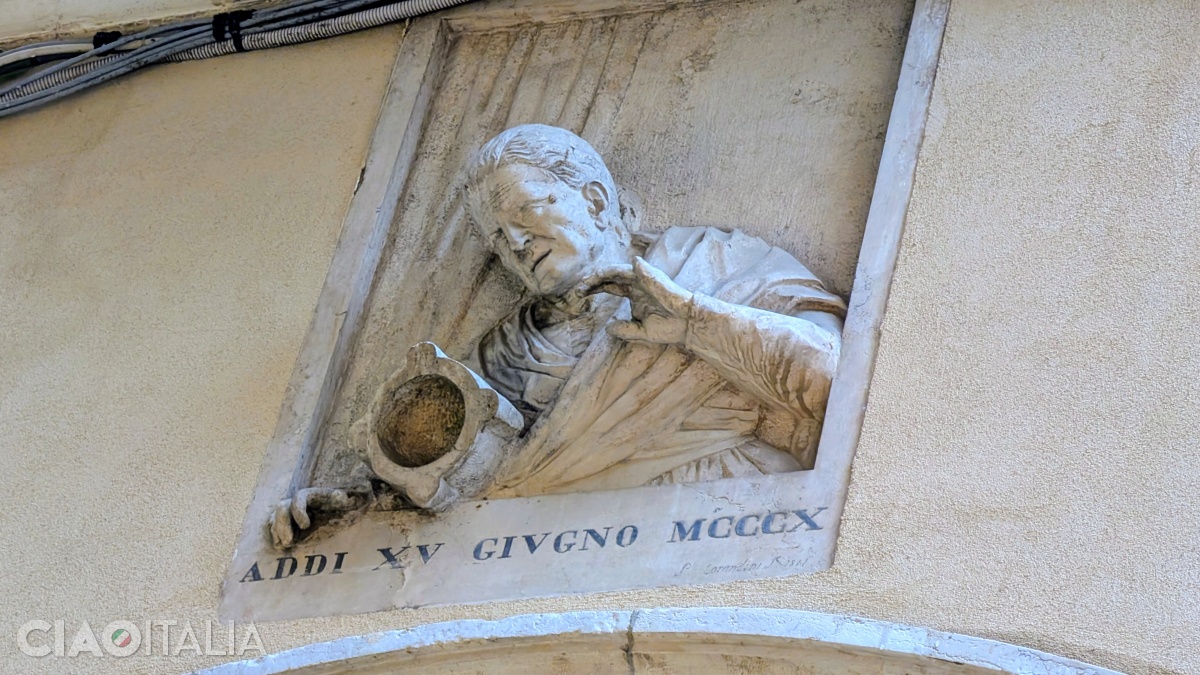
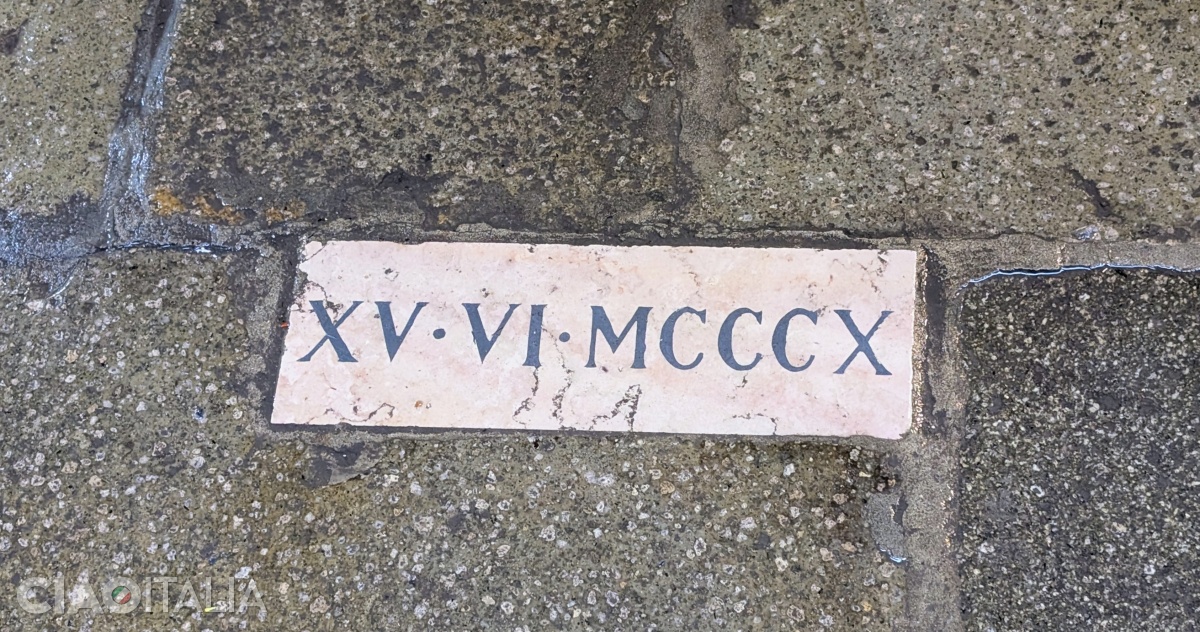
In the year 1861, the then-tenant of the house had the image of the old woman carved on the facade as she throws the mortar, along with the date of the event. The small white stone in the pavement, under the bas-relief, with the date repeated in Roman numerals, supposedly indicates the exact spot where the mortar fell.
The Tiepolo-Querini conspiracy is recorded in documents and truly happened. The plotters were defeated, sent into exile, and their houses were demolished, with columns of infamy raised in their place. For the incident with the old woman, there is no historical evidence, and it is most likely just a legend - yet another among the many stories of Venice.