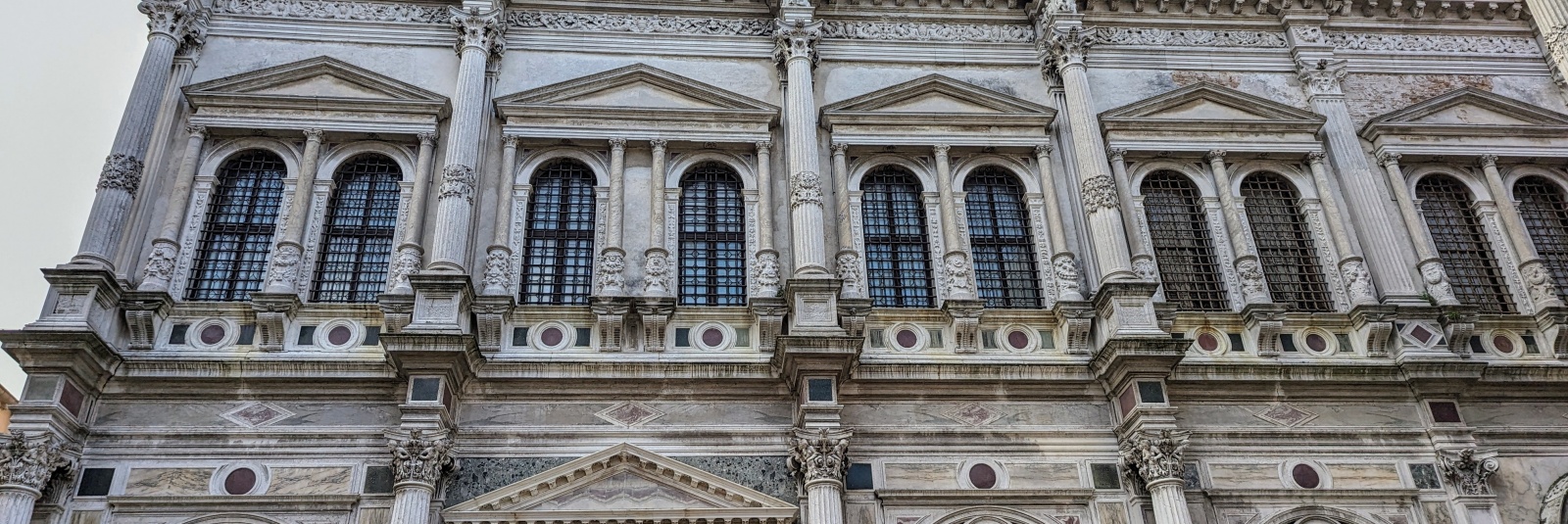
Scuola Grande di San Rocco in Venice
The Scuola Grande di San Rocco, together with the adjacent church, are important tourist attractions from Venice, standing as a remarkable testimony to the Renaissance and the art of the painter Jacopo Tintoretto.
The Scuola Grande di San Rocco is located in Campo San Rocco, within the San Polo district (sestiere), very close to the Basilica di Santa Maria dei Frari. You can get there by vaporetto (lines 1 or 2) by getting off at the San Tomà stop.
Tickets
Tickets for the Scuola Grande di San Rocco and the San Rocco Church (Chiesa di San Rocco) can only be purchased on-site.
Scuola Grande di San Rocco
The ticket price for the Scuola Grande di San Rocco is:
- Adult: €12
- Over 70: €10
- 8-18 years: €3
- Children under 8: free
The cost of an audioguide (to be used on your own mobile phone) is €5.
San Rocco Church
The admission ticket for the San Rocco Church costs:
- Adult: €3.5
- 8-26 years: €2
- Children under 8 (accompanied by at least one adult): free
Opening Hours
Scuola Grande di San Rocco
The Scuola Grande di San Rocco can be visited during the following hours:
- Monday-Sunday: 9:30 AM - 5:30 PM
- December 25: closed
- January 1: closed
The ticket office closes at 5:00 PM.
On certain days, the Scuola Grande di San Rocco may be closed due to special events. You can check for schedule changes here.
San Rocco Church
The opening hours for the San Rocco Church are:
- Monday-Saturday: 9:30 AM - 5:30 PM
- Sunday: 1:30 PM - 5:30 PM
Last entry is at 17:00.
On Christmas and New Year's Day, the church hours are 9:30 AM - 12:30 PM.
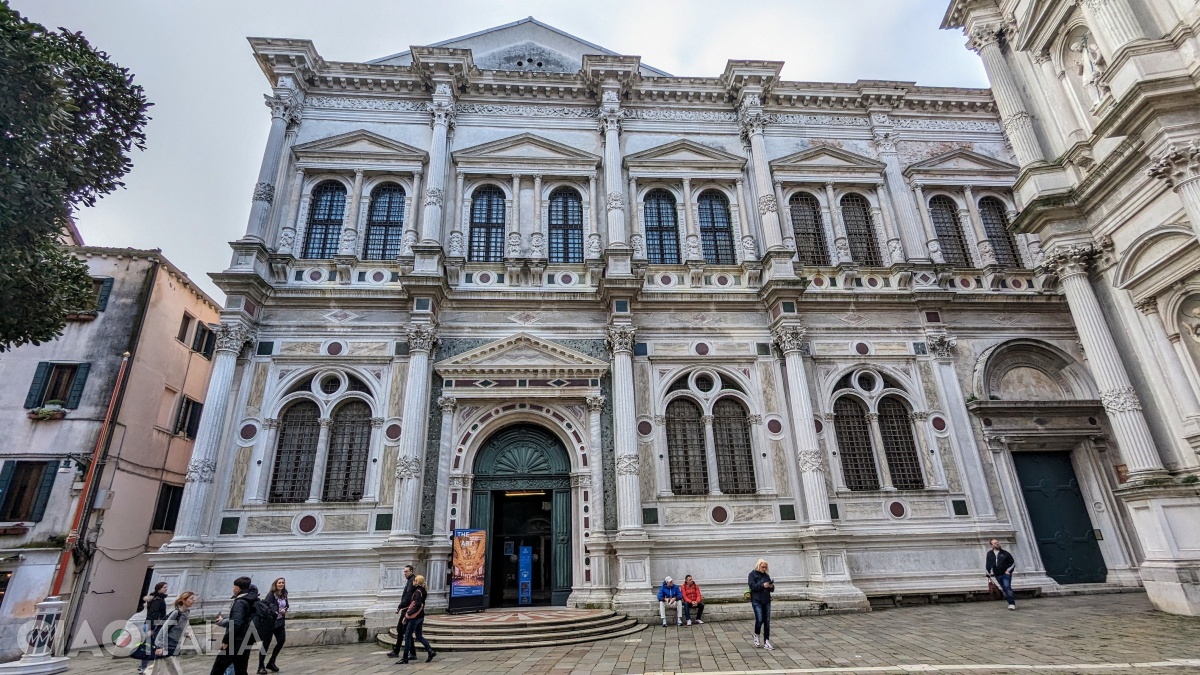
Visiting Scuola Grande di San Rocco
Scuola Grande di San Rocco translates to the "Great School of St. Roch". However, Venetian schools (scuole) were not educational institutions, but confraternities - organizations that brought together members of the bourgeoisie (craftsmen or merchants, often wealthy) and had a religious and charitable character. At the beginning of the 15th century, schools in Venice were divided into several types: those for arts and crafts, those for foreign communities, devotional schools, including the so-called Scuole dei Battuti, which practiced public self-flagellation. Gradually, the arts and crafts, devotional, and foreign community schools formed the "Small Schools" (Scuole piccole) group, while the Scuole dei Battuti formed the "Great Schools" (Scuole grandi) group, which numbered six by the end of the 16th century. Venetian schools played a very important role in the religious and charitable life of the city until the fall of the Republic in 1797. At that time, there were over 300 scuole operating in Venice.
The schools followed a set of internal regulations known as mariegola. The head of the school (the Guardian Grande) and his councilors formed the primary governing body (the Banca), which was renewed every year. Another group of members made up the Zonta, a supervisory body tasked with monitoring the activities of the Banca.
Each scuola had a patron saint to whom it was dedicated, its own church, and a building containing the Sala del Capitolo (intended for member meetings) and the Albergo (the room used for the Banca's meetings).
Founded in 1478, the Scuola Grande di San Rocco was the most important institution of its kind in Venice. Its patron, San Rocco (St. Roch), a saint of French origin, was venerated for protection against contagious diseases, especially the plague, which was widespread at the time. In 1485, the scuola brought his relics from Germany to Venice in exchange for a significant sum of money.
At the end of the 15th century, the confraternity erected the church dedicated to the saint, where his body was laid to rest. At the same time, its first independent headquarters was also constructed: the small building located to the right of the church, later known as the Scoletta ("the little school"). Today, the Scoletta houses the Leonardo da Vinci Museum.
Buy LEONARDO DA VINCI MUSEUM TICKETS
The extraordinary popularity of San Rocco among Venetians, especially in the context of frequent plague epidemics, attracted many donations, so that in the 16th century, the Scuola di San Rocco became the wealthiest in the city. It was thus decided to build a new, more imposing headquarters, commensurate with the importance the school had acquired. The building, erected starting in 1517 and known today as the Scuola Grande di San Rocco, is an elegant example of Venetian Renaissance architecture.
The school's headquarters remained undecorated until 1564, when a competition was organized for its painting. Four of Venice's most prominent painters took part, including Veronese. Tintoretto won the contract through a legendary maneuver: while the other artists presented only sketches, he arrived with a fully completed painting. He had it secretly installed in the room before the jury even arrived and, to ensure its stay, offered it as a donation. This marked the beginning of a long-lasting relationship between Tintoretto and the Scuola Grande di San Rocco. Over the next 25 years, the painter transformed the building into a true masterpiece. For a relatively modest fee, he produced approximately 60 works (you can find other major works by Tintoretto at the Gallerie dell'Accademia and the Church of Madonna dell'Orto, where he is buried). The paintings are organized into three major thematic cycles: the life of the Virgin Mary and the childhood of Jesus in the Sala Terrena, scenes from the Old Testament (on the ceiling) and the life of Jesus (on the walls) in the Sala Capitolare, and the Passion of Christ in the Sala dell'Albergo.
The Scuola Grande di San Rocco is the only one of several hundred Venetian "schools" that continues to exist today - the others were abolished by Napoleon. Currently, it counts over 300 members. Its purpose continues to be charitable, along with the preservation of the immense artistic heritage it possesses.
Sala Terrena
As soon as you enter the Scuola Grande di San Rocco, you find yourself in the large ground-floor hall (Sala Terrena), divided into three naves by two rows of columns. Chronologically, this is the last room painted by Tintoretto, who began working on it in 1582 when he was over 60 years old.
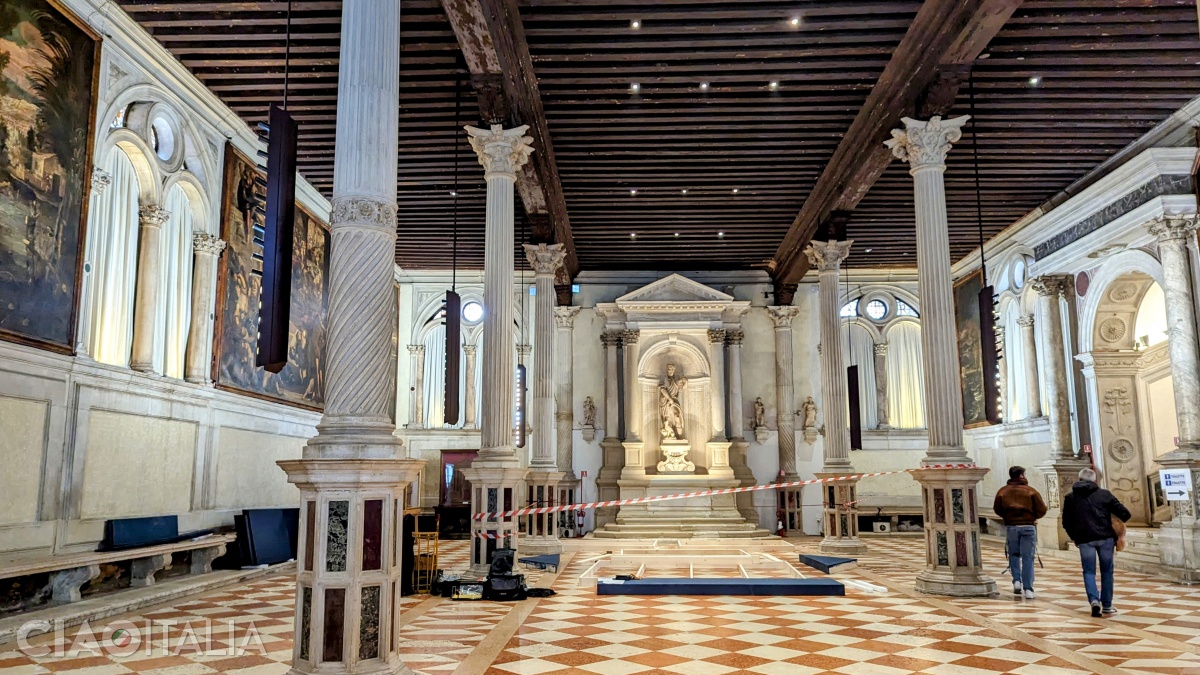
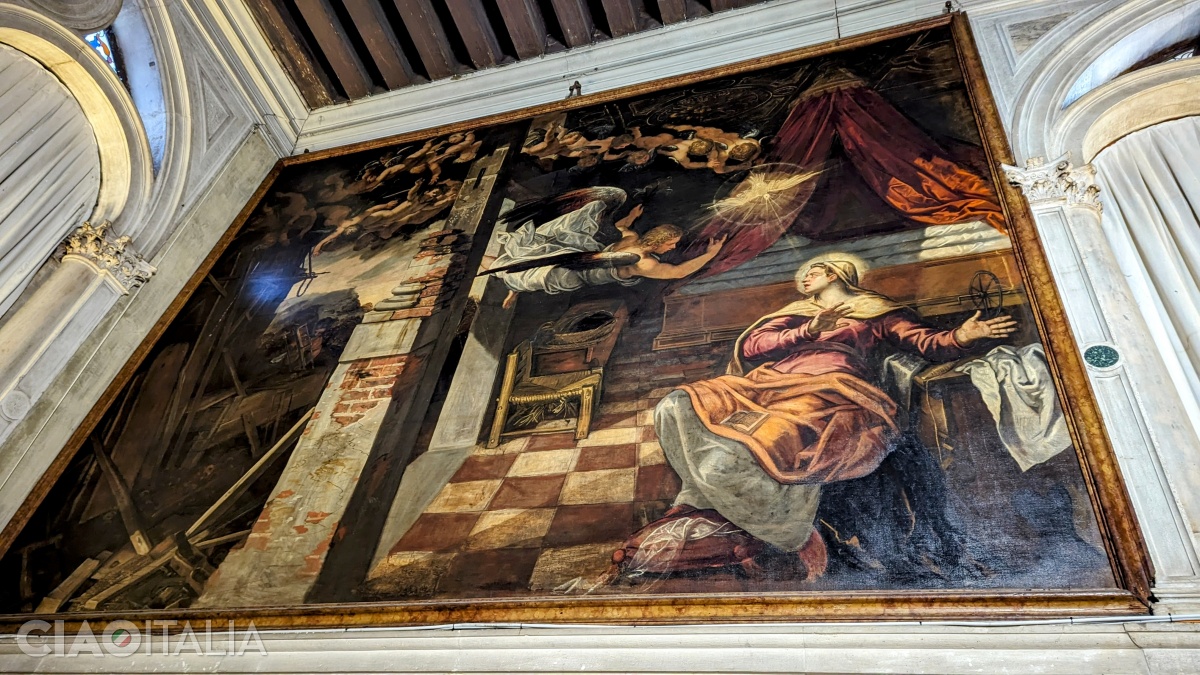
On the walls, eight large paintings (five on the left and three on the right) present scenes from the New Testament. In the "Annunciation" (the first on the left), the conventions of the time are completely ignored: the Virgin has a surprised and frightened expression, and the details show a poor dwelling with broken chairs and piles of wood.
Following on the left wall are "The Adoration of the Magi", "The Flight into Egypt", "The Massacre of the Innocents", and "St. Mary Magdalene".
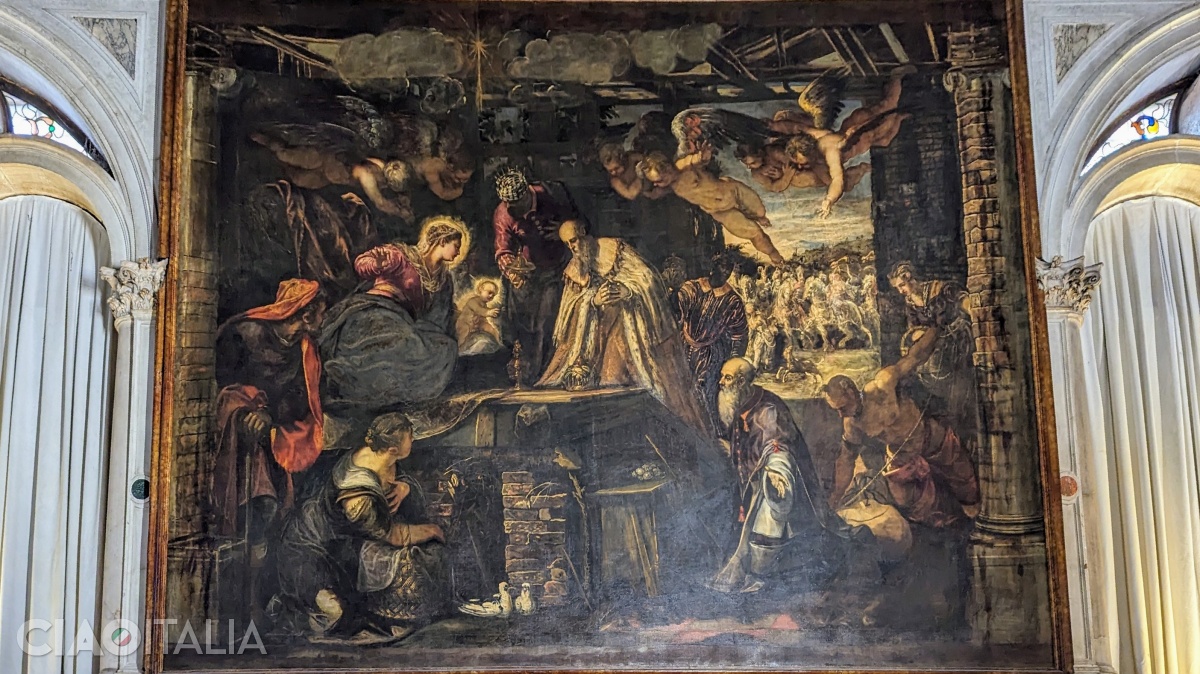
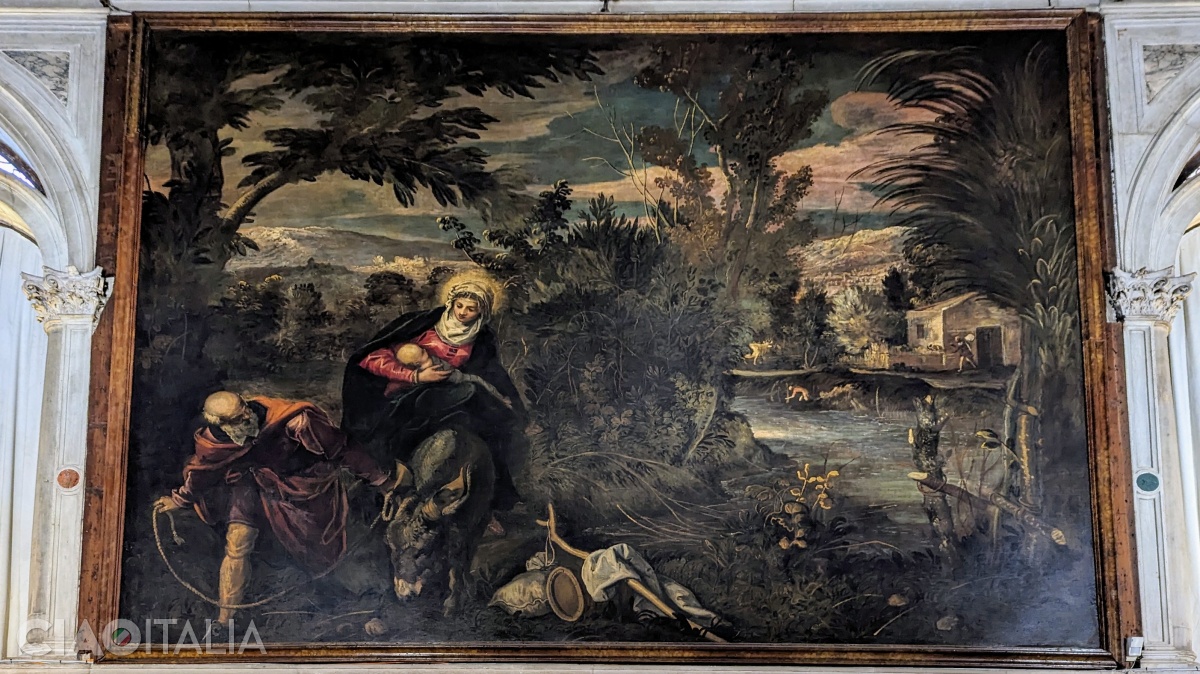
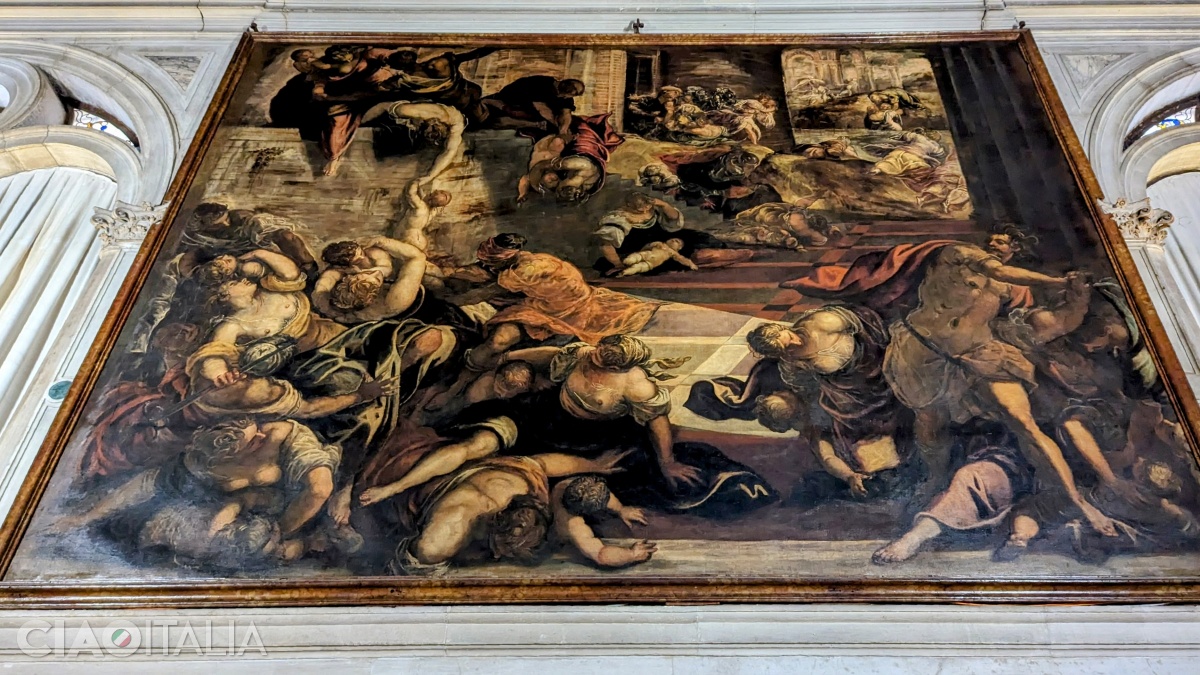
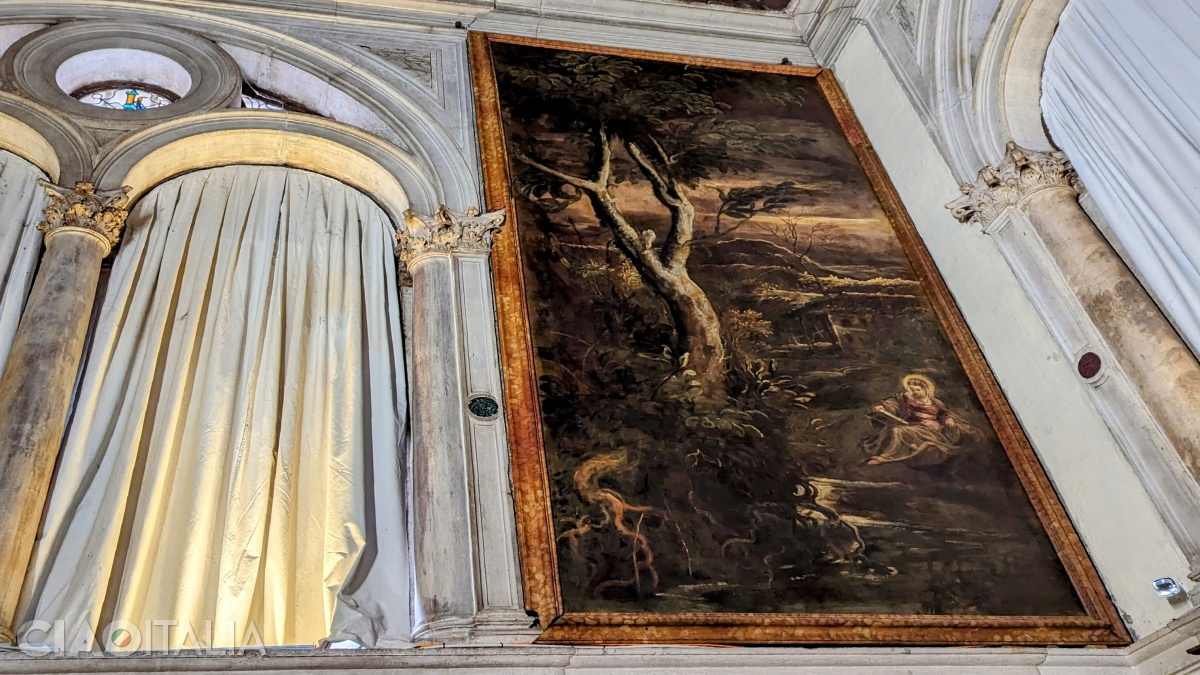
On the right wall, as you move from the entrance to the altar at the back of the hall (where religious ceremonies were occasionally held), are "The Assumption of the Virgin", "The Presentation in the Temple", and "St. Mary of Egypt".
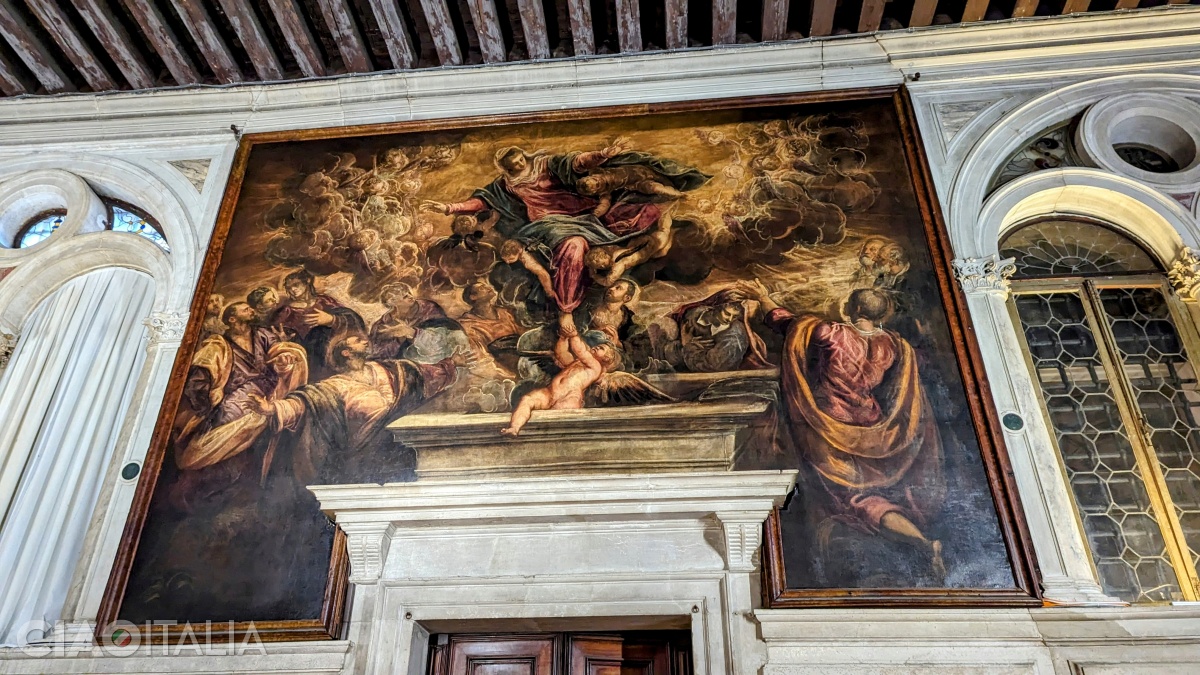
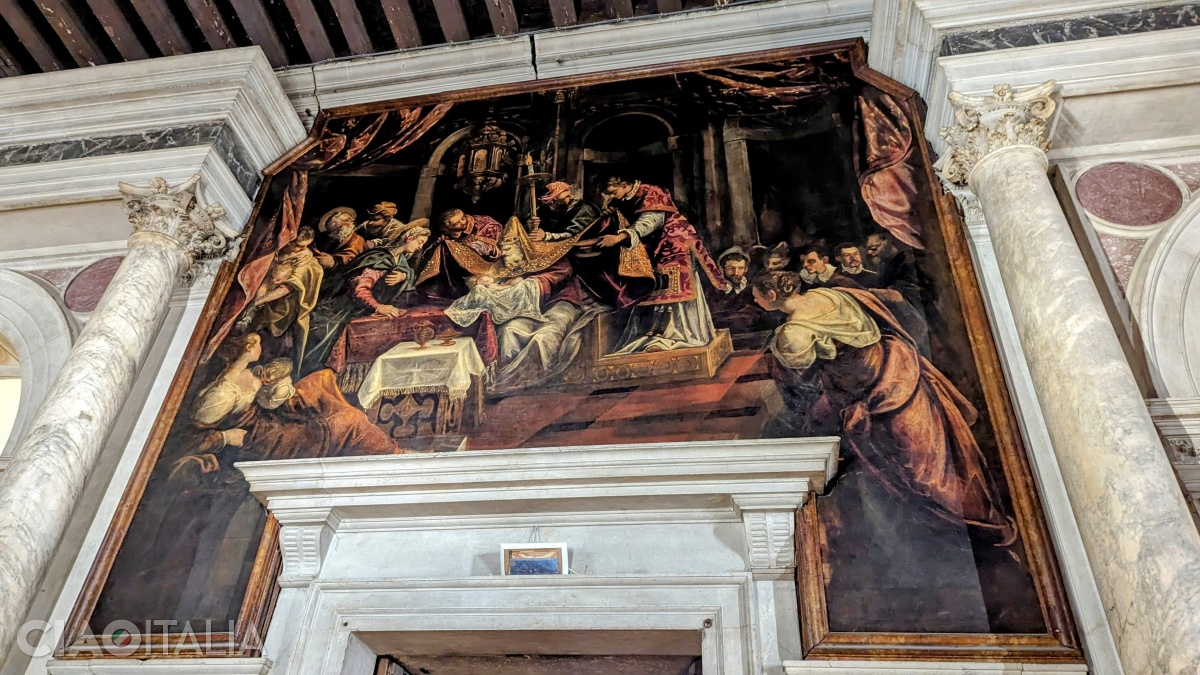
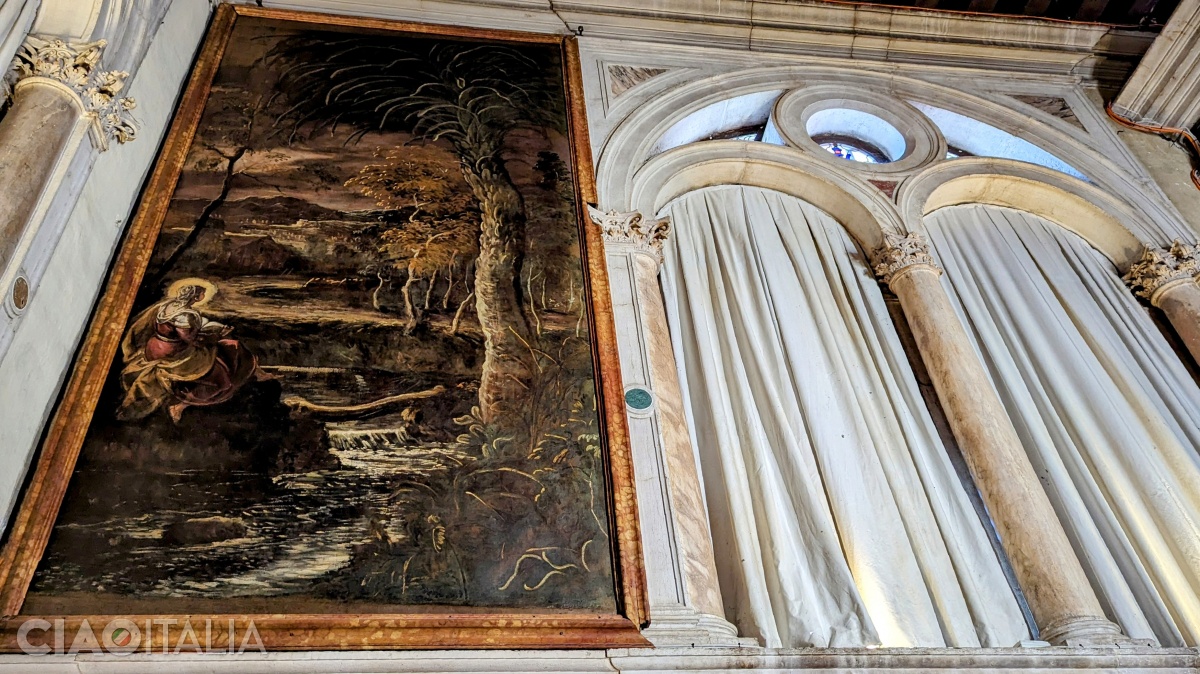
Recent research in the field shows that the paintings are not just simple iconographic representations. Certain elements, difficult to explain, indicate that Tintoretto might have been inspired by the controversial theological doctrine of Guillaume Postel, a French linguist accused of heresy by the Inquisition Tribunal of Venice in 1555. In fact, the pilgrim depicted kneeling in "The Adoration of the Magi" looks surprisingly like Postel's portrait.
Considering the same research, the paintings "St. Mary Magdalene" and "St. Mary of Egypt", located at the back of the hall toward the altar, would symbolize the coming of a second Messiah - a woman who, according to Postel, would fulfill the mission started by Jesus, the redemption of original sin. If you look closely at the two paintings, you will notice that both represent the same person - a woman dressed and styled identically, seen first from the front and then from the back.
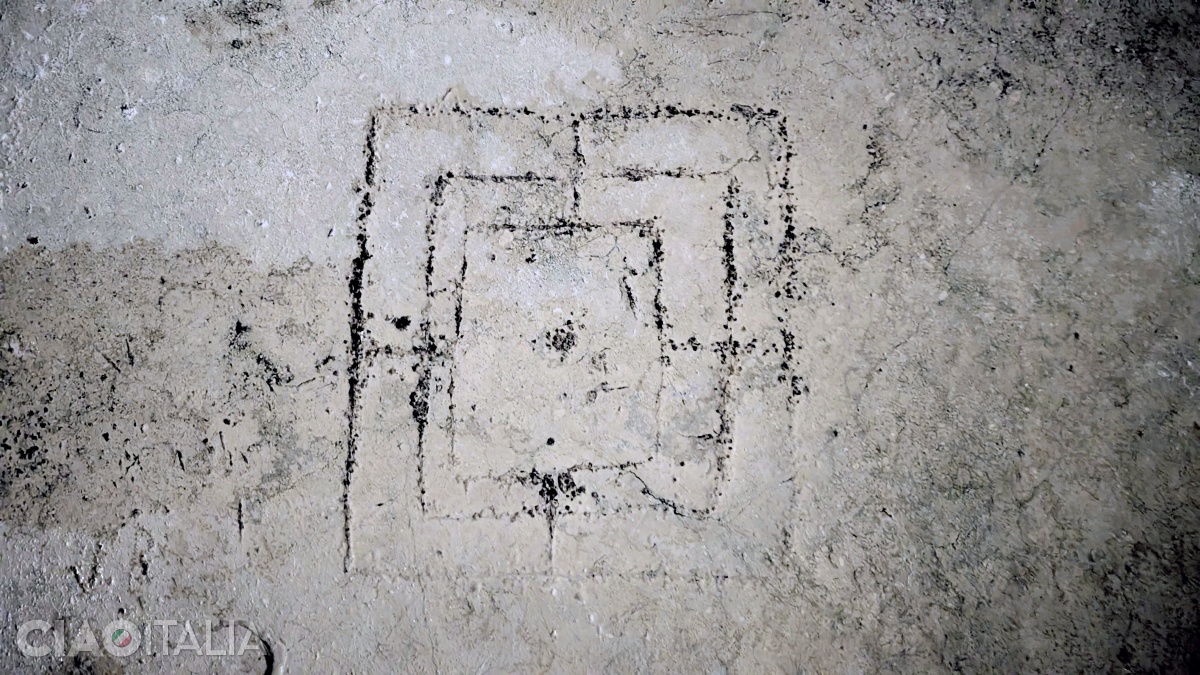
To all these interpretations, one more curiosity is added: on the stone bench to the left of the entrance to the Scuola di San Rocco, a strange design is engraved. At first glance, it appears to be a board for the game "Nine Men's Morris". However, some interpretations link it to an esoteric symbol representing the three stages of the path toward initiation, passing through three distinct worlds - physical, spiritual, and divine. The same symbol has been found on another wall in Venice (it is far too small to have ever been used as a game board), as well as on the first floor of the Fondaco dei Tedeschi. Interestingly, it also appears in various other locations across Europe and Asia.
Scalone
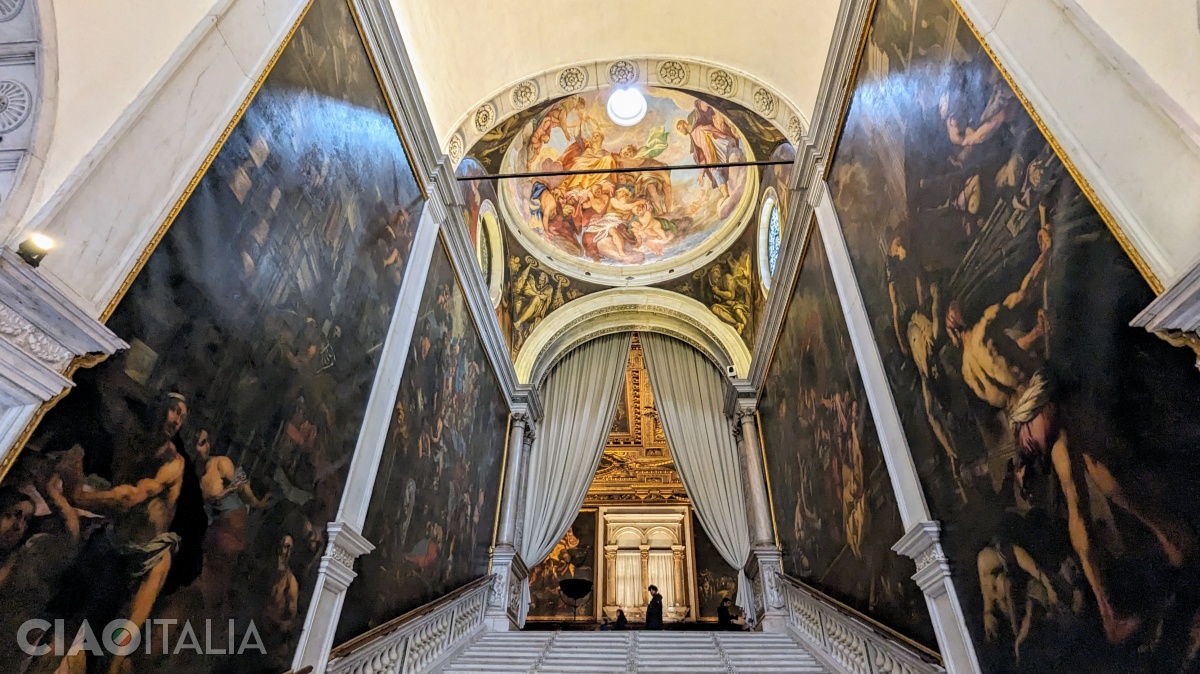
The monumental staircase leading to the upper floor is called the Scalone and is also adorned with works of art.
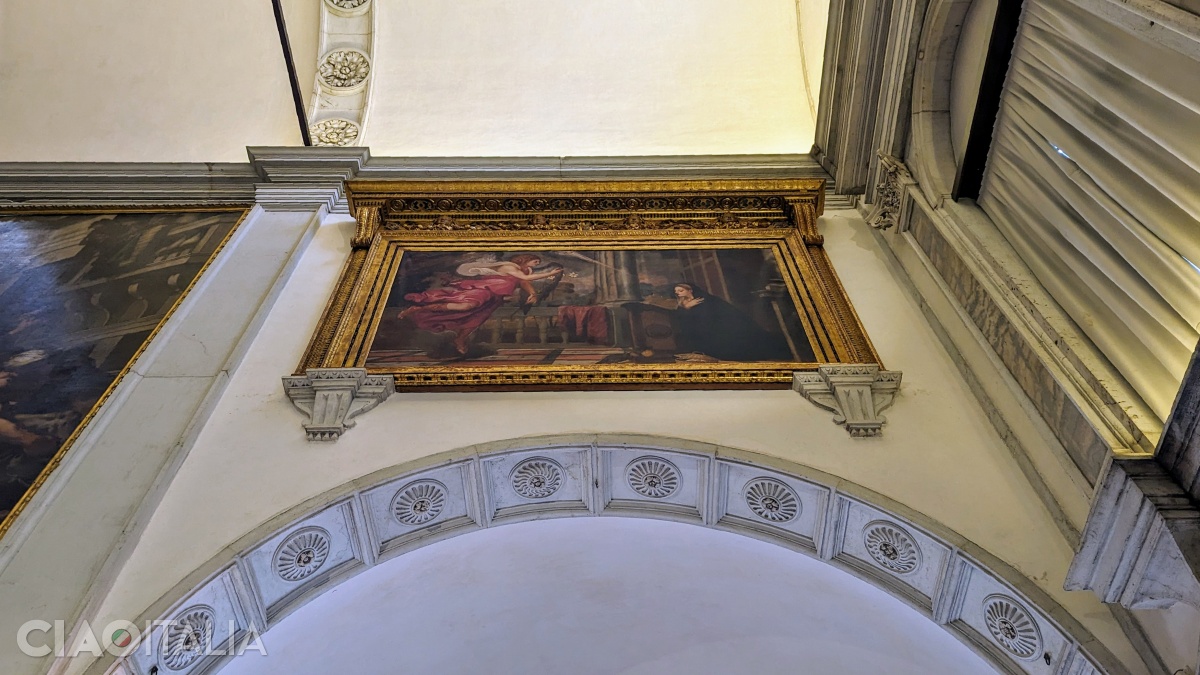
At the intermediate level, above the right arch, is Titian's "Annunciation".
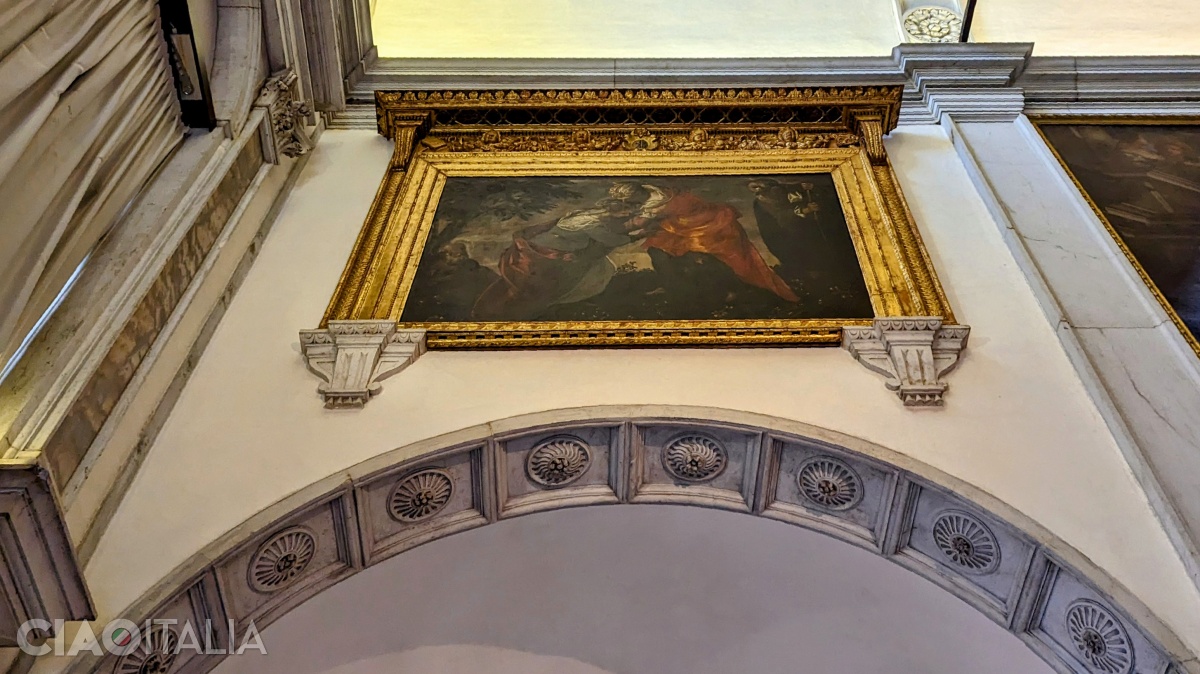
Opposite, above the left arch, is the "Visitation", painted by Tintoretto.
Between the windows is a marble commemorative plaque with gold letters, recalling the terrible plague epidemic that struck Venice in 1576. The large paintings bordering the stairs, created by Antonio Zanchi and Pietro Negri, have the same subject but refer to the 1630 epidemic, after which the Senate of the Republic decided to build the Basilica di Santa Maria della Salute (which you can see under construction in Negri's painting - the one on the left of the stairs).
Sala Capitolare
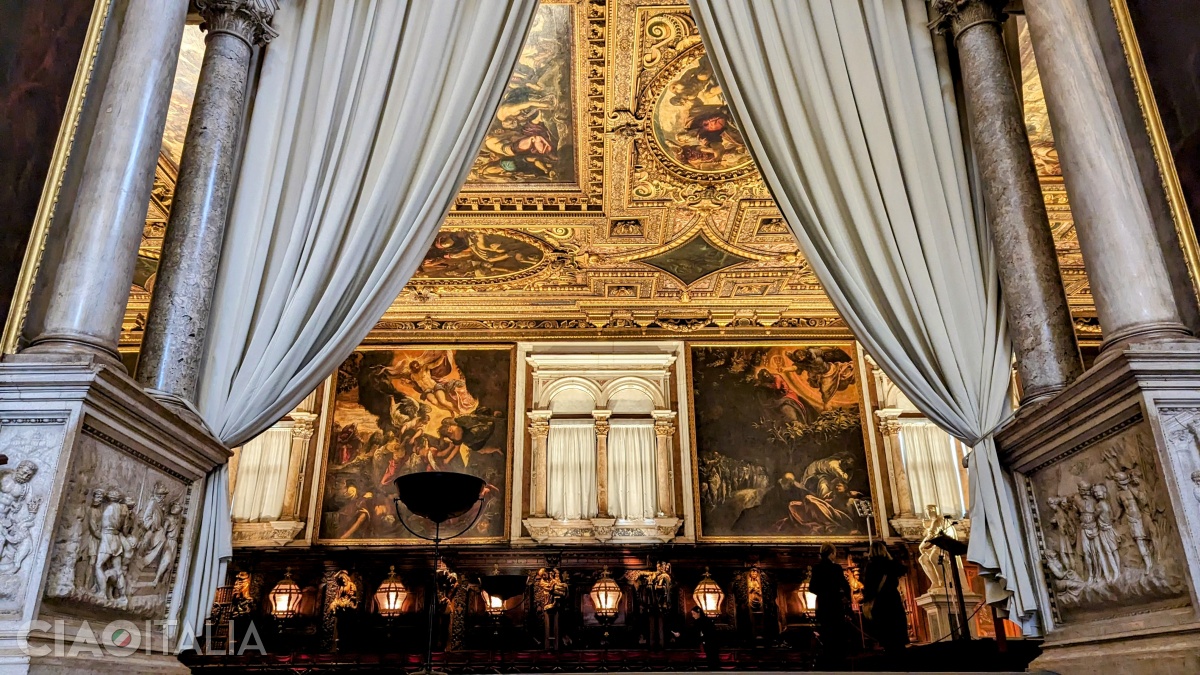
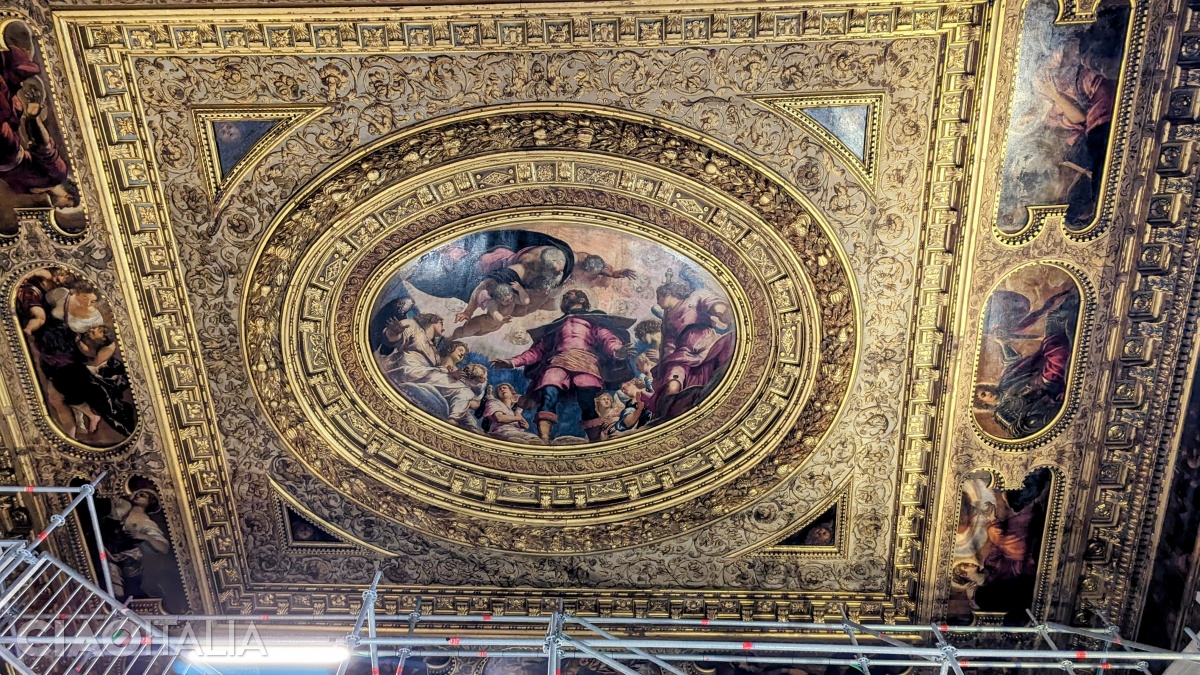
On the upper floor is the Sala Capitolare, another grandiose hall where the association's member meetings were held. Tintoretto worked on decorating this hall for 6 years, between 1575 and 1581, creating 33 canvases.
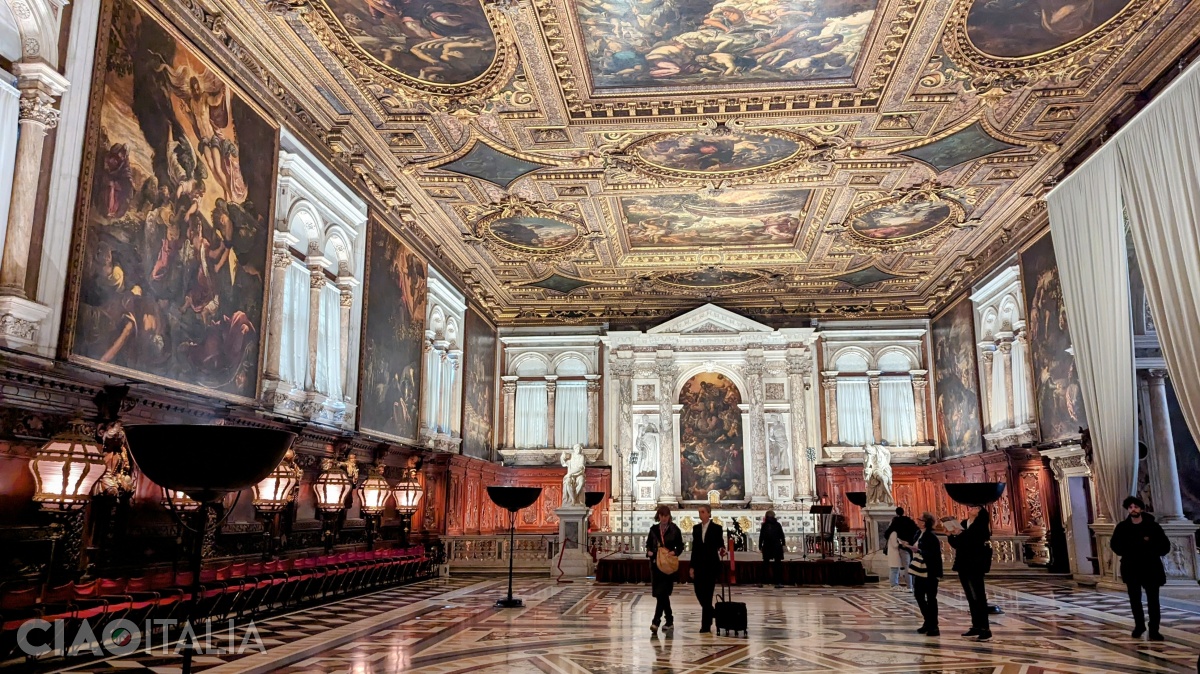
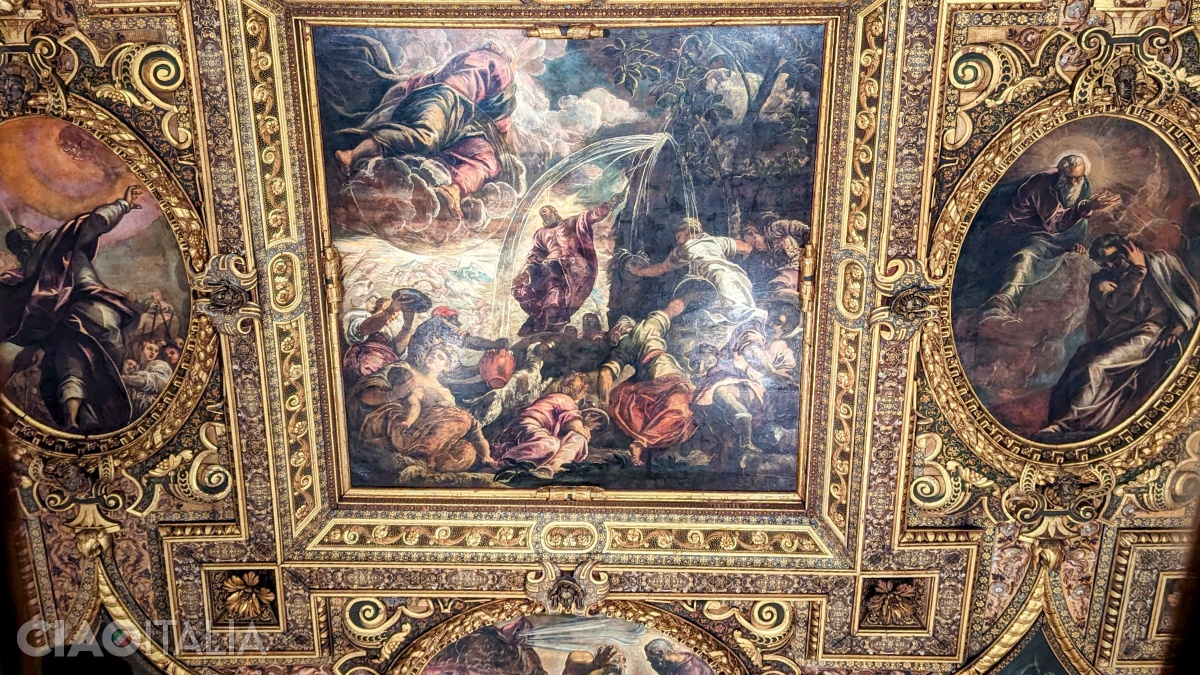
The three large paintings on the ceiling present essential moments from the exodus of the Jewish people. The central panel was the first completed and represents "The Brazen Serpent". To the left is "Moses Striking Water from the Rock", and to the right is "The Gathering of Manna". Around them, ten oval panels present other scenes from the Old Testament. The eight diamond-shaped panels, also executed by Tintoretto in chiaroscuro tempera, were replaced in 1778 with oil copies.
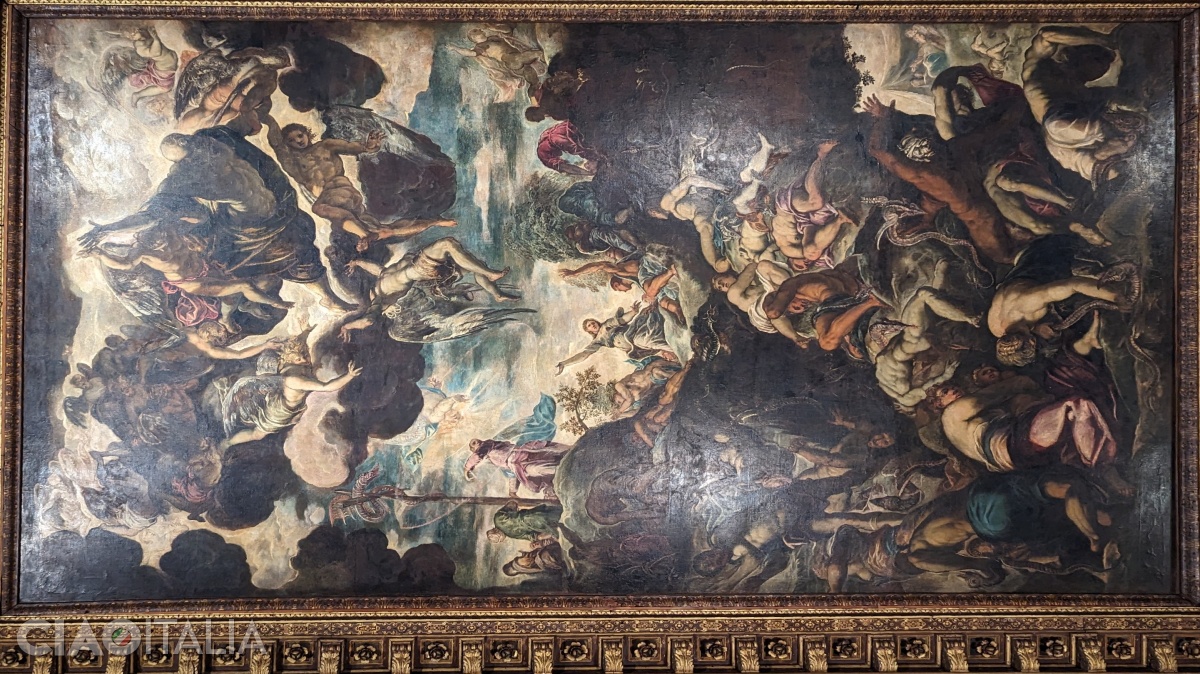
Along each long side of the hall, between the windows, are five large paintings illustrating episodes from the New Testament.
On the wall facing the entrance are:
- "Adoration of the Shepherds"
- "The Baptism of Christ"
- "The Resurrection of Christ"
- "The Agony in the Garden"
- "The Last Supper"
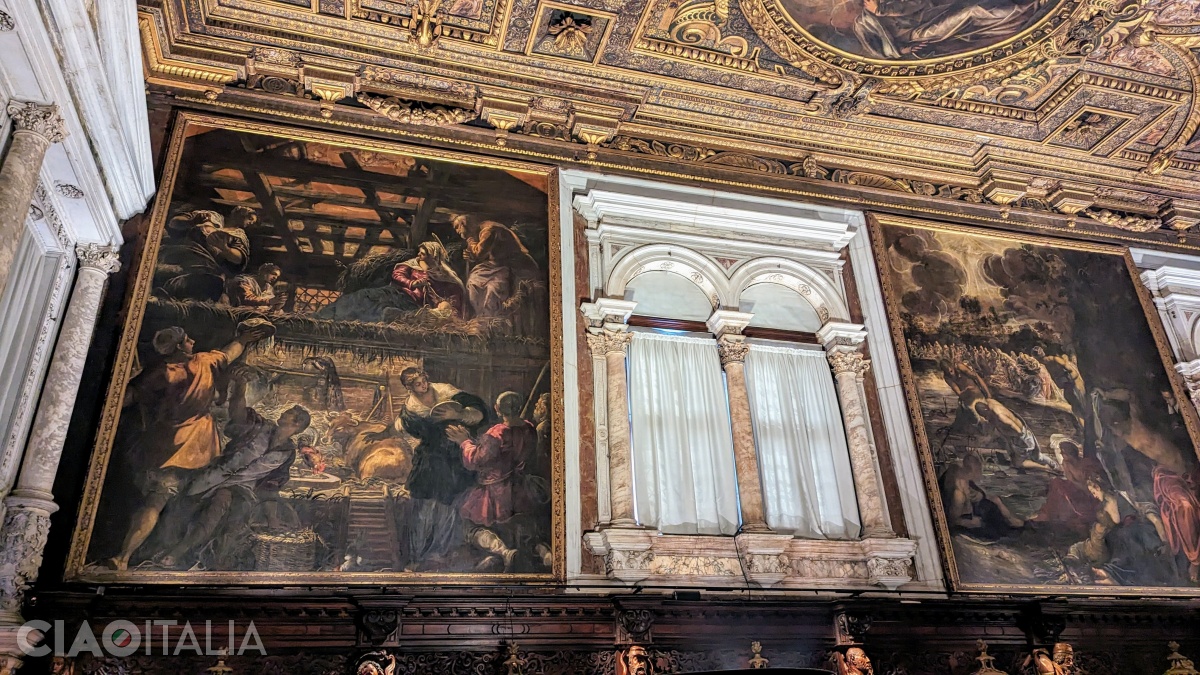
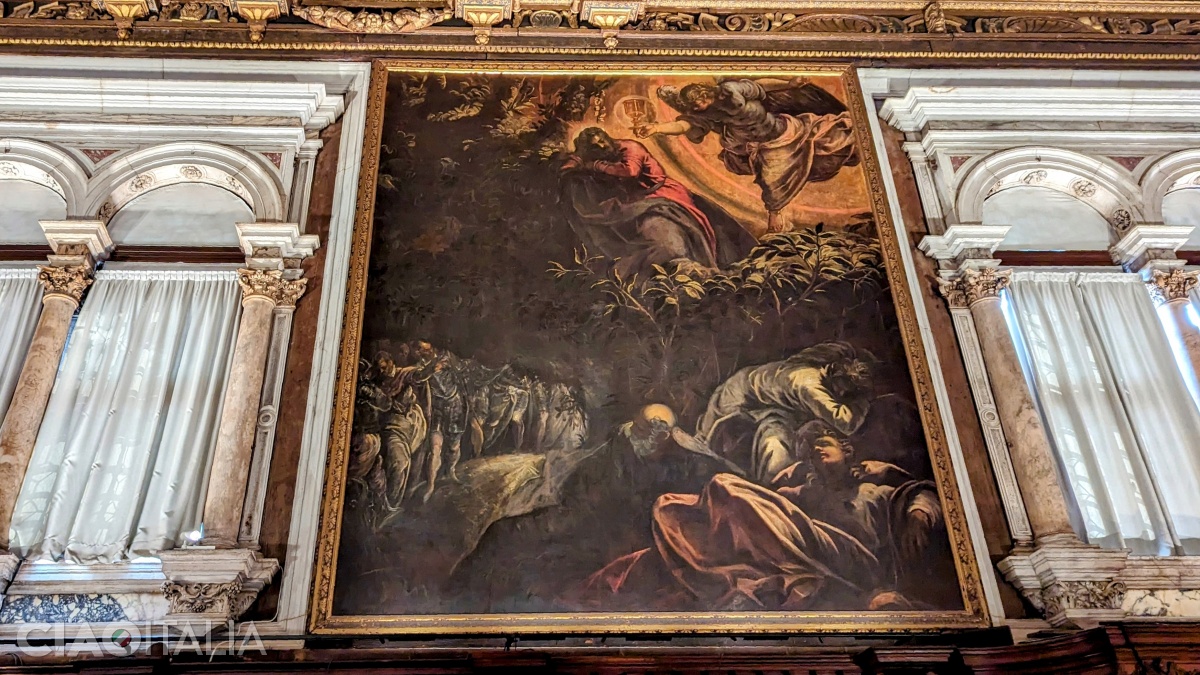
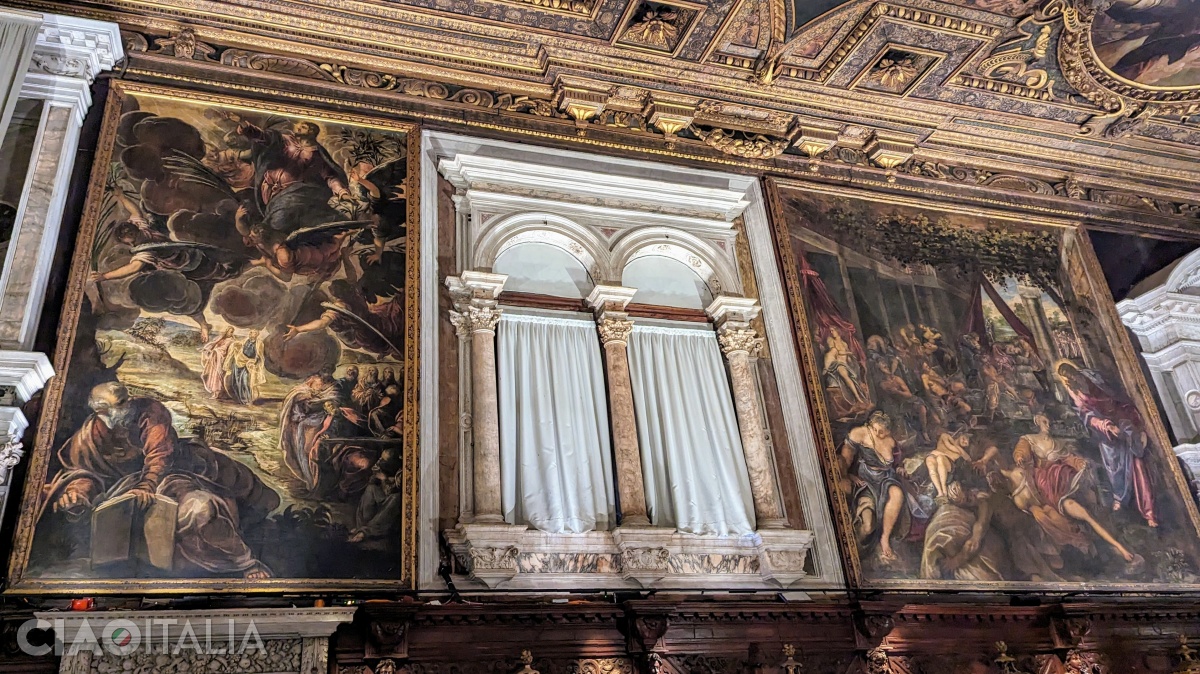
On the wall where the entrance to the hall is located:
- "The Multiplication of the Loaves and Fishes"
- "The Raising of Lazarus"
- "The Ascension"
- "The Healing of the Paralytic"
- "The Temptation of Christ"
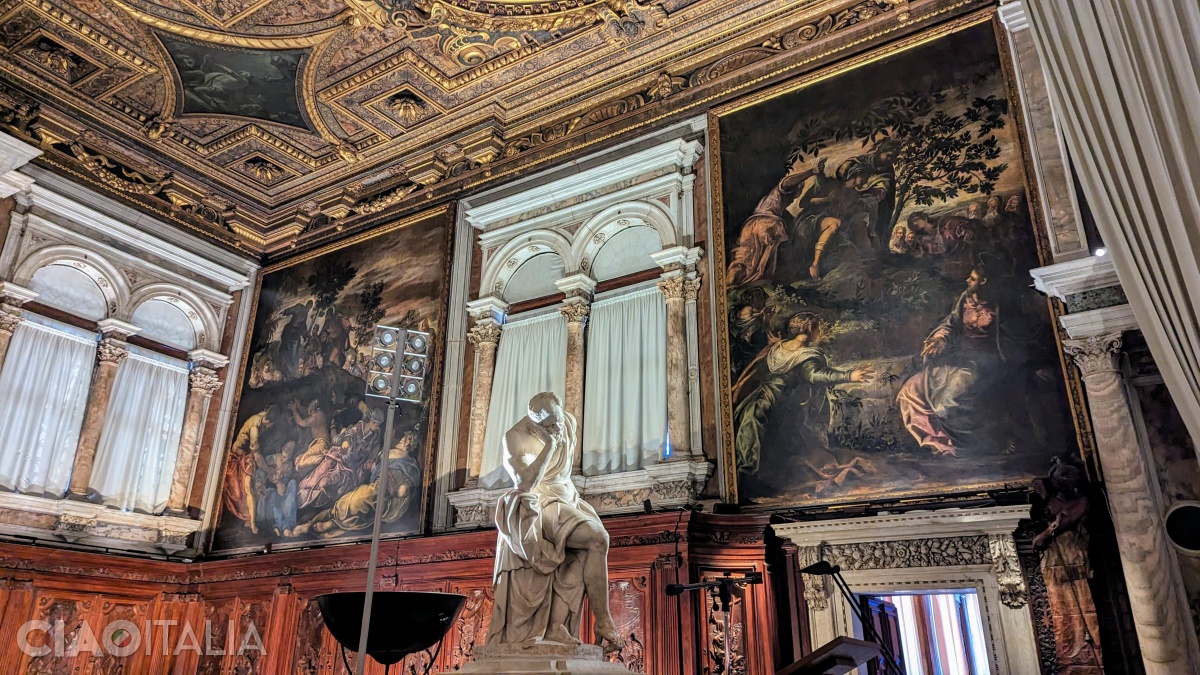
On the wall to the left of the entrance, the statue of Hercules is flanked by canvases representing Saints Roch and Sebastian, who were invoked against the plague.
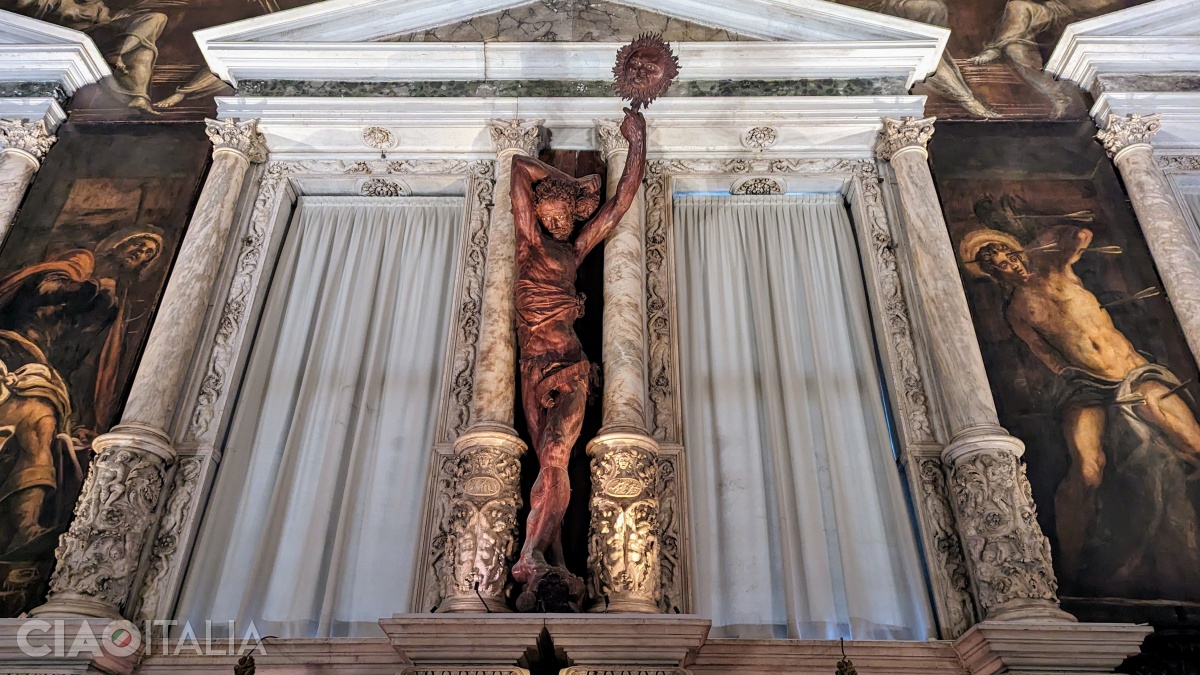
On the wall to the right of the entrance, the altar panel is titled "The Apparition of St. Roch" and was the last painted, in 1588, with the help of Domenico, the artist's son.
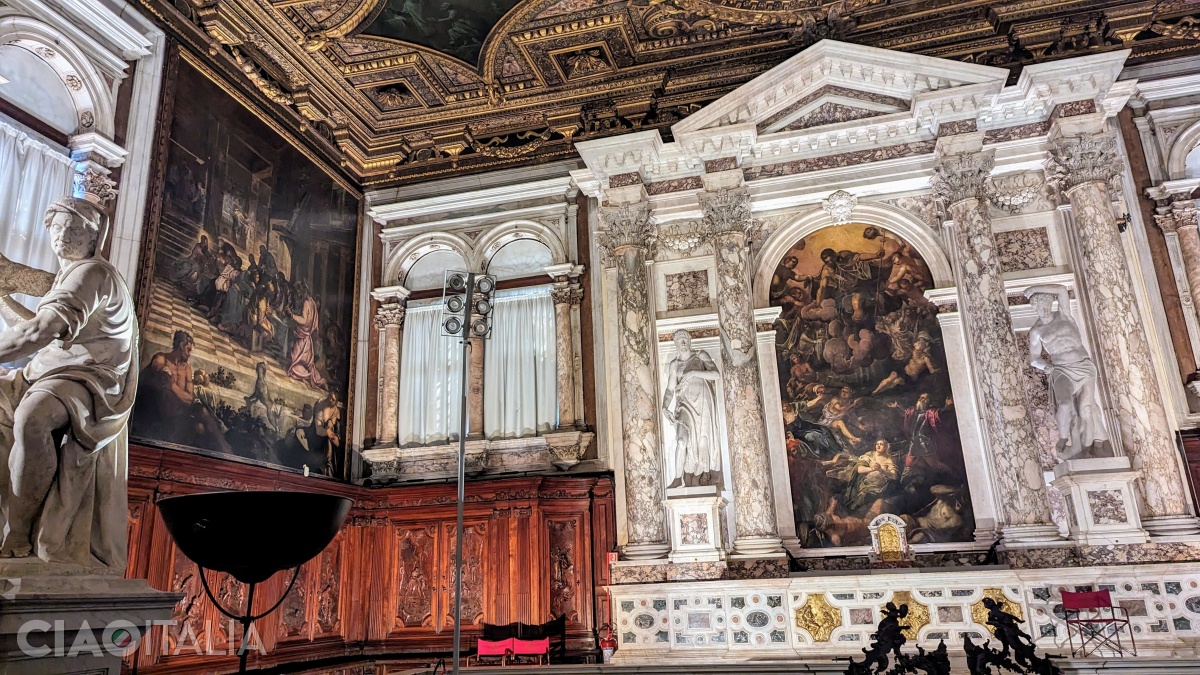
After admiring Tintoretto's canvases, look down at the lower part of the hall. The allegorical walnut wood sculptures, separated by decorative inlaid panels, were created by Francesco Pianta between 1657 and 1676 and mostly represent virtues and vices. The sculptural cycle begins immediately to the right of the entrance with the statue of Mercury but continues from the left of the opposite wall with "Melancholy" and "Honor".
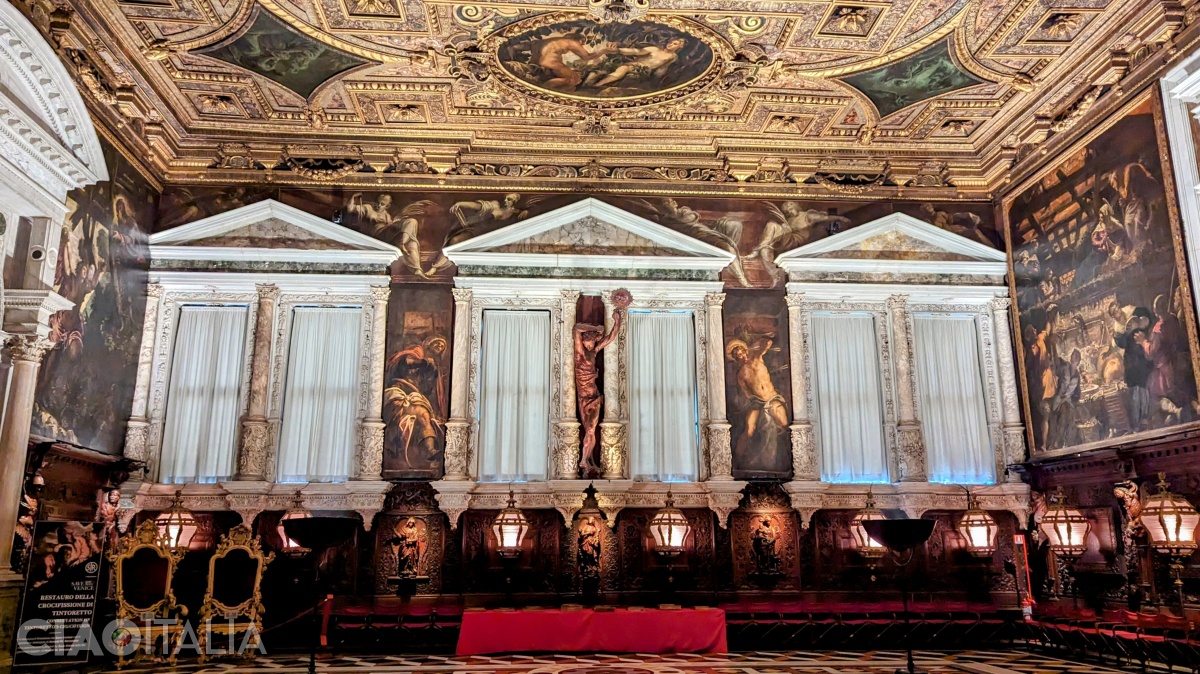
On the right side of the hall, toward the altar, the doors of the cabinets where the school's books and documents were kept are decorated with 24 wooden bas-reliefs by Giovanni Marchiori (1741-1743). Among the episodes from the life of Saint Roch are representations of "Faith" (under the window on the right side of the altar, after the statue of Mercury), "Hope" and "Charity" (under the windows on either side of the altar), and "Religion" (under the last window on the left side of the altar).
Sala dell'Albergo
Next is the small Sala dell'Albergo, also called the Albergaria, where the school's governing council meetings took place. Being the most important, this was the first room painted. In the center of the gilded ceiling is the painting "St. Roch in Glory", for which Tintoretto received the contract to paint the headquarters. Around it are allegorical figures, which the artist also painted free of charge.
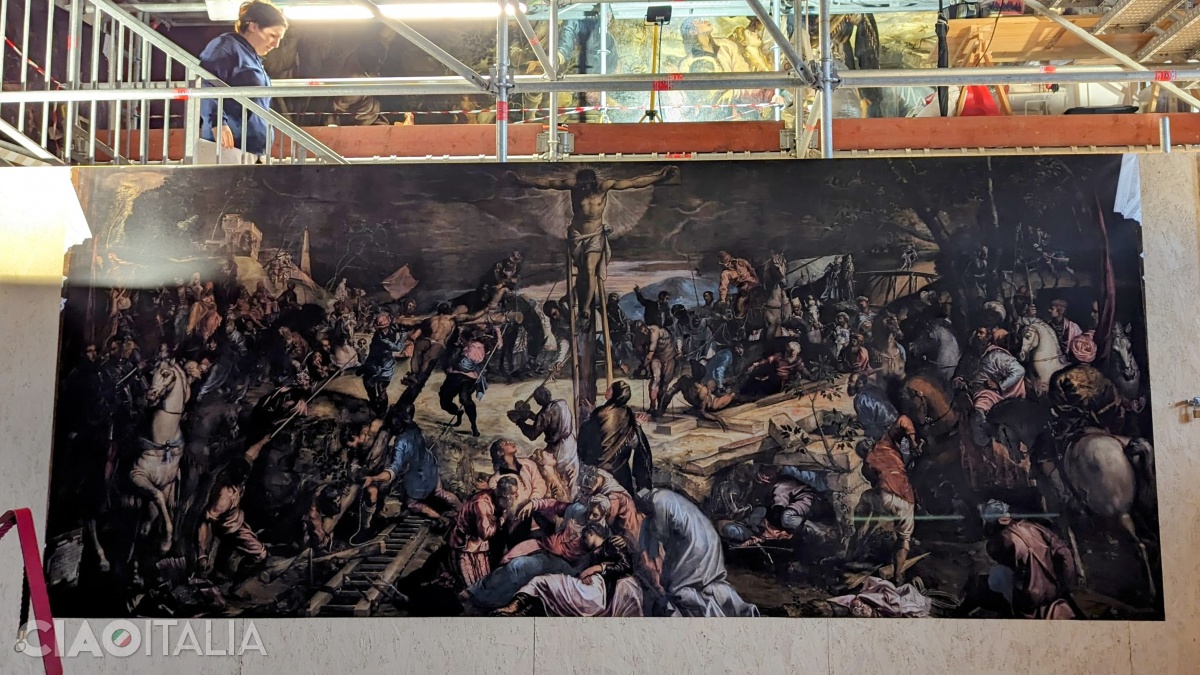
The room is dominated by the famous "Crucifixion", an immense painting created in 1565 (by which time Tintoretto had also become a member of the Scuola Grande di San Rocco) and considered one of the most beautiful on this theme.
On the opposite wall, scenes from the "Passion of Christ" are represented: on the right "Christ before Pilate", in the center (above the portal) "Ecce Homo", and on the left "The Ascent to Calvary".
Scala del Tesoro
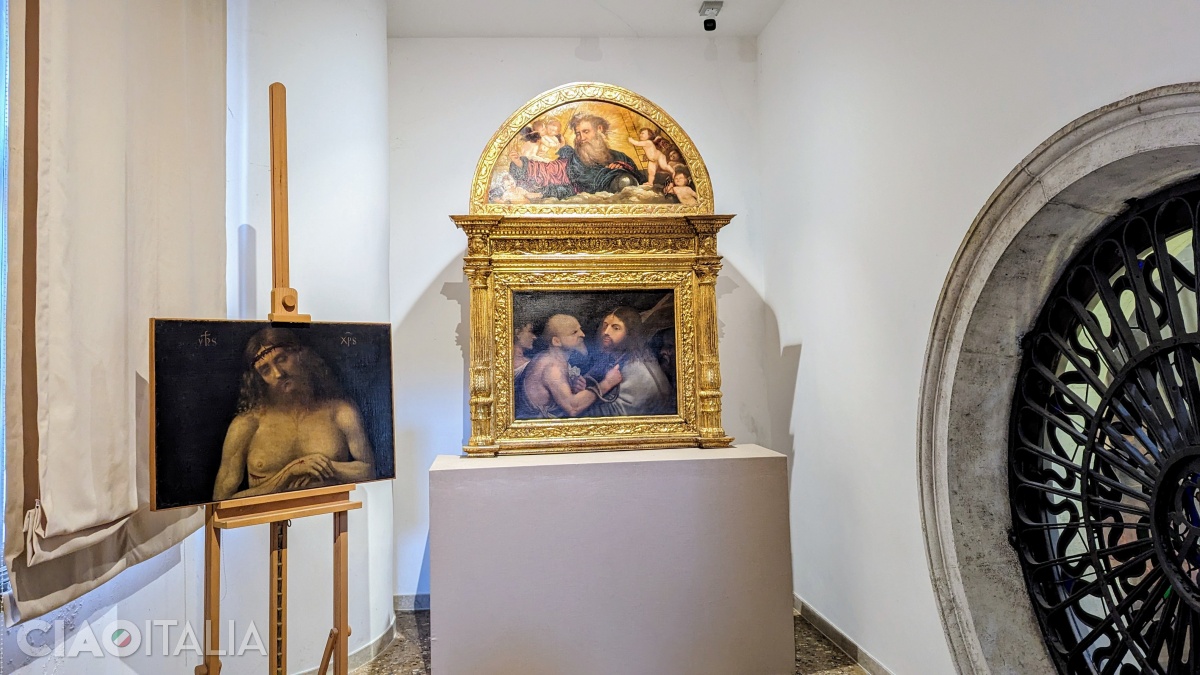
From the Sala Capitolare, another staircase, called the Scala del Tesoro ("Treasury Staircase"), climbs toward the Sala del Tesoro ("Treasury Room"). About halfway up, a small room called the Cereria opens. It houses one of the most important works owned by the Scuola Grande di San Rocco: "Christ Carrying the Cross" by Giorgione. The painting was once in the San Rocco Church and was considered miraculous, attracting numerous donations that helped build the school's new building.
Above it, in the lunette, is "The Eternal Father with Angels", attributed to Titian, and to the left is the work "The Dead Christ" by Vittore Belliniano.
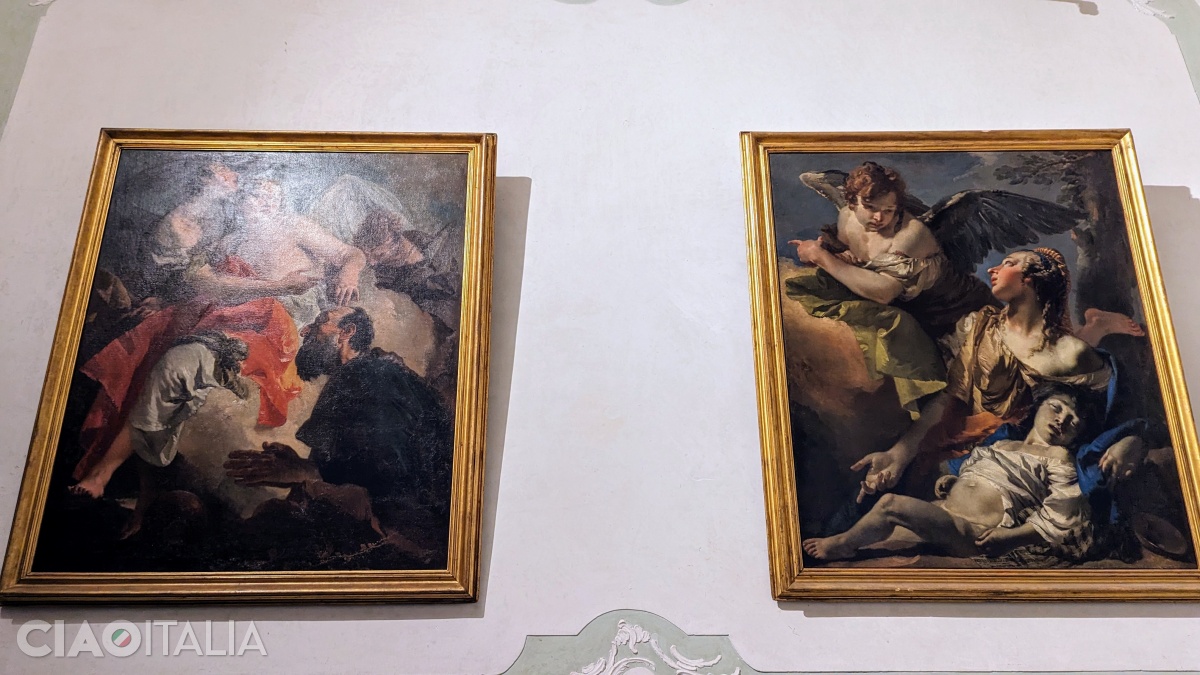
Continuing up, you will see two paintings by Giambattista Tiepolo on the left wall of the stairs: "Abraham and the Angels" and "Hagar and Ishmael".
Sala del Tesoro
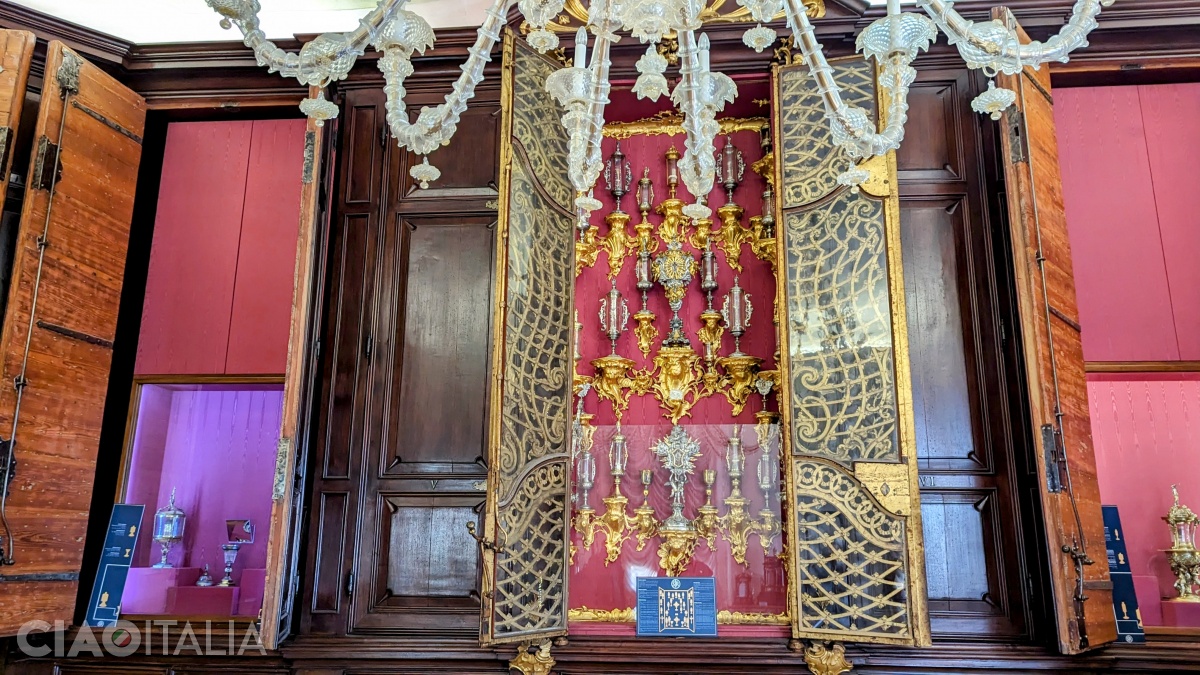
The Treasury Room contains large 18th-century cabinets where the association's riches were kept. Upon the fall of the Republic, the Scuola Grande di San Rocco lost much of this wealth, but some precious cult objects have been preserved.
The San Rocco Church
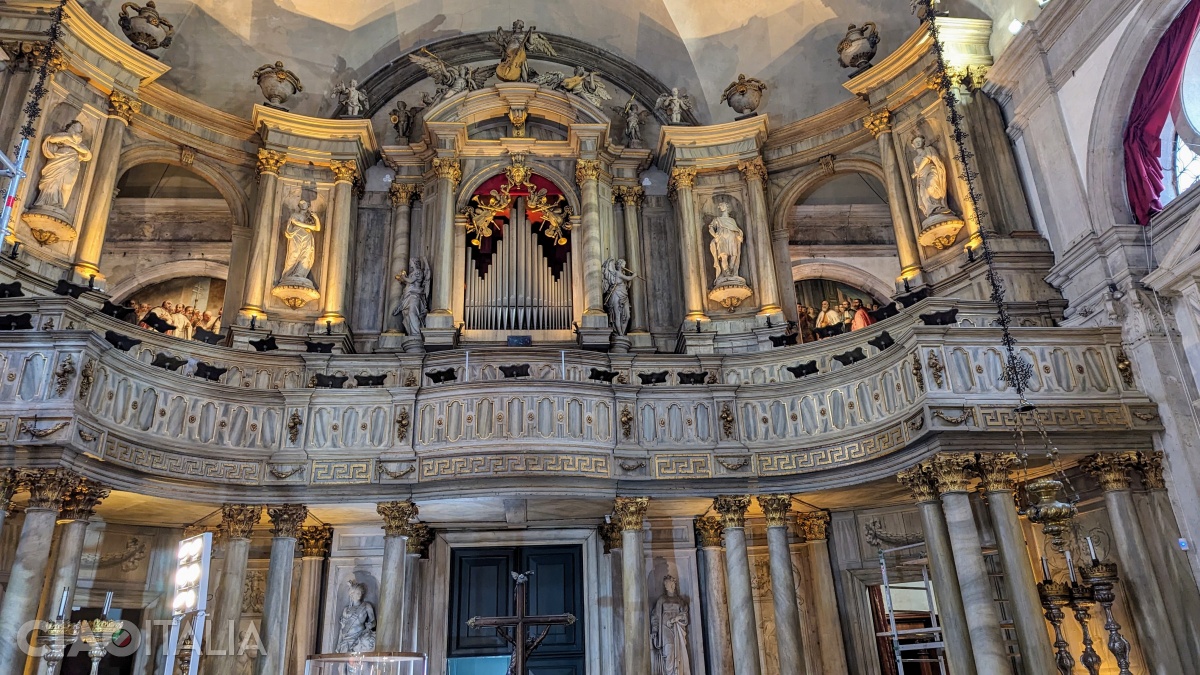
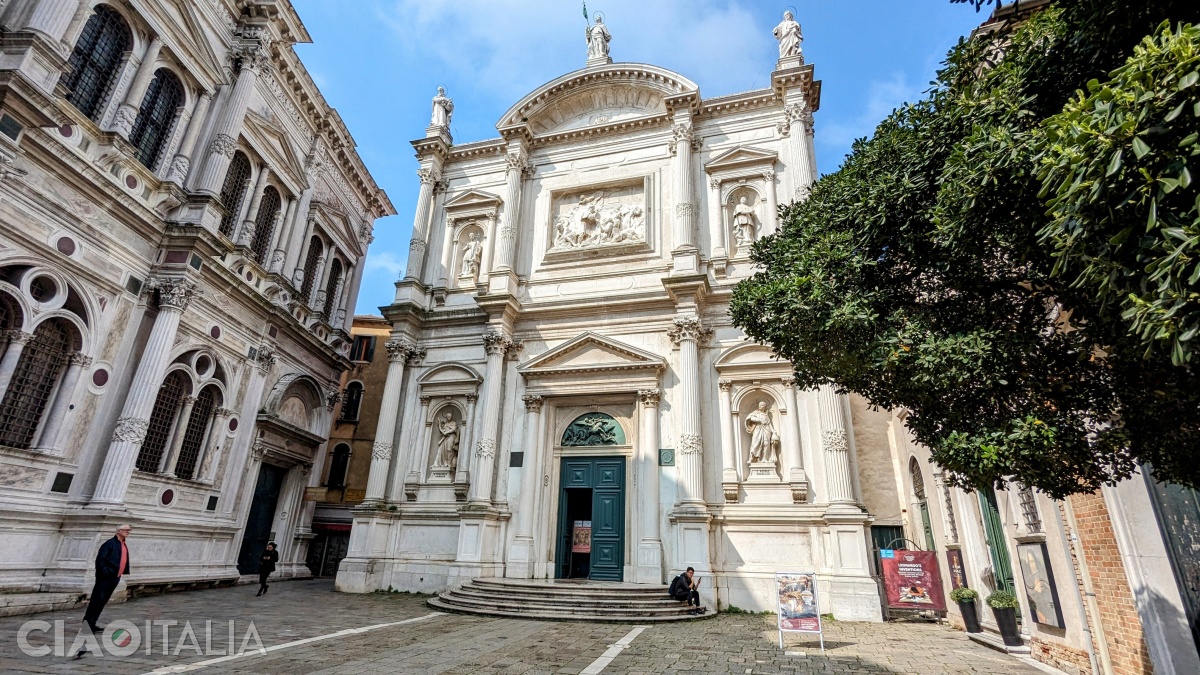
The San Rocco Church (Chiesa di San Rocco) was erected at the same time as the school's first headquarters (Scoletta), between 1489 and 1508. Its current form, however, dates from the 18th century when it was rebuilt, with the façade inspired by that of the Scuola Grande di San Rocco. From the original Renaissance construction, only part of the apse and the portal - now located on one of the sides - remain.
In the main altar, the relics of Saint Roch are preserved, for which the church was originally built.
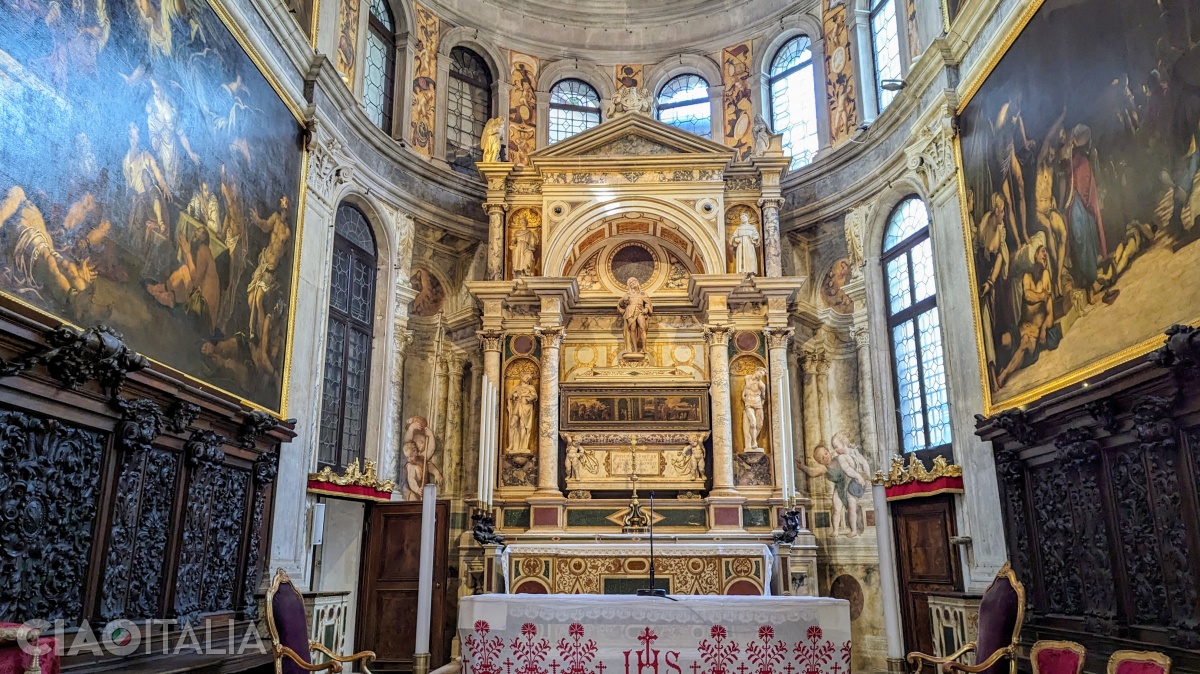
The church houses several works by Tintoretto. The four canvases on either side of the main altar present scenes from the last part of St. Roch's life.
To the right are "St. Roch Curing the Plague Victims" (painted in 1549, this was the first representation of the plague in Venetian art) and "St. Roch Blessing the Animals".
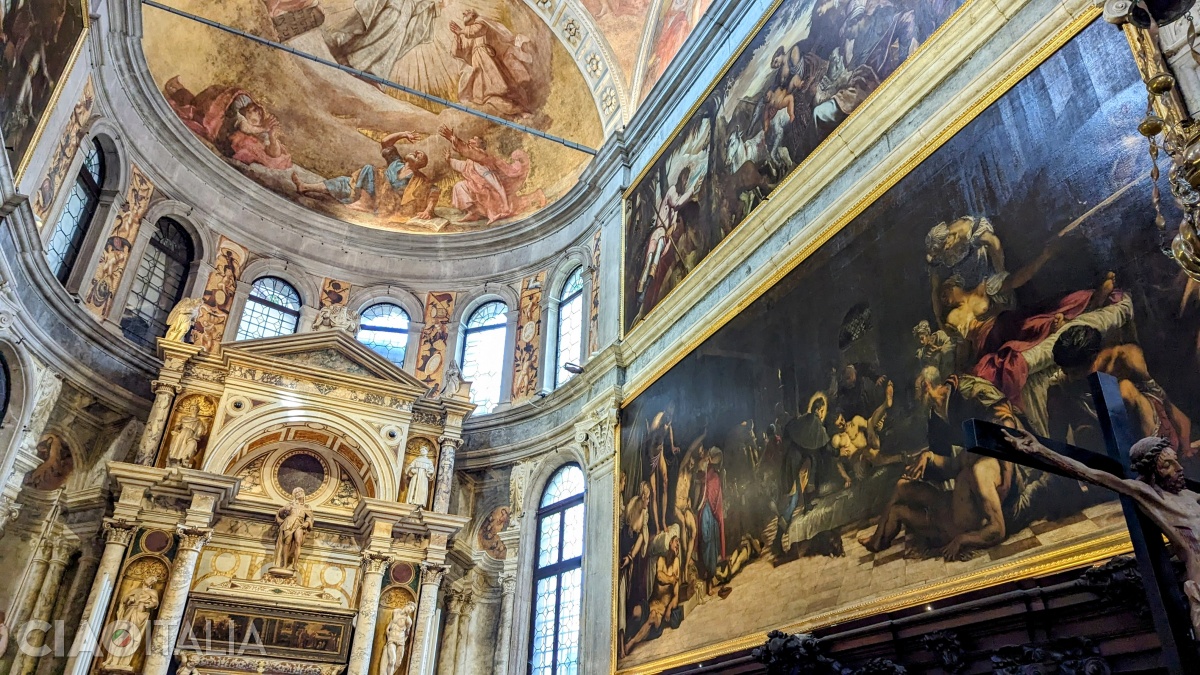
To the left of the main altar are "The Capture of St. Roch" and "St. Roch in Prison Visited by an Angel".
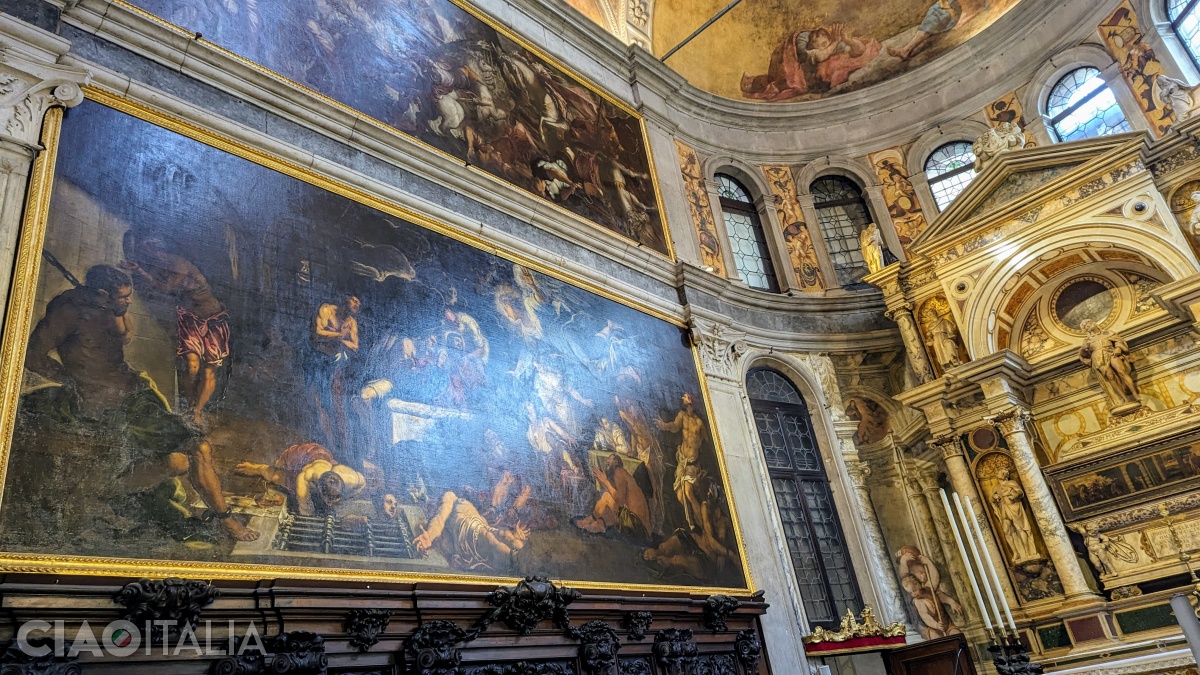
In an altar on the right side are the paintings "St. Roch in the Desert" and "The Healing of the Paralytic". Of the first painting, only the general composition and the figure of the saint are attributed to Tintoretto. The second, created in 1559, originally consisted of two parts decorating the doors of a large cabinet where the church's money was kept. In 1674, the cabinet was removed, and the two parts were assembled into a large canvas that now decorates the right wall of the church.
The church also contains paintings by other artists, including Pordenone and Sebastiano Ricci.