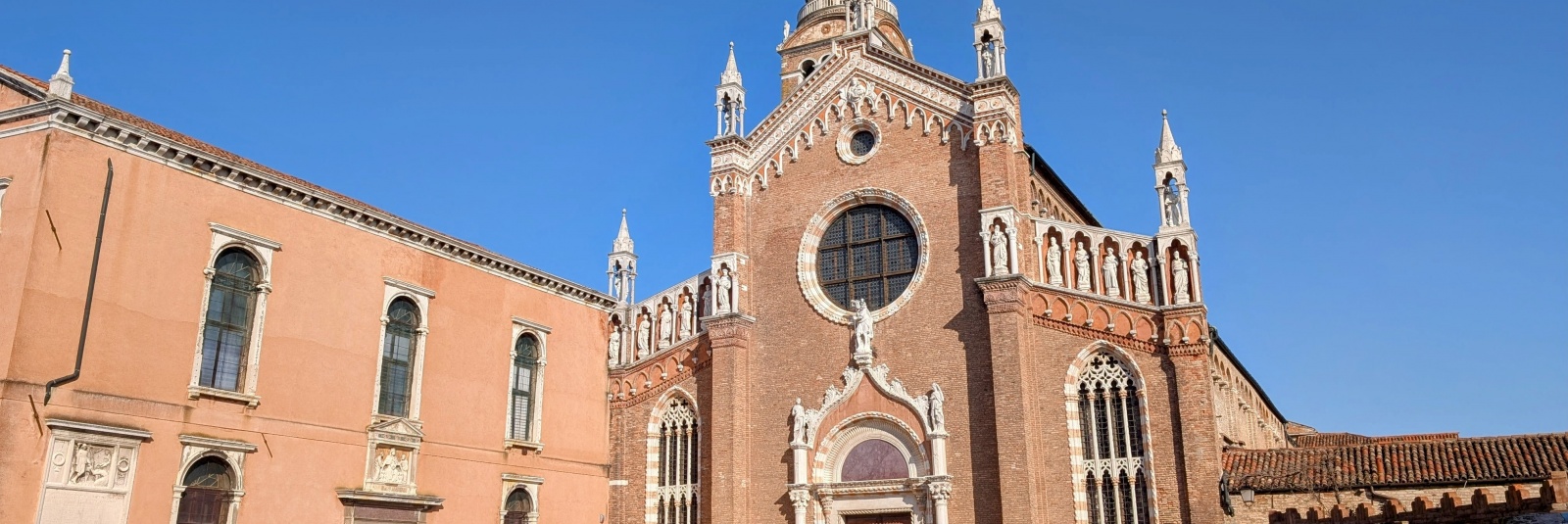
Madonna dell'Orto: Tintoretto's Church in Venice
The Madonna dell'Orto Church in Venice is also known as "Tintoretto's Church". The artist, whose home was located nearby, was a parishioner here. Inside, you will find several of the painter's works, as well as his tomb. If you love art, and Tintoretto in particular, add this place to your list of things to visit in Venice.
How to Get to Madonna dell’Orto Church?
The Madonna dell'Orto Church is located in the north of the city, in the Cannaregio district, in a quiet area far from the tourist hustle and bustle of Venice. Vaporetto lines 4.1 and 5.1 have a stop in the immediate vicinity.
Ticket Prices
The Madonna dell'Orto Church is part of the Chorus Association circuit and can be visited for free (see also the article Free Things to Do in Venice).
Opening Hours
You can visit the Madonna dell'Orto Church during the following hours:
- Monday-Saturday: 10:30 AM - 5:00 PM
Last entry is at 4:45 PM.
The church is closed on Sundays, Easter, August 15th, December 25th, and January 1st.
Visiting the Madonna dell'Orto Church
History
The first church was built on this site in 1350 by monks of the Umiliati ("humiliated") order, whose prior was Tiberio de' Tiberi of Parma. Initially, the church was dedicated to San Cristoforo (St. Christopher), protector of travelers and merchants. The choice of this saint was likely determined by the church's location in an area characterized at that time by intense commercial activity, as well as its proximity to the departure point for many islands in the Venetian lagoon.
In 1377, the name was changed to the one preserved to this day: Madonna dell'Orto ("Our Lady of the Orchard"). The story goes that the parish priest of the Santa Maria Formosa Church at the time commissioned the sculptor Giovanni de Santi to create a statue of the Virgin. However, the statue was not to the priest's liking, and he rejected it even before it was finished. So, until he decided what to do with it, De Santi placed it in his garden. Every night, the statue began to glow, which caused an increasing number of people to head to the garden in question to pray, considering it miraculous. To prevent the spread of the cult outside religious institutions, the bishop of the San Pietro di Castello Church (which was Venice's cathedral for a long time before St. Mark's Basilica) asked the sculptor to place the statue in a church. De Santi offered it to the monks of the new San Cristoforo church, setting three conditions: to be buried in front of the spot where the statue would be placed, to always have a mass officiated in his memory, and to receive a considerable sum of money. The monks accepted the first two requests but did not have the required money, so the statue was purchased by the Scuola San Cristoforo (like the Scuola Grande di San Rocco, this was a religious and charitable merchant organization) and was placed inside the church in 1377 (you can still see it today in the San Mauro Chapel). In 1414, the patronage was officially changed to Madonna dell'Orto - "Our Lady of the Orchard".
Over time, the church was restored several times and was held by various religious orders. In the 19th century, for a few years, it was used by the Austrian army as a warehouse for straw and wine.
The Exterior
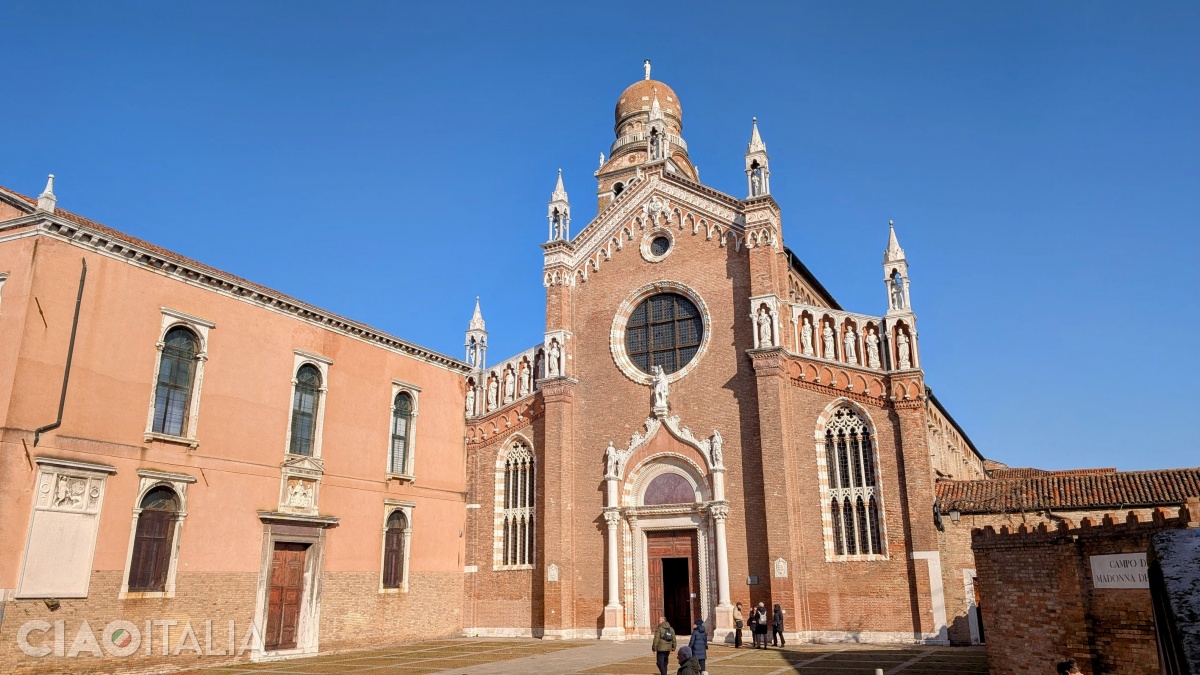
Before entering the church, take a look at the small square where it is situated. The pavement consists of bricks arranged in a herringbone pattern, framed by Istrian stone squares (the predominant building material in Venice). This is one of the few surviving examples of traditional pavement (from before the introduction of stone blocks in the 17th century) in the city. You will find another example of such pavement nearby, a 5-minute walk away, in Campo dell'Abazia.
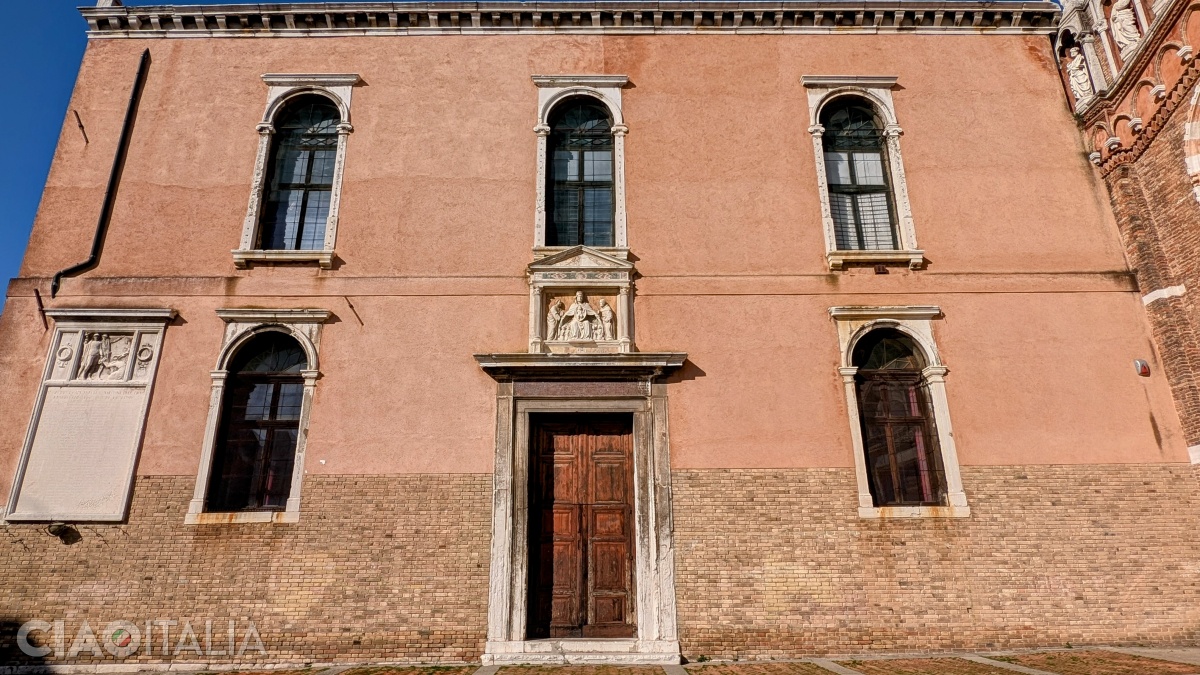
The building on the left side of the church is Scuola San Cristoforo dei Mercanti - the institution that provided the funds to place the statue we mentioned above within the church. It was built in 1377 and reconstructed in 1571, at which time it was raised by one level (if you look toward the right side of the building, you will see how it covers the left side of the church, which was built earlier). Above the entrance portal is a beautiful 14th-century bas-relief. It depicts the Madonna della Misericordia (the Virgin and Child), protecting the crowd of faithful with her mantle, flanked by St. Mark and St. Francis. Many of the paintings that once decorated the school building were lost following the decree of dissolution issued by Napoleon in 1806. Some, including Veronese's "Annunciation", are kept today at the Accademia Galleries in Venice.
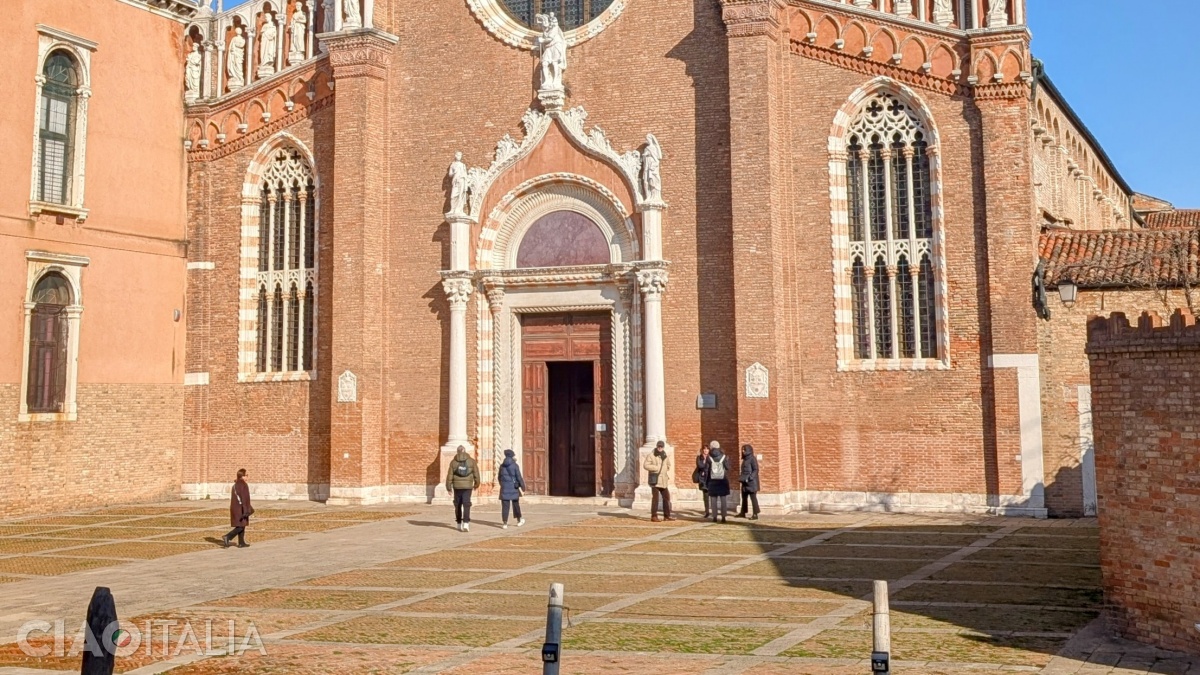
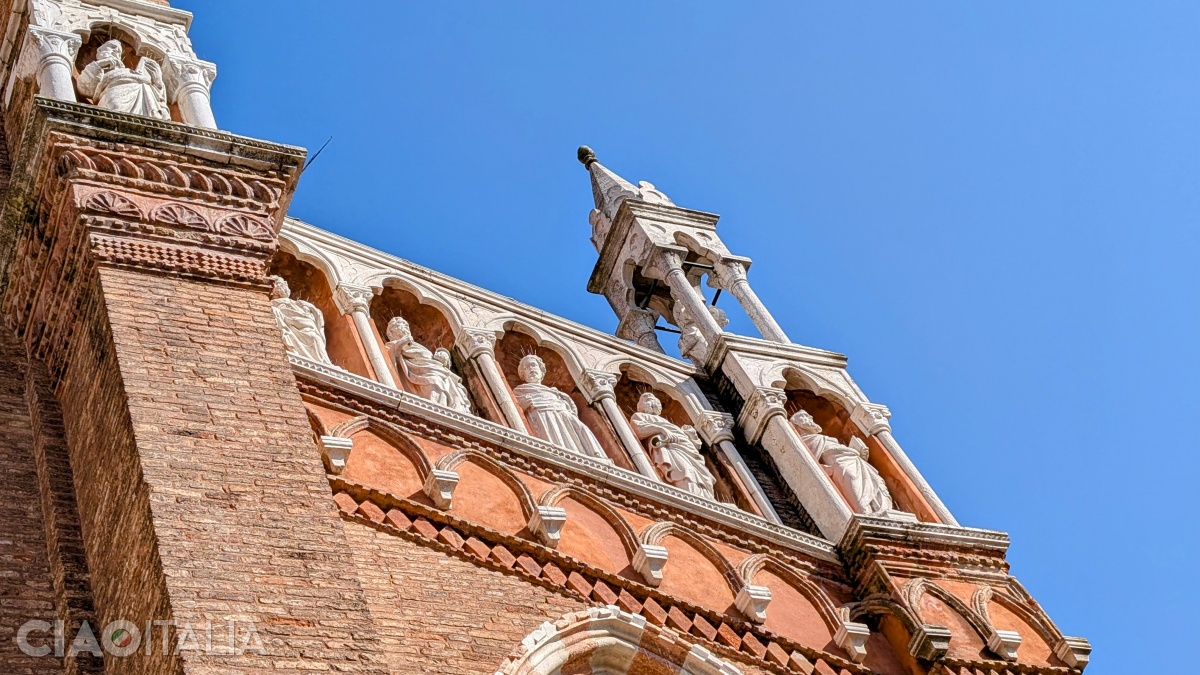
Now, take a look at the church's beautiful facade. Its architectural details, highlighting the transition from the Gothic to the Renaissance style, bear witness to the 15th-century restoration. The red brick and the frames of the windows and portal are characteristic of the Venetian Gothic. Within the niches, the statues of the twelve apostles are still preserved, with six on each side.
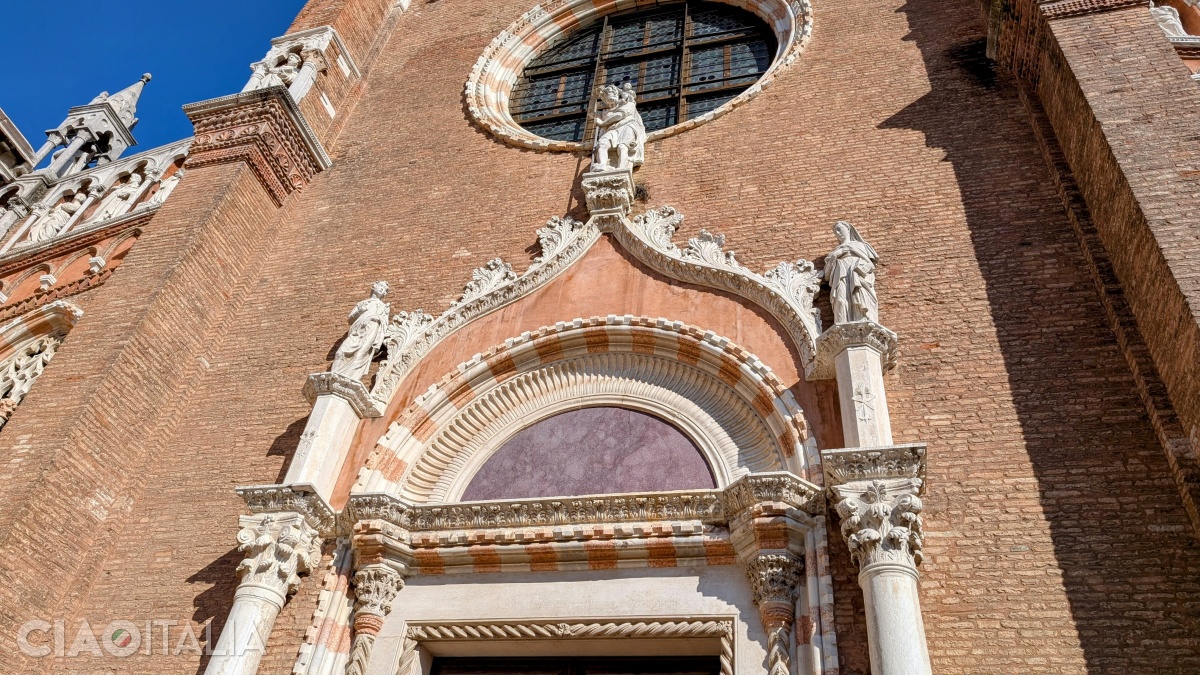
The entrance portal, decorated with acanthus leaves, and the rose window above it were designed by Bartolomeo Bono, the same sculptor who worked on the Porta della Carta at the Doge's Palace. Above the purple porphyry lunette are statues representing St. Christopher (center), Archangel Gabriel (left), and the Virgin Mary (right). On the columns supporting the statues appears the symbol of St. Christopher: the letter X (from the Greek name Χριστόφορος), over a stylized palm tree. Above the small rose window, at the top of the facade, is another bas-relief of the Virgin and Child.
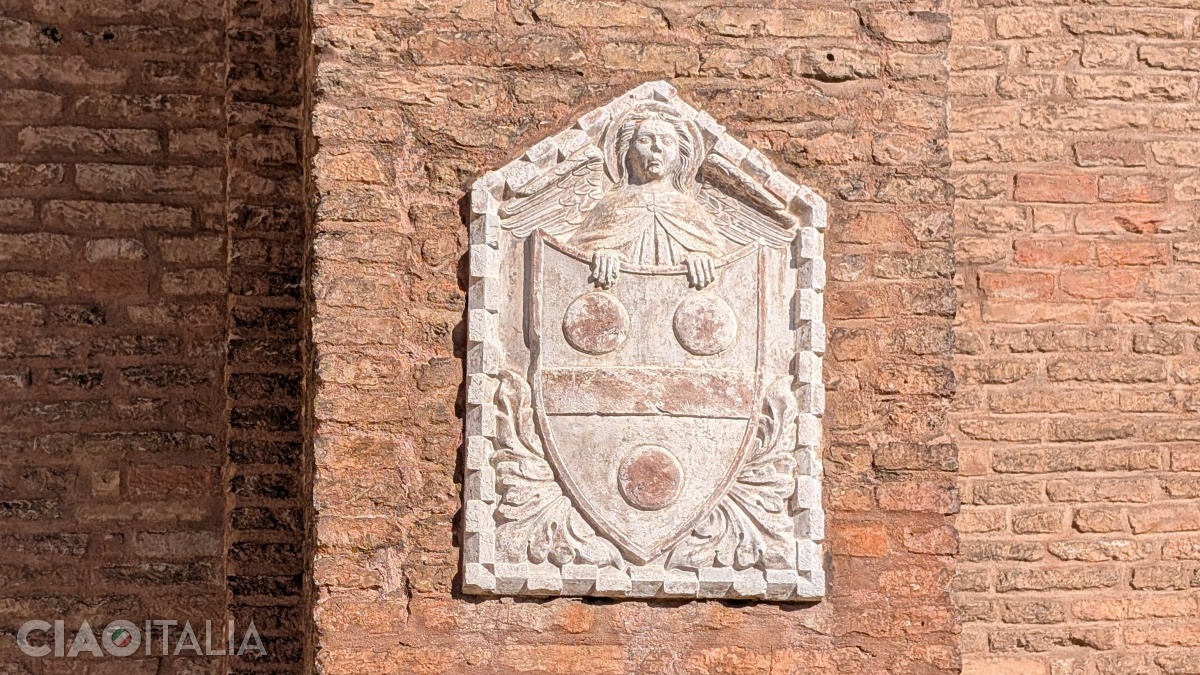
On either side of the white columns framing the portal, the coats of arms of Tiberio de' Tiberi, the church's founder, were embedded.
In the 19th century, statues brought from the Santo Stefano Church on Murano Island, which had been demolished, were placed in the five Gothic stone turrets. The statues symbolize "Prudence", "Charity", "Faith", "Hope", and "Temperance".
The Interior
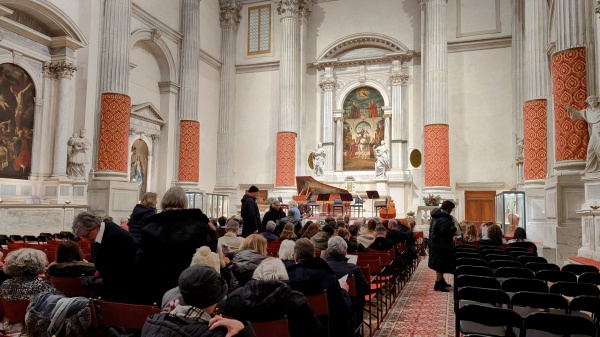
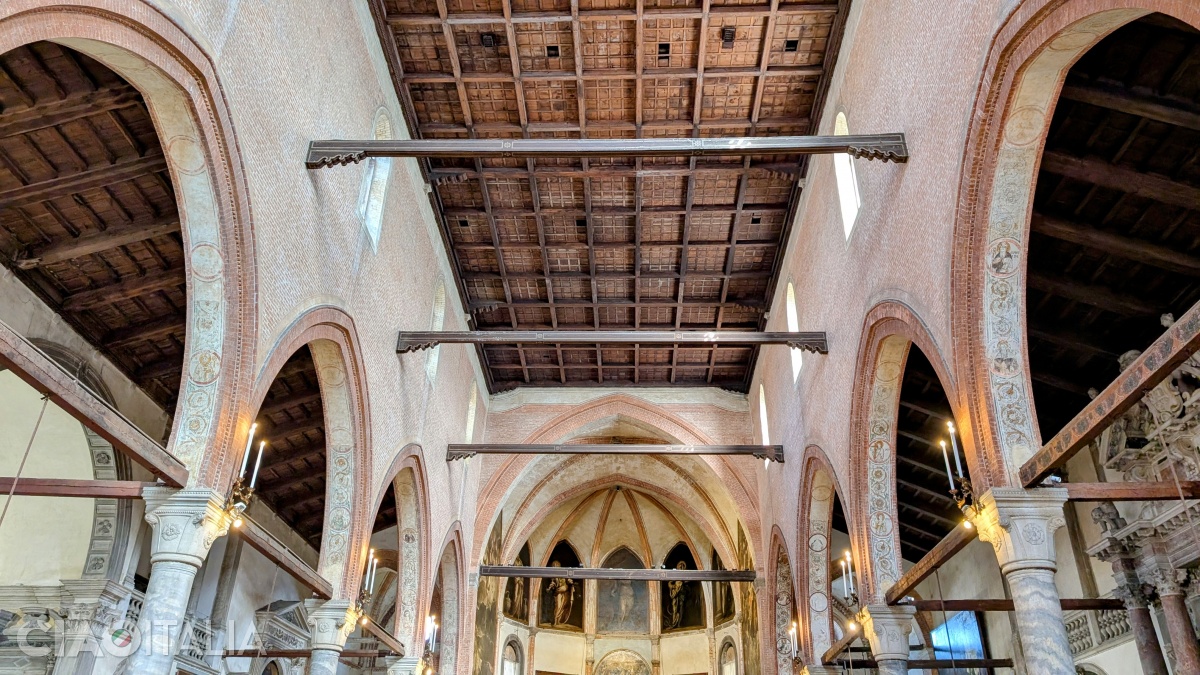
The church's interior is divided into three naves, separated by arches supported by marble columns. On the inner side of the arches, 15th-century frescoes are still preserved - a rarity in Venice, where frescoes seldom withstand the humid climate. There are four altars on the right wall, and four chapels open into the left nave.
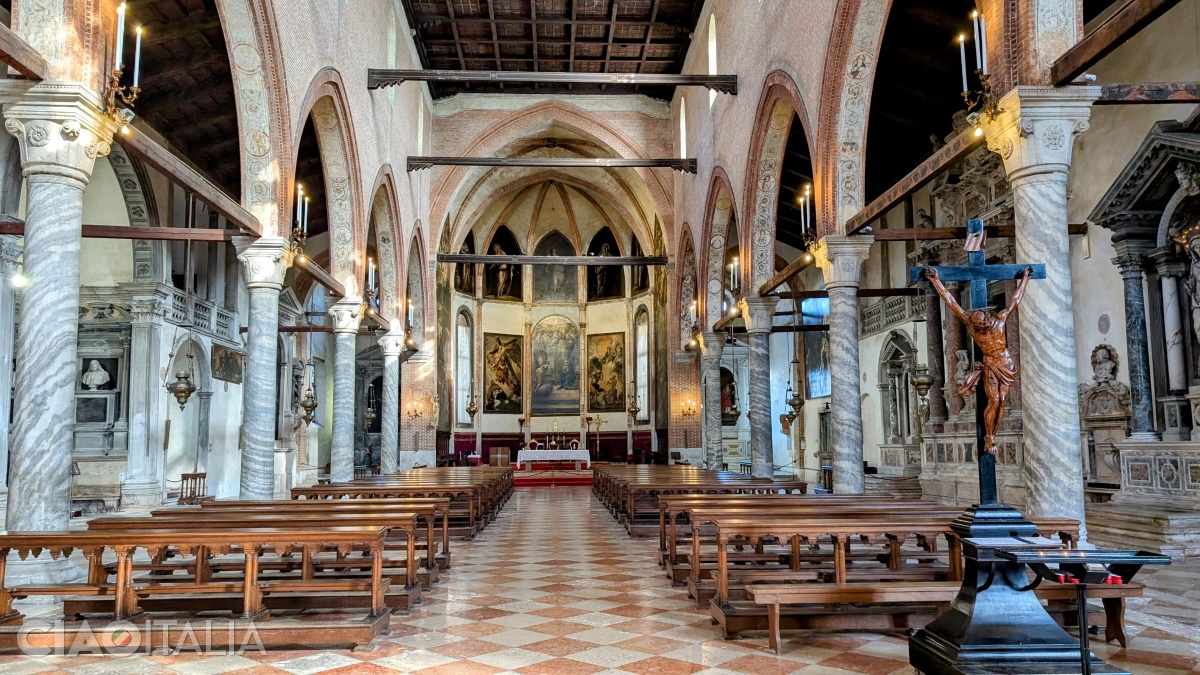
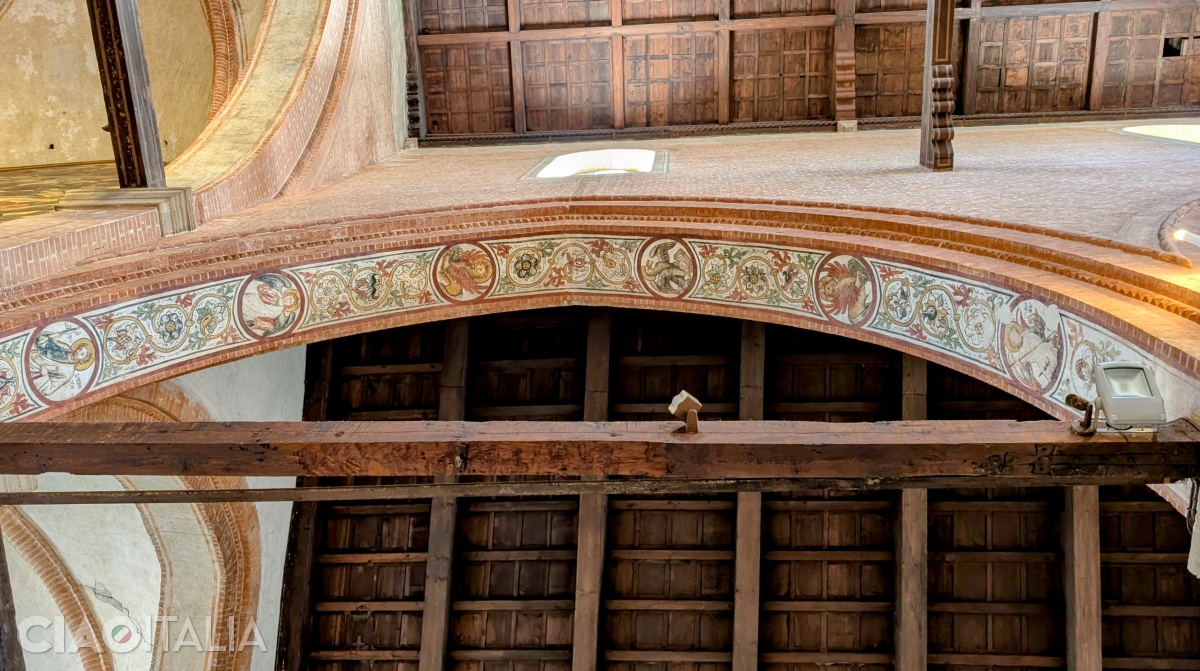
The coffered ceiling dates from the 20th-century restoration, replacing the old Gothic-shaped roof decorated with frescoes.
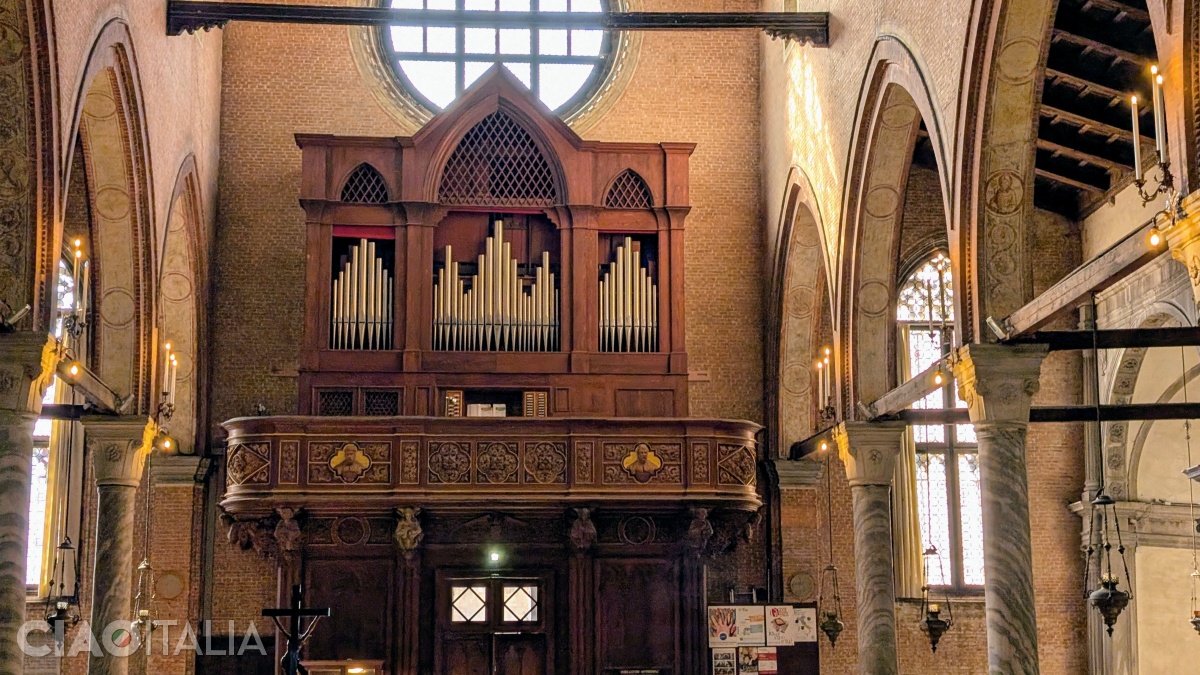
The organ, located above the entrance, dates from the 19th century and is one of the largest in Venice. Built in 1878, it was originally designed for the La Fenice Theater.
However, the church's fame is primarily due to the paintings of Jacopo Tintoretto. He lived and worked nearby, near Campo dei Mori, where both his home and studio were located. Tintoretto worked for Madonna dell'Orto for thirty years, often free of charge, accepting payment only for the cost of the materials used. In this same church, where he was a dedicated parishioner, he also found his final resting place, alongside his father-in-law and two of his children.
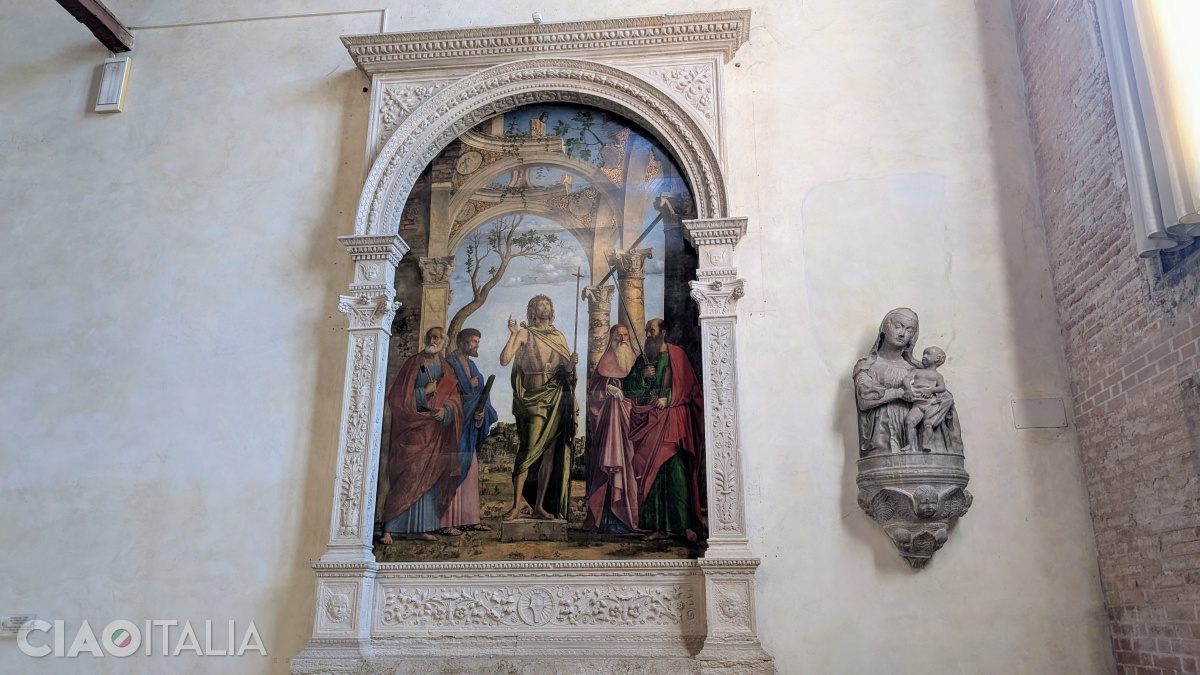
You can begin your tour with the altars in the right nave of the church. The first painting is a famous altarpiece created by Cima da Conegliano at the end of the 15th century. It depicts "St. John the Baptist, between Saints Peter, Mark, Jerome, and Paul", symbolizing the pillars of the new Church. Against the backdrop of a hilly landscape, the domes of St. Anthony's Basilica in Padua and the castle of Conegliano can be recognized. The ruins are an allusion to the decline of the pagan world.
The "Virgin and Child" sculpture on the wall to the right also dates from the 15th century and has been attributed to Antonio Rizzo, who designed the Giants' Staircase at the Doge's Palace.
Continuing to the left, is "St. Christopher the Martyr", a 19th-century copy of the original painting by Cima da Conegliano, which is held today at the Gallerie dell'Accademia.
The central altar (Altare dell'Immacolata) was created at the end of the 16th century to house the miraculous statue that gave the church its name - a statue you will see a little later in one of the chapels.
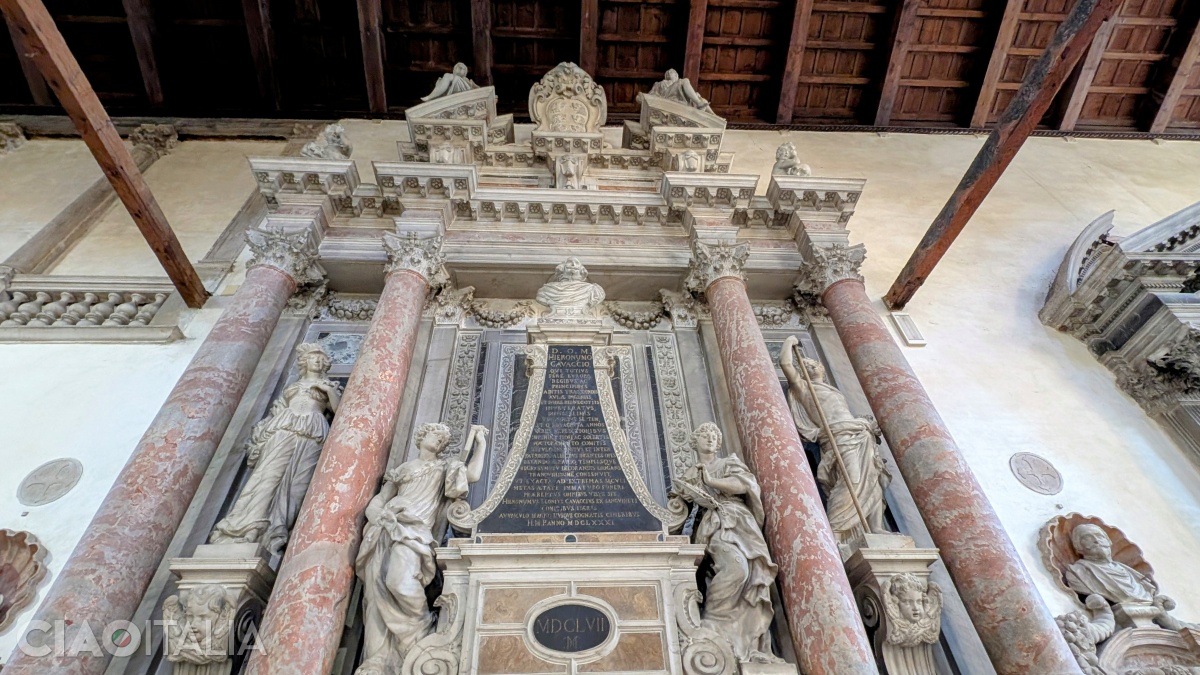
The Baroque altar that follows is a commemorative monument, commissioned in 1657 by Girolamo Cavazza, a Venetian who had purchased his noble title. He died in 1681 and was buried in the church where he had arranged his own funerary monument during his lifetime. Among the authors of the statues is Josse Le Court, the Flemish sculptor who also created the main altar of the Santa Maria della Salute Church and the altar of the Crucifix in the Basilica di Santa Maria dei Frari.
To the left is the altar featuring "The Martyrdom of St. Lawrence", created by Daniel van den Dyck in the 17th century.
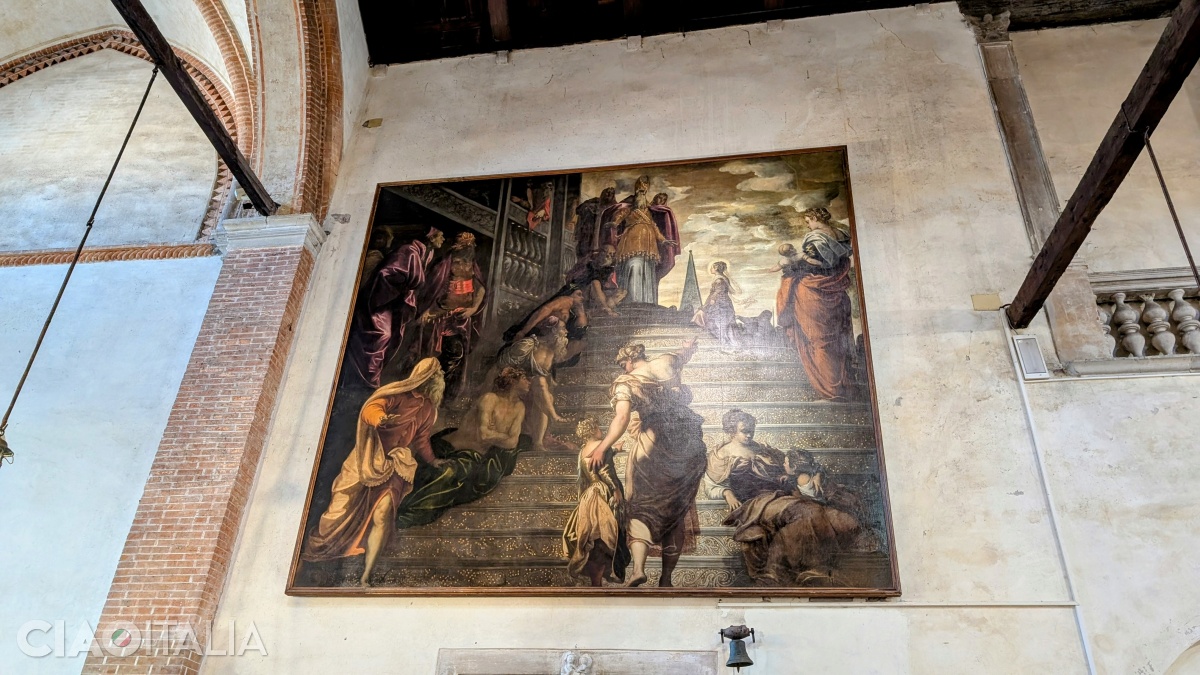
The final painting on the right side is among Tintoretto's most celebrated works. "The Presentation of the Virgin in the Temple" was also the first commission he completed for the Church of Madonna dell'Orto. If you look closely, you will notice a fine vertical line down the center that divides the canvas in two. Originally, the painting was designed as decoration for the doors of the old organ; the two halfs were only joined together in the 18th century. The composition is highly scenographic, a hallmark of most of Tintoretto's works. Mary climbs an imposing staircase, decorated with gold leaf, toward the priest who awaits her with open arms. She is followed by three women, each accompanying a little girl, all positioned within the light-bathed part of the painting.
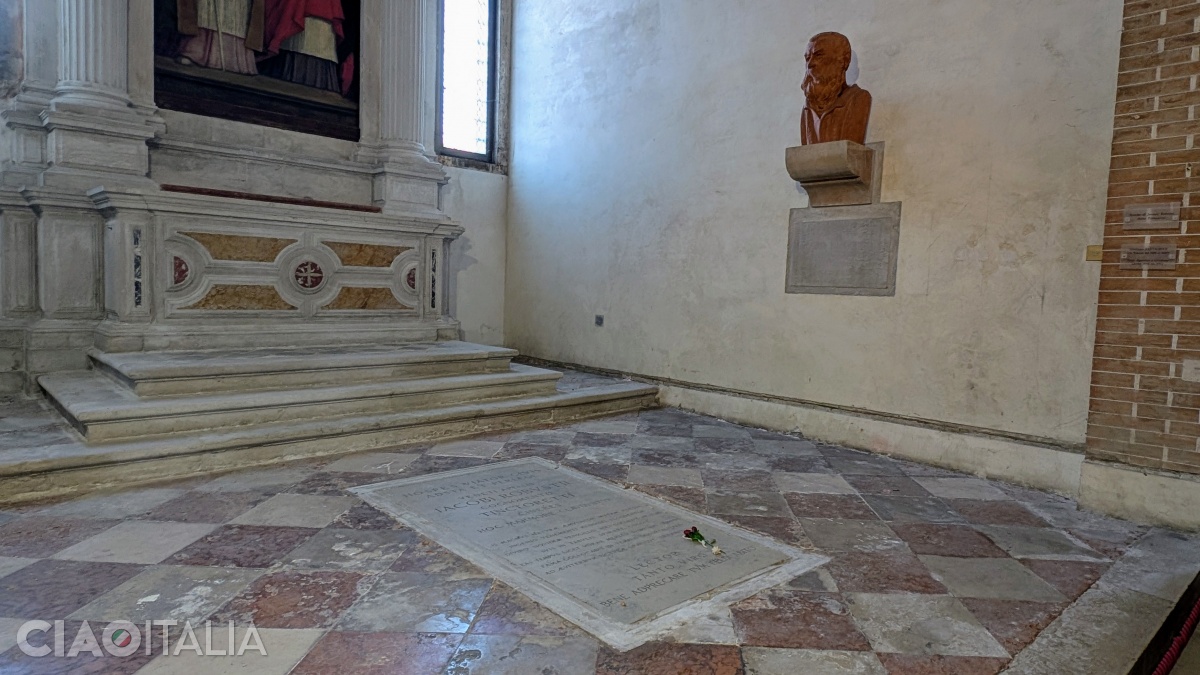
On the right side of the altar, there is a chapel featuring a 16th-century painting of Saints Augustine and Jerome. This is the chapel where Tintoretto was buried, alongside his children Marietta and Domenico (who were also painters), and his father-in-law. The funerary slab and the bust on the wall were added during the 1930s restoration.
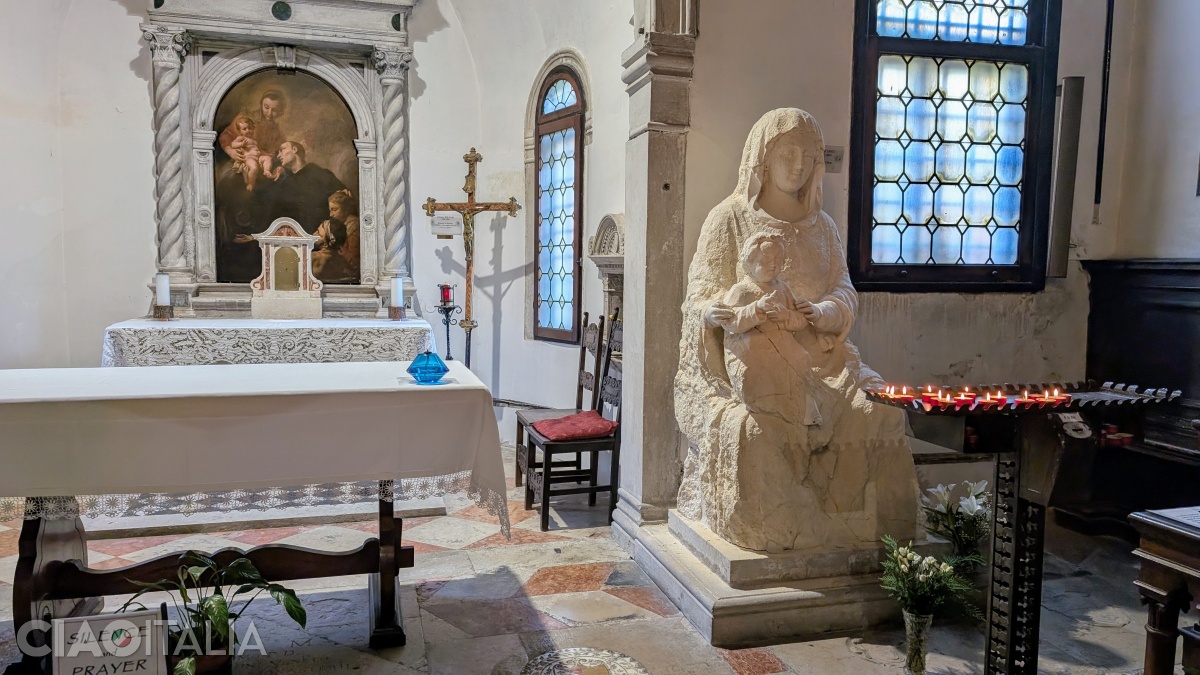
To the right, a door leads to the San Mauro Chapel, intended for prayer. Here, you can see the statue of the Virgin that gave the church its name in the 14th century. Also buried here, according to his final wishes, is Giovanni de Santi, the sculptor who created it. The walls of the chapel are decorated with works depicting various Venetian saints.
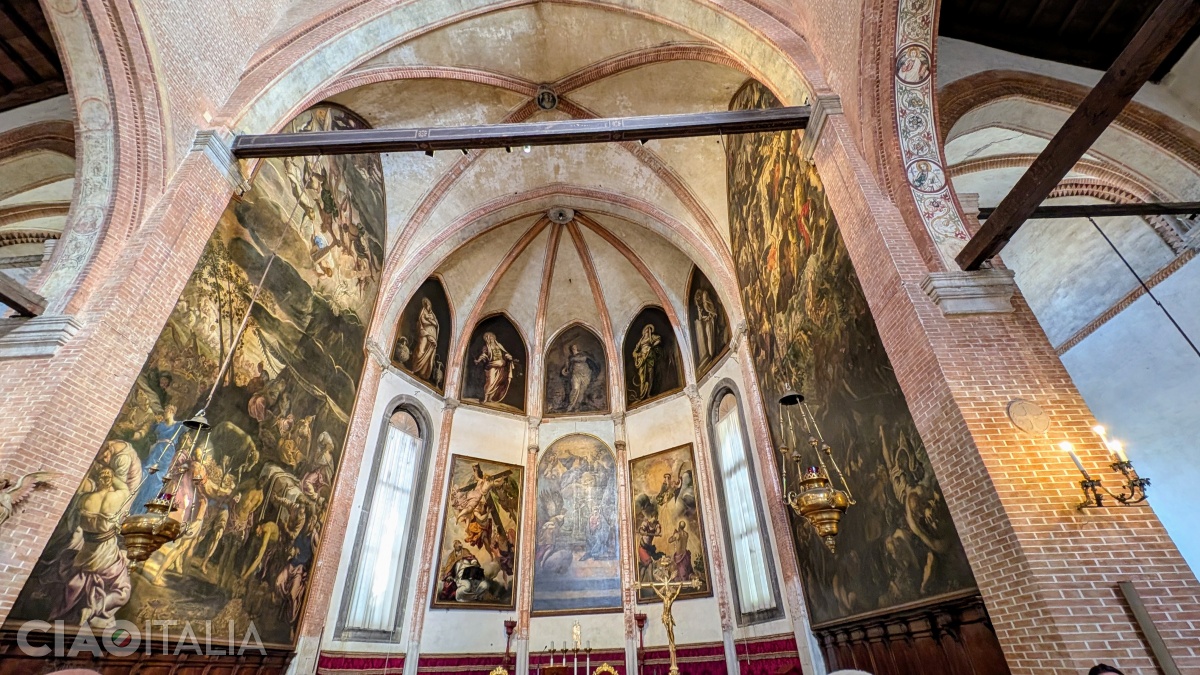
Return to the main altar, which is also dominated by works by Tintoretto. The two large side paintings represent "The Last Judgment" (on the right) and "The Adoration of the Golden Calf" (on the left).
The central panel depicts the "Annunciation" by Palma il Giovane. The side panels are by Tintoretto: "The Apparition of the Cross to St. Peter" (left) and "The Beheading of St. Paul" (right). Above these are the Christian Virtues (from left to right): "Temperance", "Justice", "Faith", "Prudence", and "Fortitude". All were painted by Tintoretto, except for the one in the center ("Faith", depicted holding a chalice), which was created by Pietro Ricchi.
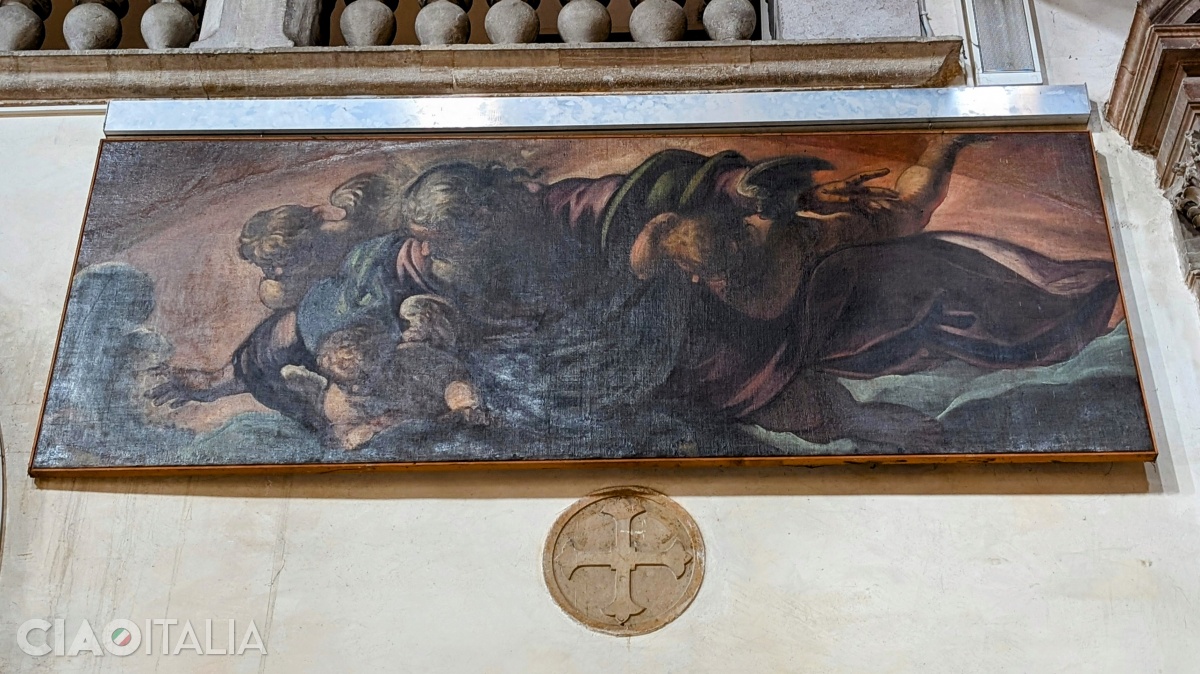
Continue the tour by heading back through the left nave. On the wall near the altar is another painting by Tintoretto: "The Eternal Father in Glory".
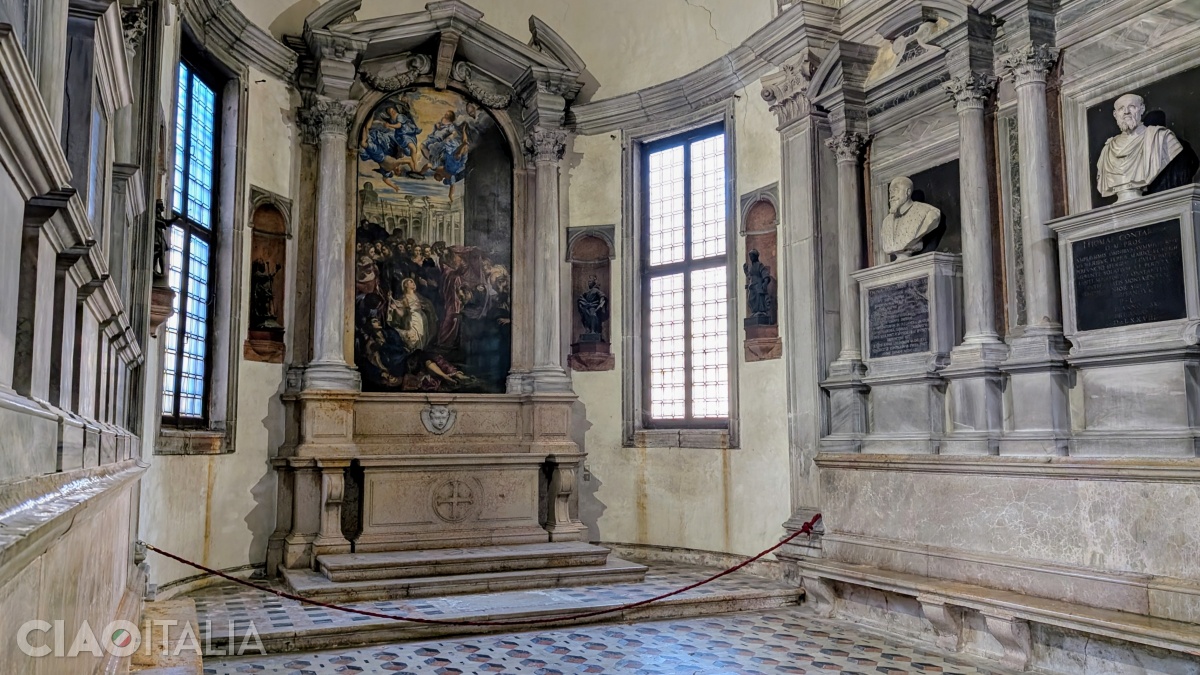
In the next chapel (Contarini Chapel), which features a precious polychrome marble floor, you will find "The Miracle of St. Agnes" (a saint from Rome), also by Tintoretto. The walls are lined with funerary busts of members of the prominent Contarini family.
The following chapel is the Morosini Chapel. Its altar features three paintings by Domenico, Tintoretto's son, while on the left wall hangs "The Crucifixion" by Palma il Giovane, which was relocated here from a demolished Venetian church.
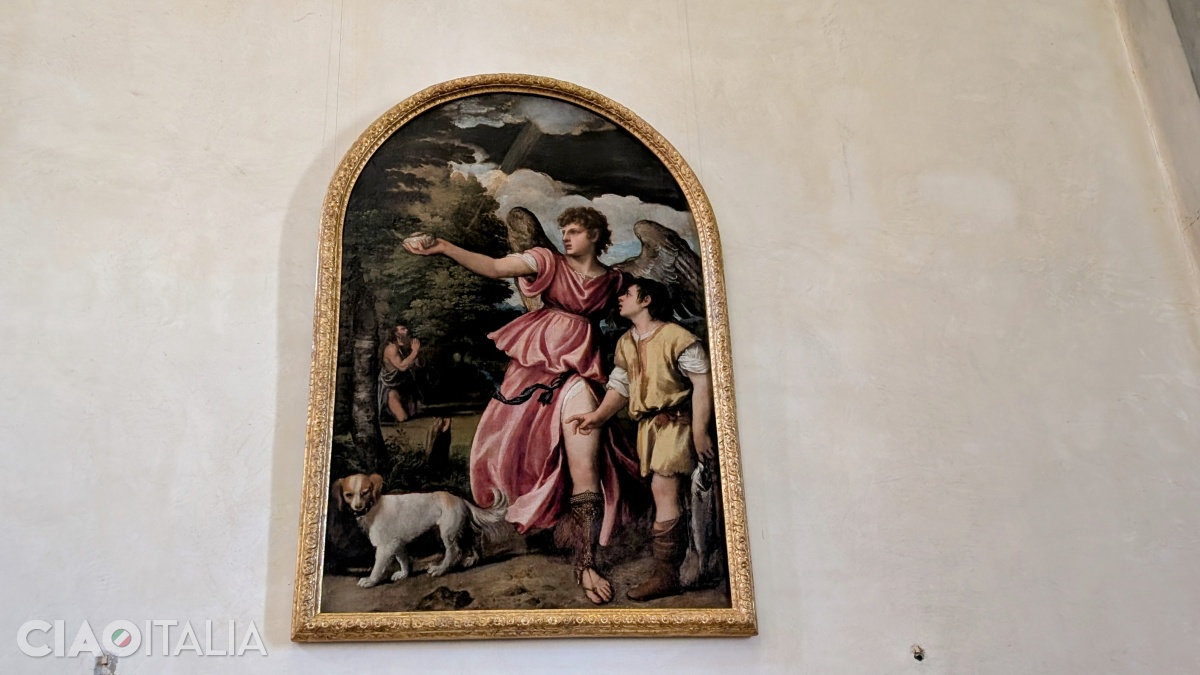
Continuing on, you reach the Vendramin Chapel. On the left side is the painting "Tobias and the Angel" - an early work by Titian, completed between 1540 and 1545. In the background, Saint John the Baptist is depicted in prayer.
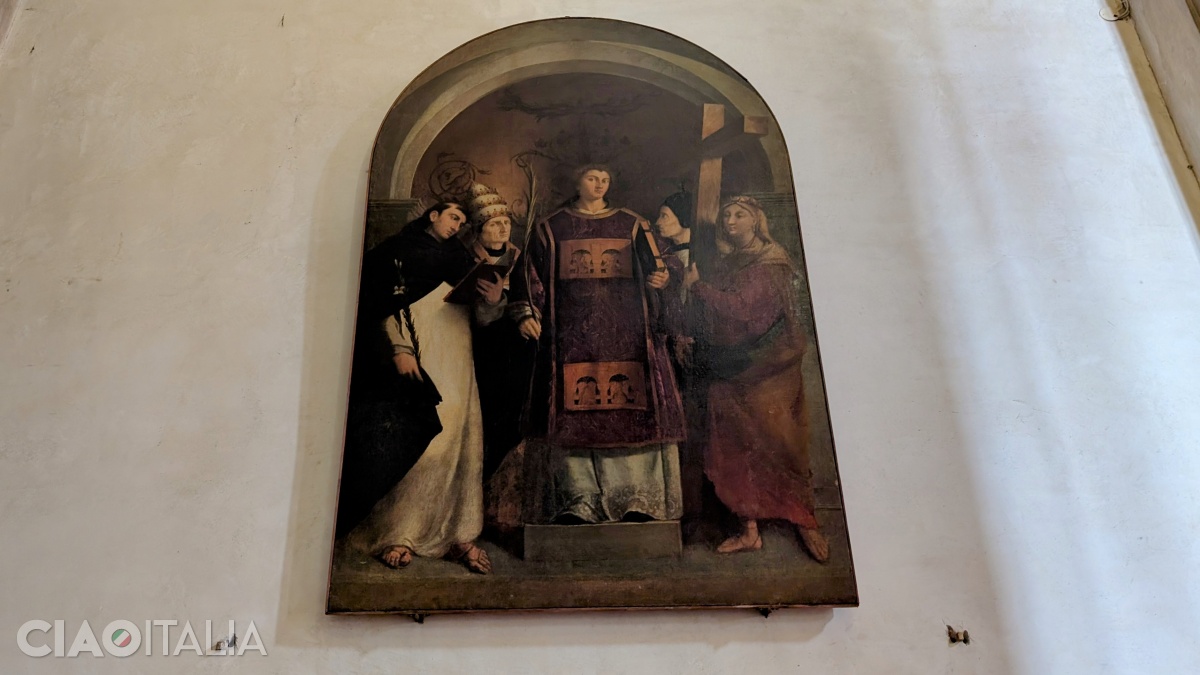
On the opposite wall hangs a work by Palma il Vecchio: "Saint Vincent Martyr, between St. Dominic, Pope Eugene IV, the Blessed Lorenzo Giustiniani, and St. Helen".
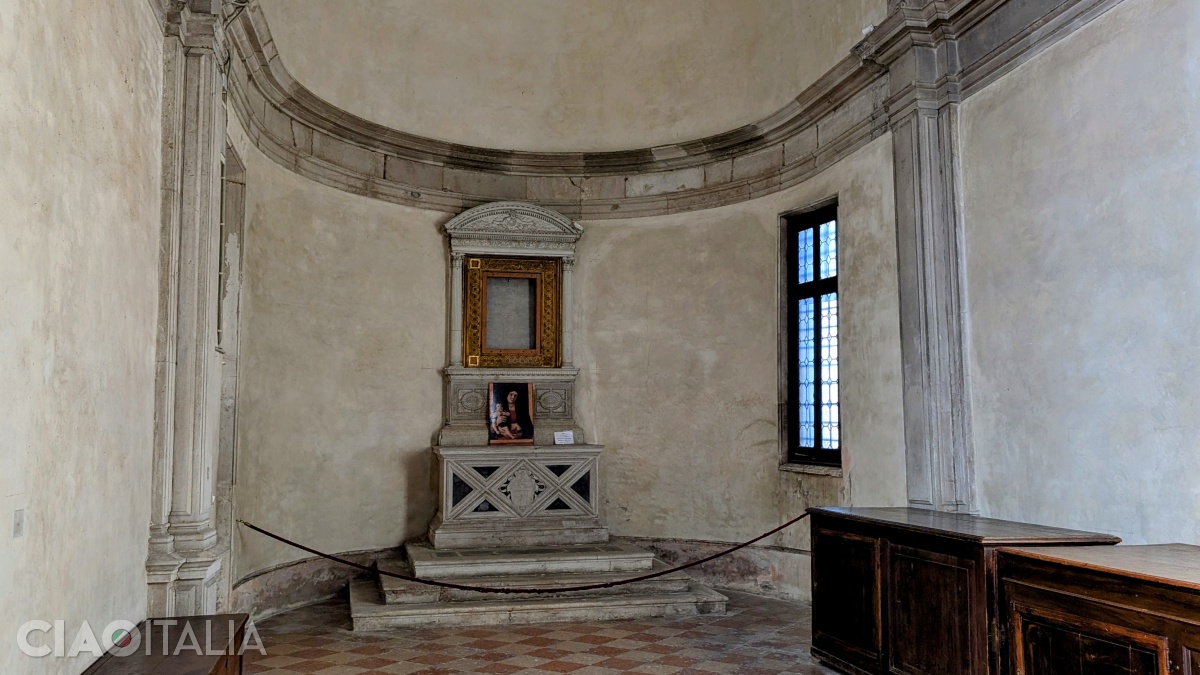
The final chapel, located nearest the door, stands empty today. This was once the home of one of the most significant works in the Church of Madonna dell'Orto - an altarpiece of the "Virgin and Child" by Giovanni Bellini. The painting was stolen in 1993 and has never been recovered.
What to See Nearby?
Tintoretto’s House
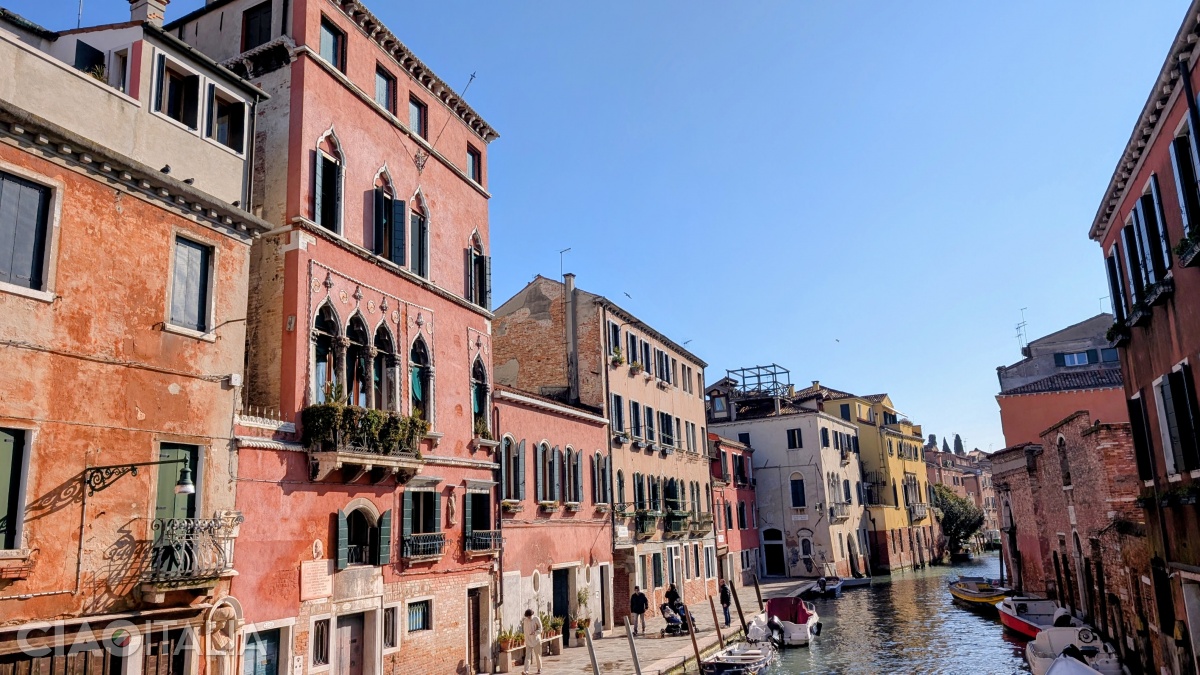
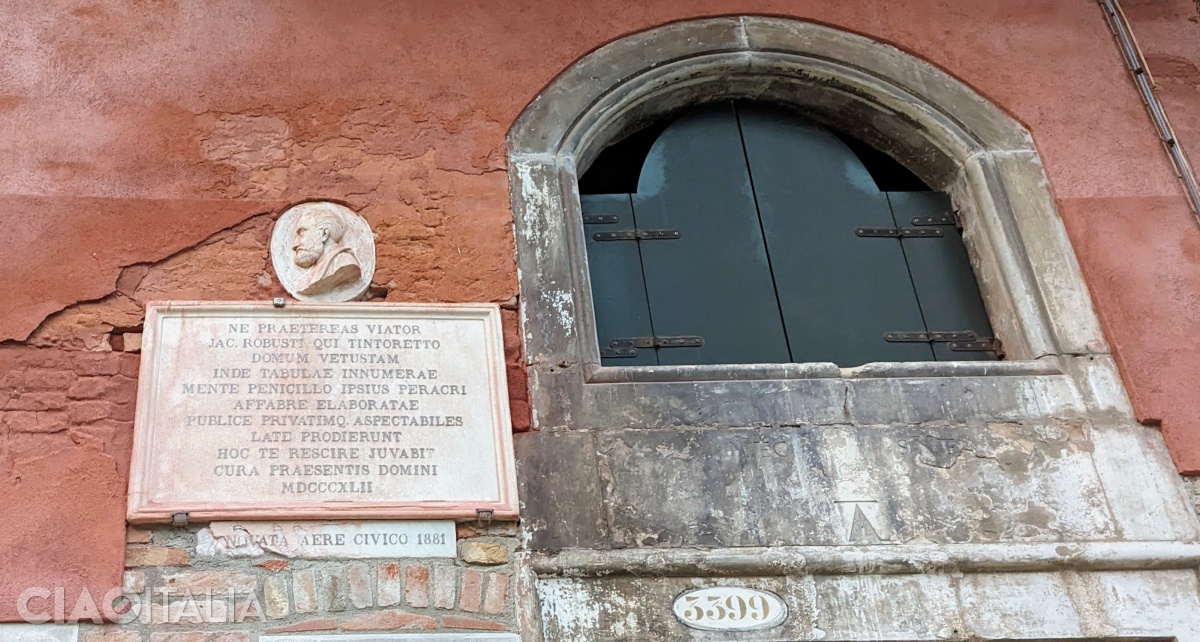
Just a short walk away, at Fondamenta dei Mori no. 3399, stands the house where Tintoretto spent the last 20 years of his life until his passing in 1594. The house - a 15th-century Gothic building - is a private residence and is not open to the public, but it is well worth seeing from the outside.
Tintoretto was born in Venice in 1518. Recent research indicates that his real name was Jacopo Comin. He was nicknamed "Tintoretto" ("the little dyer") because of his father's profession; Giovanni Battista dyed silk fabrics. In 1509, his father had courageously participated in the defense of the gates of Padua against the imperial armies, earning the nickname Robusti. This name was passed down to Jacopo, who was the eldest of 22 children.
An inscription on the wall of the house serves as a reminder that this was Tintoretto's home: Non ignorare, viandante, l’antica casa di Jacopo Robusti detto il Tintoretto. Di qui per ogni dove si diffusero innumerevoli dipinti, mirabili pubblicamente e privatamente, magistralmente realizzati con fine ingegno dal suo pennello. Ti farà piacere apprendere ciò per la solerzia dell'attuale proprietario. 1842 ("Do not overlook, traveler, the ancient house of Jacopo Robusti, called Tintoretto. From here, innumerable paintings spread everywhere, admired both in public and private spaces, masterfully created with fine ingenuity by his brush. You will be pleased to learn this due to the diligence of the current owner. 1842").
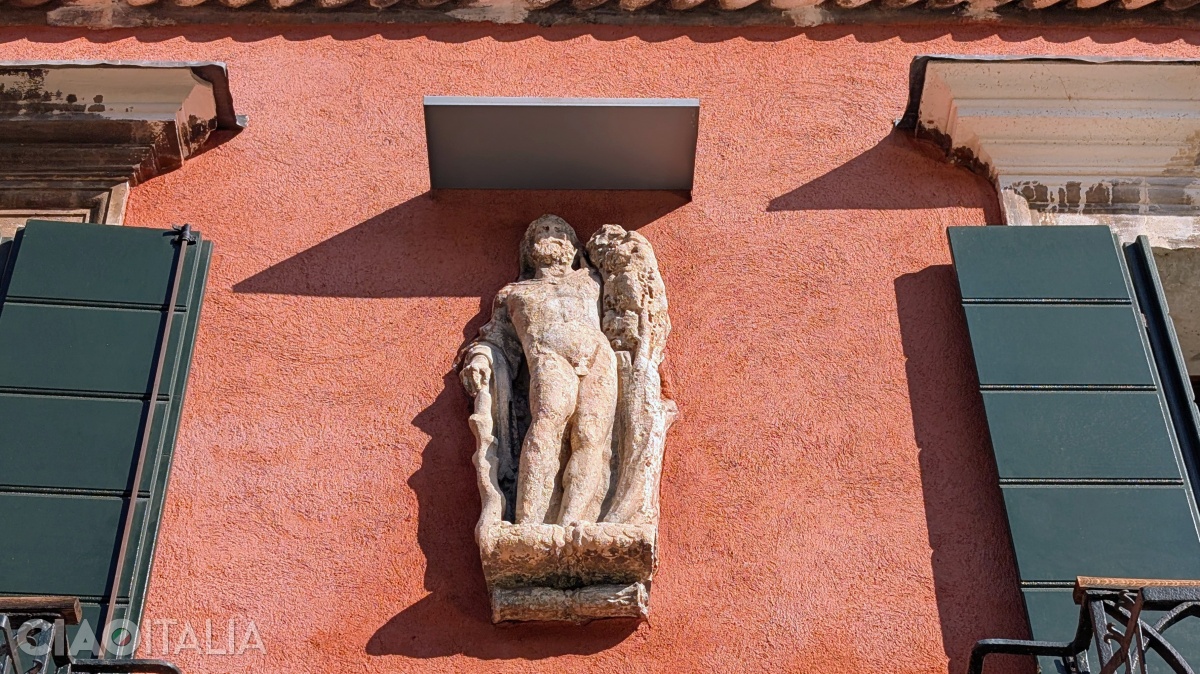
To the right, between the two windows on the first floor, stands a small statue whose features have been significantly worn away by time. It likely has Roman origins and depicts a nude Hercules holding a club. Legend has it that one morning, while Marietta, Tintoretto's eldest daughter, was on her way to the Church of Madonna dell'Orto, she was approached by an old woman. The woman convinced the girl to steal consecrated hosts, promising her that in exchange, she would become like the Virgin Mary. Instead of swallowing the hosts, the girl kept them in her mouth and later hid them in her blouse. Once home, she placed them in a box buried in the garden near the animal watering trough. After a few days, something strange happened: the animals began to gather and kneel at that very spot. Terrified, Marietta confessed everything to her father. Tintoretto realized he was dealing with a witch and told his daughter to invite her into the house the next time they met. When the woman arrived, the painter - who had prepared a heavy club - greeted her with a rain of blows. To escape, the witch transformed into a cat and tried to flee. When she couldn't find an exit, she threw herself against a wall, passing right through it in a cloud of smoke and leaving a hole behind. To cover the hole and serve as a warning to the witch, Tintoretto placed the statue of Hercules with his club over the spot.
The Statues of the Four "Moors"
To the left of Tintoretto's house stands a strange, leaning statue that appears to represent an Arab man. Three other mysterious statues are embedded into the walls of an old factory building in the small square of Campo dei Mori.
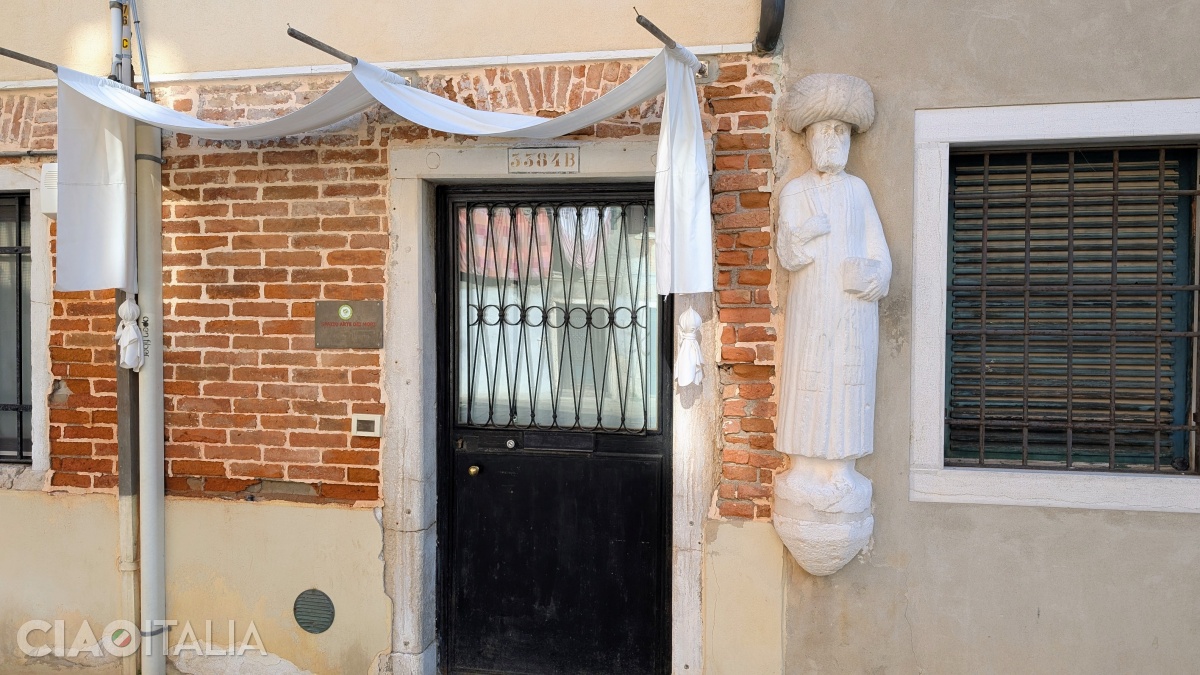
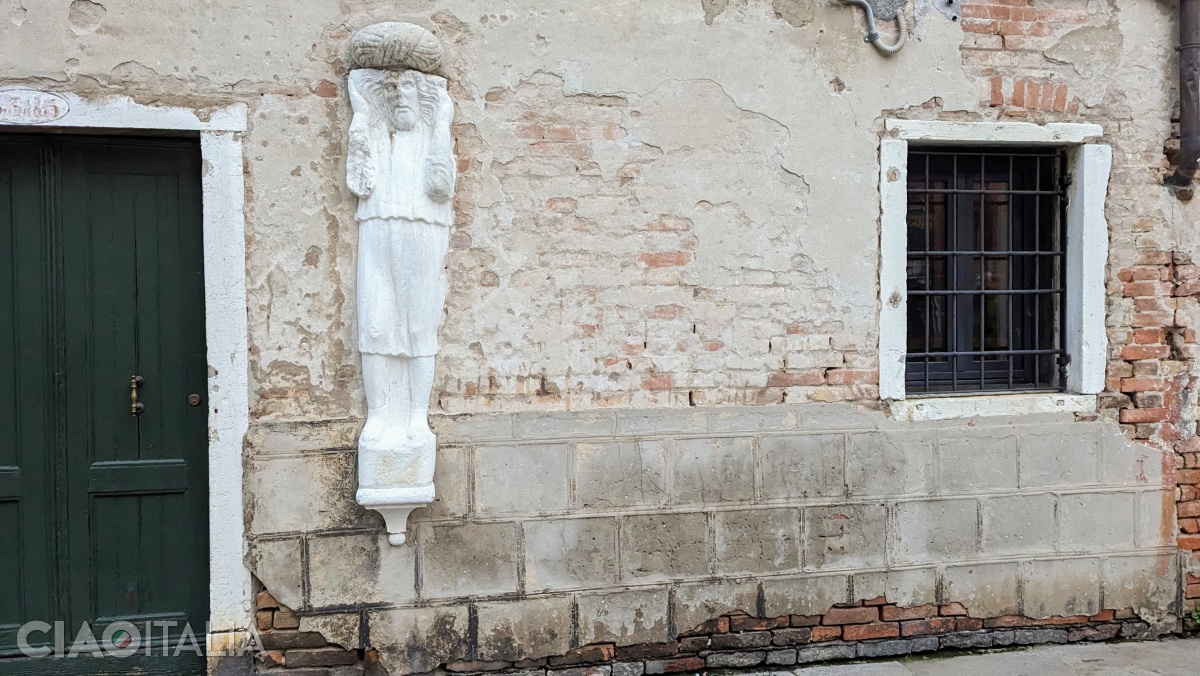
The three statues facing the square depict three merchant brothers (Antonio Rioba, Sandi, and Afani), who moved to Venice in 1113 from Morea - the name by which the Peloponnese was known in the Middle Ages. Although their family name was Mastelli, the locals called them mori ("Moors"), a name that has been preserved in the toponym of this area to this day.
The identity of the fourth statue - the one located next to Tintoretto's house - is unknown, but locals call it el Moro Mambrun.
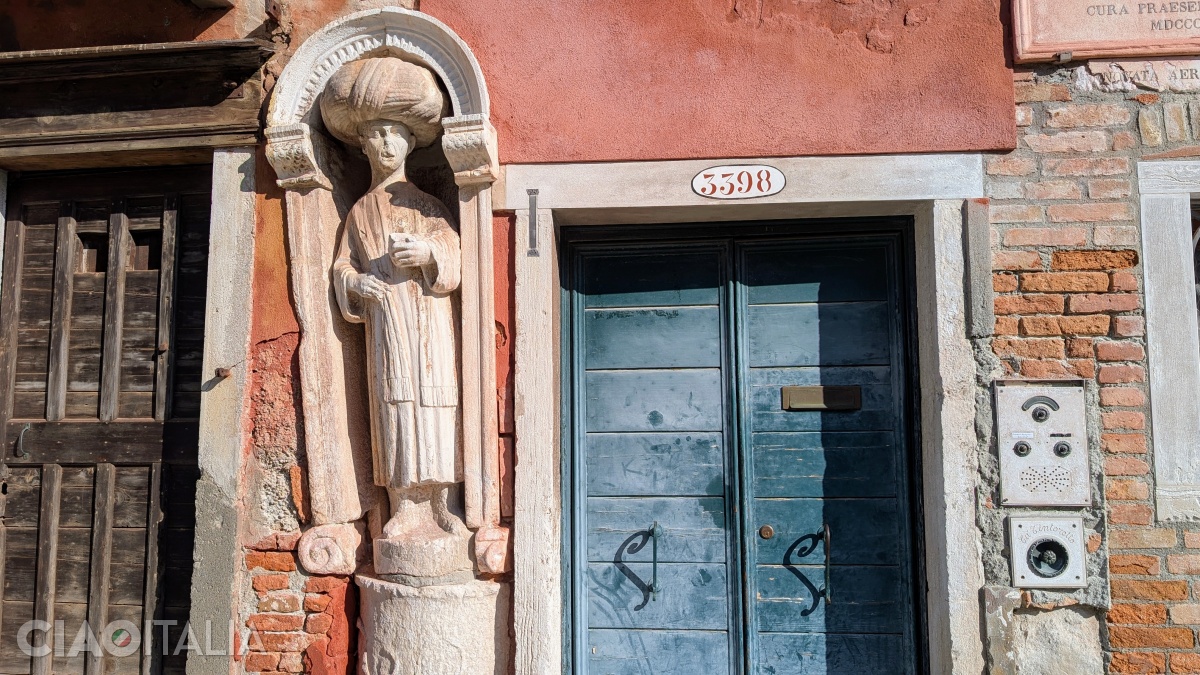
Legend has it that the three merchants once swindled a Venetian woman, who then turned her prayers to Saint Mary Magdalene (according to some traditions, the woman was Mary Magdalene herself). She transformed the three brothers, along with the shopkeeper who had been their accomplice, into stone statues that were placed in the square as a warning to dishonest people.
The most famous of the "Moors" is Antonio Rioba. In the 19th century, the statue lost its nose, which was replaced with a piece of iron. Since then, a superstition has emerged: they say that if you rub the nose of "Sior" Rioba, you will have luck in business and become wealthy (for more Venetian superstitions, see also the article on things to do in Venice).
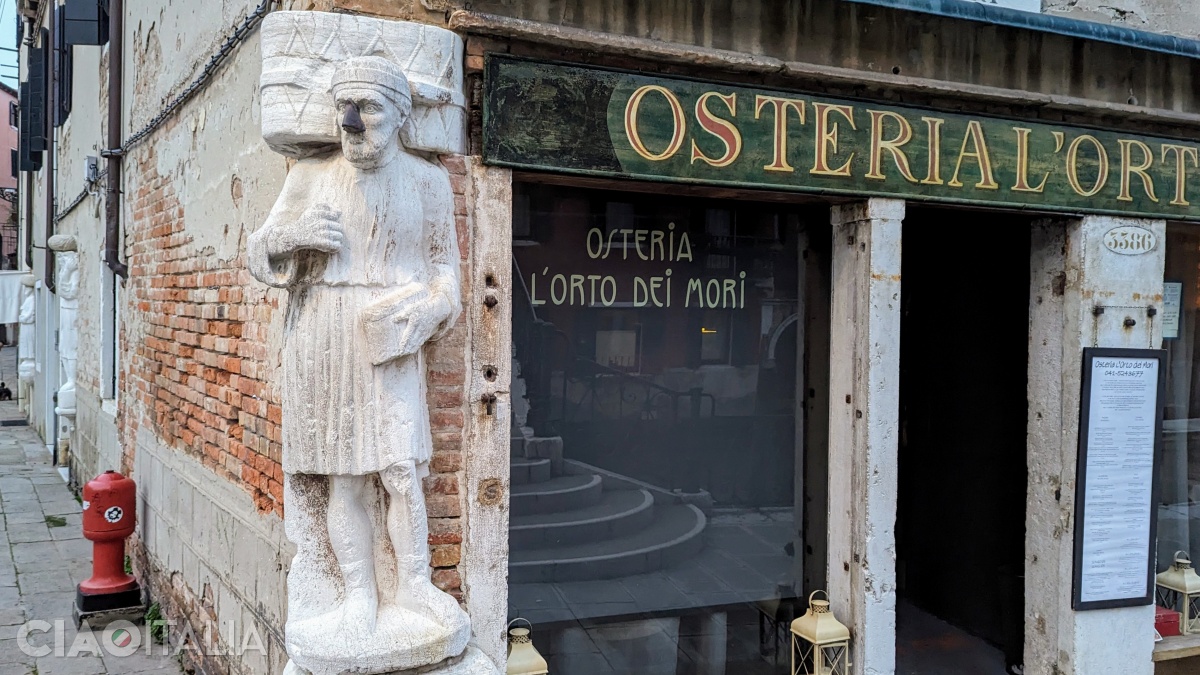
The name Rioba comes from the inscription rioba on the left side of the pack he carries on his back. In fact, the word continues on the opposite side, but the last part (rbaro) is much less visible. The full inscription, riobarbaro, likely referred to the rhubarb he was depicted as carrying. In the past, the statue was often used to play pranks on rookie porters; they would be given incredibly heavy loads and told to deliver them to the non-existent "Sior Antonio Rioba of Campo dei Mori". For a long time, it was also a Venetian custom to leave anonymous notes on the statue featuring ironic and satirical texts.
More recently, during a night in the spring of 2010, the statue of Sior Antonio Rioba was decapitated. Both the police and the local population quickly mobilized; the head was recovered a few days later, and the sculpture was carefully reassembled.
Palazzo Mastelli
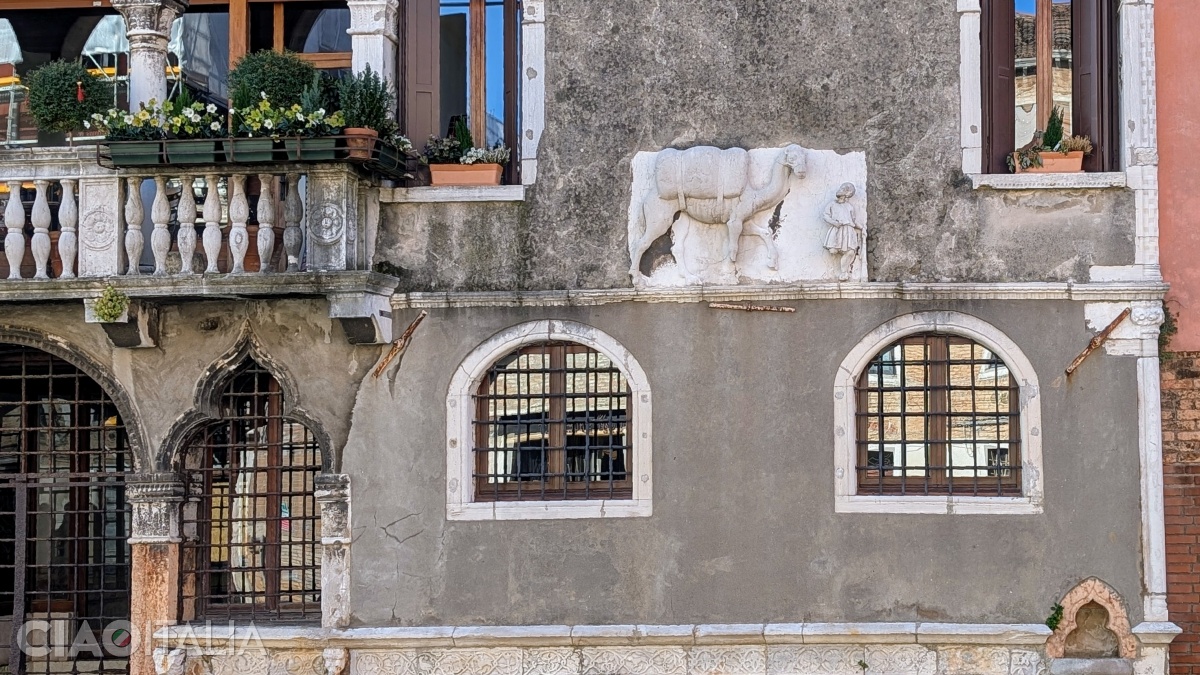
Very close to the Madonna dell'Orto Church, on the opposite side of the canal of the same name, lies Palazzo Mastelli, which is said to have been built by the three brothers mentioned above. The palace is also known as Ca' Cammello ("The House of the Camel") because of the relief on its facade. This relief depicts a man in a turban and Oriental costume leading a camel - an allusion to the spice trade in which the Mastelli family was involved.
According to a legend, a wealthy merchant from the East, abandoned by the woman he loved, left his city and moved to this palace in Venice. To ensure he could be easily found should his beloved change her mind and come looking for him, he had this relief sculpted onto the wall of his home.
On the facade of the same palace, in the lower right, you can spot another interesting detail: a small Oriental fountain. Until recently, those passing by in boats on the canal in front could stop and drink water directly from it.