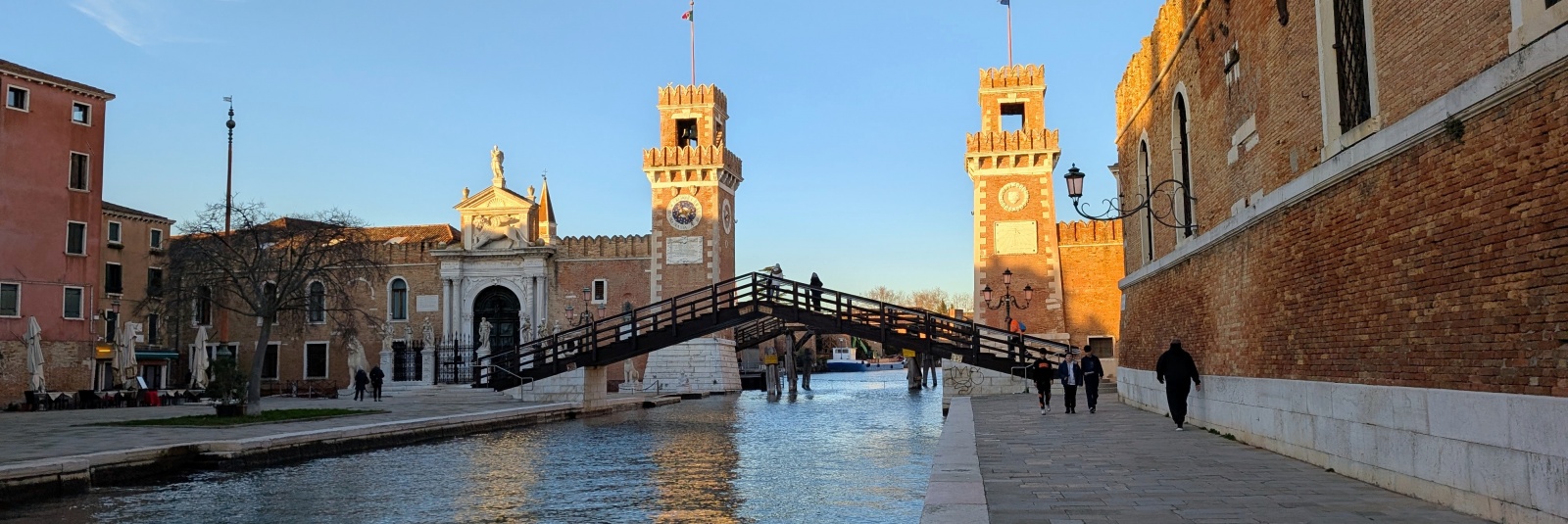
The Arsenal (Arsenale) of Venice
The Arsenal (Arsenale) is one of the Venetian sights least known to tourists, but it is well worth a visit, especially if you are a history buff. Venice's former shipyard is the place where the fearsome ships were built that secured the Serenissima's dominance over the Mediterranean.
How to Get to the Arsenal?
The Arsenale is located at the eastern end of Venice, in the Castello district. Many people never manage to get inside - partly because Google Maps directs you to the historic entrance gate, which is interesting to see but remains closed, as a military base lies beyond it.
If you want to visit the Arsenal, it is important to know that it is divided into Arsenale Nord and Arsenale Sud. Arsenale Nord can be visited free of charge, while Arsenale Sud is only open during the Biennale; to see the interior spaces then, you will need to purchase an exhibition ticket. Even if you don't go inside, it is worth taking a stroll through the Arsenale Sud area to see the monumental entrance gate and the Naval Museum.
How to Get to Arsenale Nord:
- Take one of the vaporetto lines 4.1, 4.2, 5.1, or 5.2 and get off at the Bacini-Arsenale Nord stop.
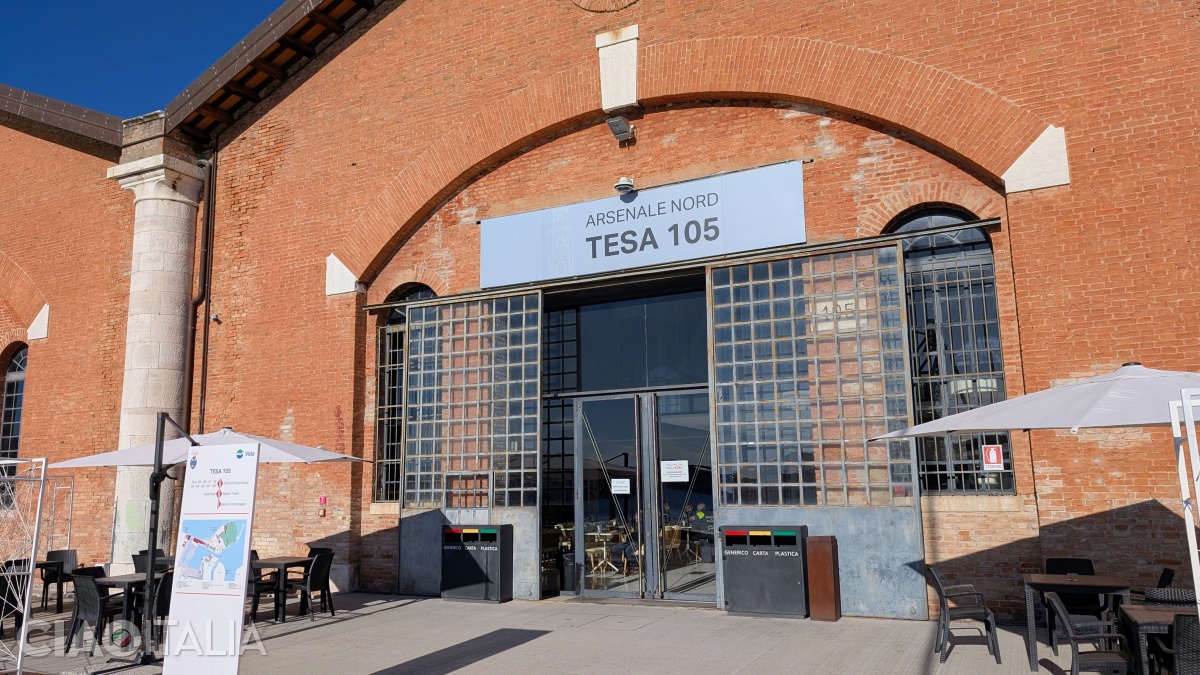
- Then, enter the Arsenal through Bar Tesa 105.
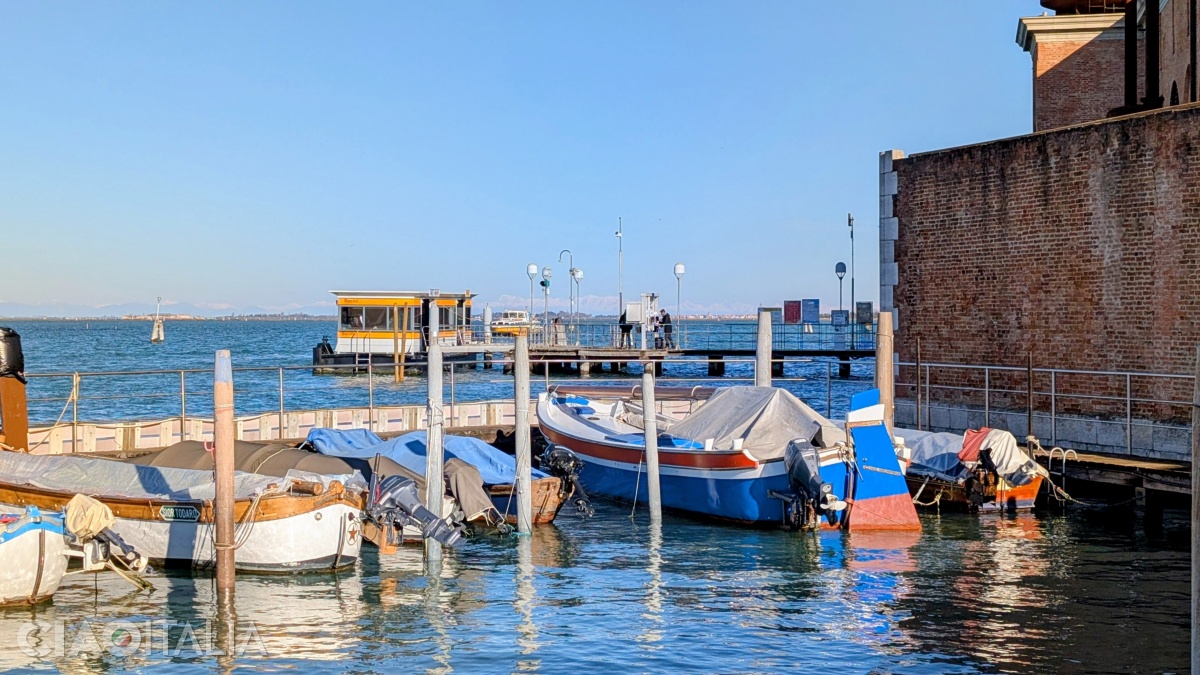
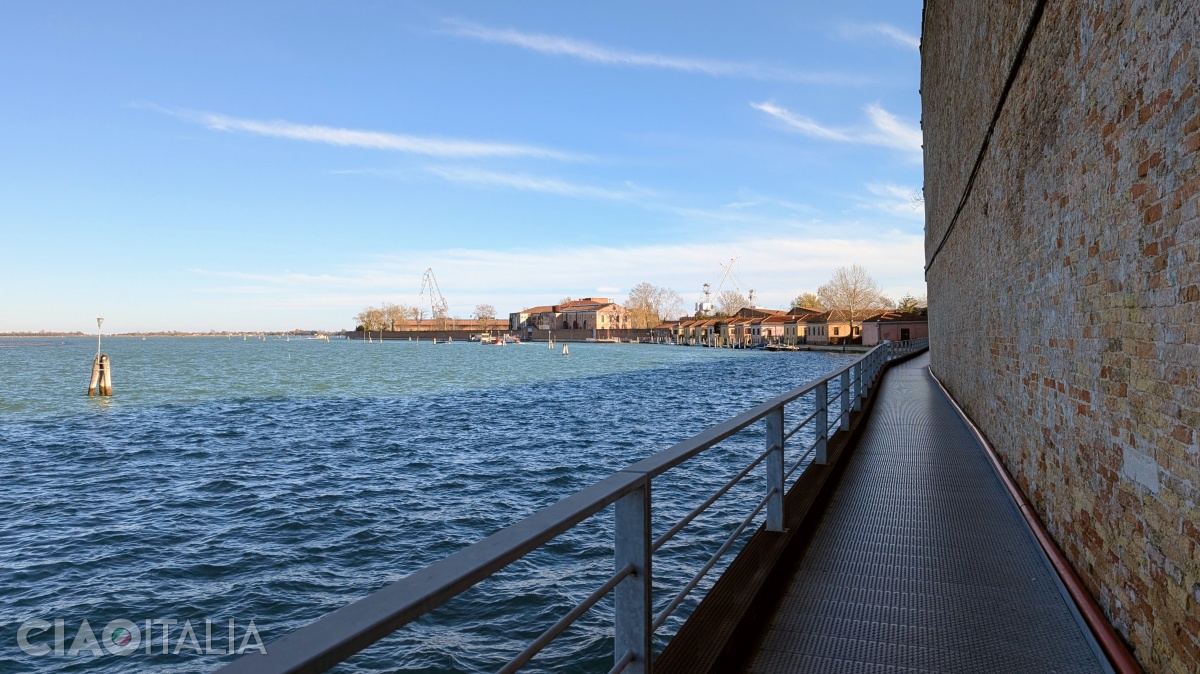
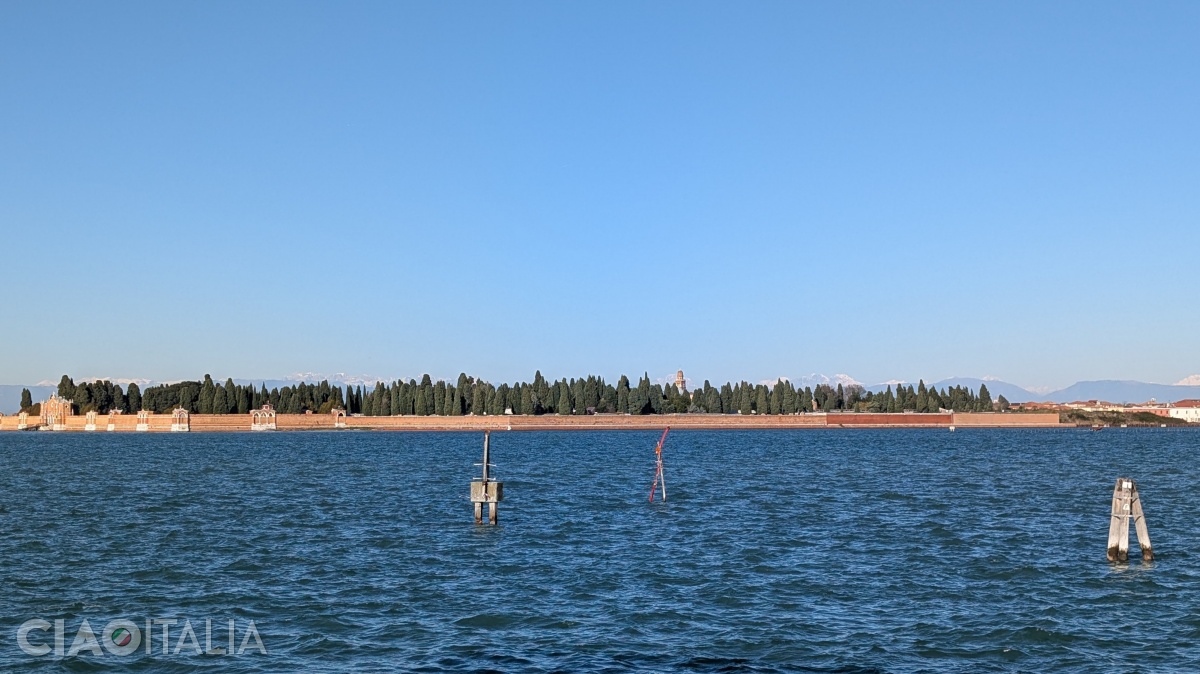
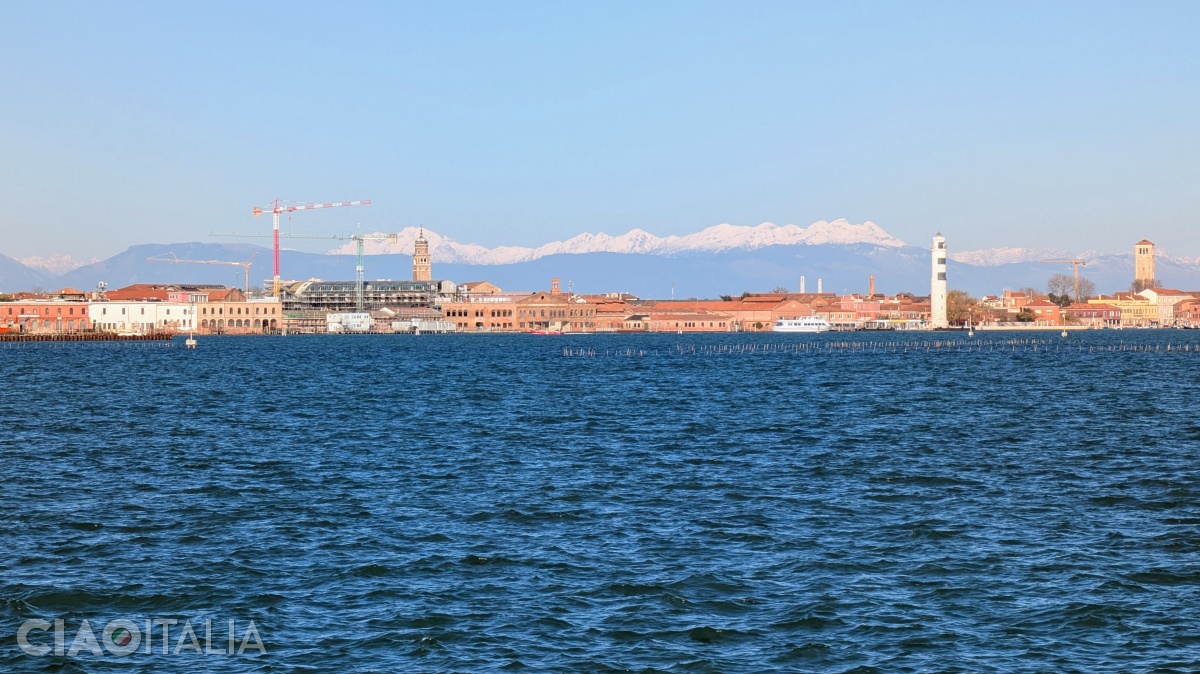
Alternatively, if the weather is nice, you can reach Arsenale Nord by taking a walk along the walkway built along its walls, which you access via Fondamenta Case Nuove. Besides offering a unique perspective of Venice, you can also see several islands of the Venetian lagoon - you will most likely recognize San Michele, Murano, and Burano. On clear days, the peaks of the Dolomites stand out clearly in the distance.
How to Get to Arsenale Sud:
- Take one of the vaporetto lines 1, 4.1, or 4.2 and get off at the Arsenale stop.
- Then, walk along Fondamenta Arsenale until you reach the monumental gate.
Alternatively, you can walk from the Doge's Palace along Riva degli Schiavoni, passing by the Pieta Church - nicknamed "Vivaldi's Church" (see also the article Concerts in Venice).
Opening Hours
Arsenale Nord
Arsenale Nord is open year-round, coinciding with the opening hours of Bar Tesa 105, which serves as the entrance. Typically, outside of the Biennale season (from late November to early May), the bar is only open Monday to Friday, between 10:00 AM and 5:00 PM (on days when the bar is closed, you will not be able to enter Arsenale Nord). We recommend calling ahead to check the schedule.
Arsenale Sud
Arsenale Sud is only open while the Venice Biennale is taking place - typically from early May until the end of November.
Visiting the Arsenal
Enclosed by brick walls spanning approximately 3 km, the Venetian Arsenal was a vast complex of shipyards and armories, serving as the largest production center of the pre-industrial age. It operated continuously for seven centuries and was the site where the ships that conquered territories and secured the glory and power of the Venetian Republic were built.
The origins of the Arsenal date back to the 12th century. Inside, there is a plaque bearing the inscription: Nel MCIV, quando le venete armi di gloria avide e di conquista/ i lidi della Siria occupavano, questo arsenale ne ebbe principio. ("In 1104, when the Venetian arms, eager for glory and conquest,/ occupied the shores of Syria, this arsenal had its beginning."). However, the plaque was only installed in the 19th century by the Austrians, and researchers state that no historical sources exist to support 1104 as the official founding date of the Arsenal.
In the Venetian dialect, the Arsenal was called arzanà, derived from the Arabic word daras-sina'ah ("workshop"). The word darsena is still used today to refer to the inner water basins.
Three main activities took place in the Arsenal: shipbuilding, rope-making, and the production of cannons and other weaponry.
The workers who labored in the Arsenal were known as arsenalotti. They were carpenters, rope-makers, blacksmiths, sawyers, caulkers, or designers, organized into genuine assembly lines. As renowned craftsmen, they were among the most respected shipbuilders in the world and enjoyed specific privileges. They formed the Doge's guard of honor, rowed the famous Bucintoro galley used in official ceremonies, and even served as the city's firefighters. Their industriousness became legendary - it is said that for the battle of Cyprus against the Turks (1597) they built 100 vessels in just 60 days, and once even constructed a fully armed warship in a single day while the King of France was attending a banquet.
Dante, who visited Venice in 1321, was deeply impressed by these sweat-drenched men who used boiling pitch in their work. The verses through which he immortalized them in the "Inferno" from the "Divine Comedy" (Canto XXI) can be found on a plaque located at the main entrance to the Arsenal.
"As in the Arsenal of the Venetians boils in the winter the tenacious pitch to smear their unsound vessels o'er again,
For sail they cannot; and instead thereof one makes his vessel new, and one recaulks the ribs of that which many a voyage has made;
One hammers at the prow, one at the stern, this one makes oars, and that one cordage wists, another mends the mainsail and the mizzen."
By the second half of the 16th century, the number of workers at the Arsenal had reached 3,500. This was a time when Venice focused its efforts on the struggle against the Turks. Six specially built large galleys, armed with cannons, played a decisive role in the victory at the Battle of Lepanto in 1571.
The Arsenal was managed by three Provveditori, elected by the Senate from among the patricians, who were required to live within its precincts in rotation. Alongside them were three Patroni all'Arsenal, appointed by the Great Council. They held the keys to the Arsenal gates, handled supplies, supervised the works, and paid the workers' wages.
During the years of French and Austrian occupation, the Arsenal underwent numerous changes. Following World War II, the area began to decline. Only in 1980, on the occasion of the first International Architecture Exhibition organized by the Venice Biennale, was a part of the former rope factory (Corderia) restored and opened to the public. Since then, an increasing number of buildings and spaces within the Arsenal have been restored and repurposed into exhibition venues.
Arsenale Nord
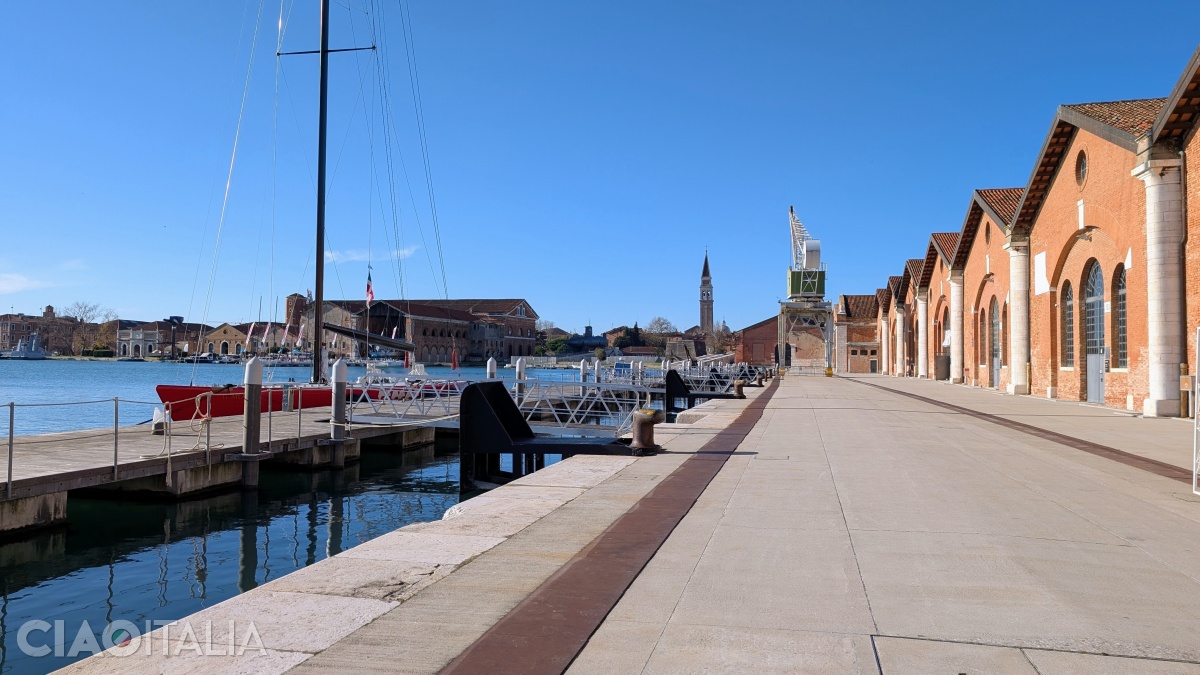
Arsenale Nord offers an overview of the former shipyard. You can see the old ship sheds and docks, historic cranes, the Arsenal Tower, the Building Bridges art installation, and the Enrico Dandolo military submarine.
The Arsenal Tower (Torre dell'Arsenale)
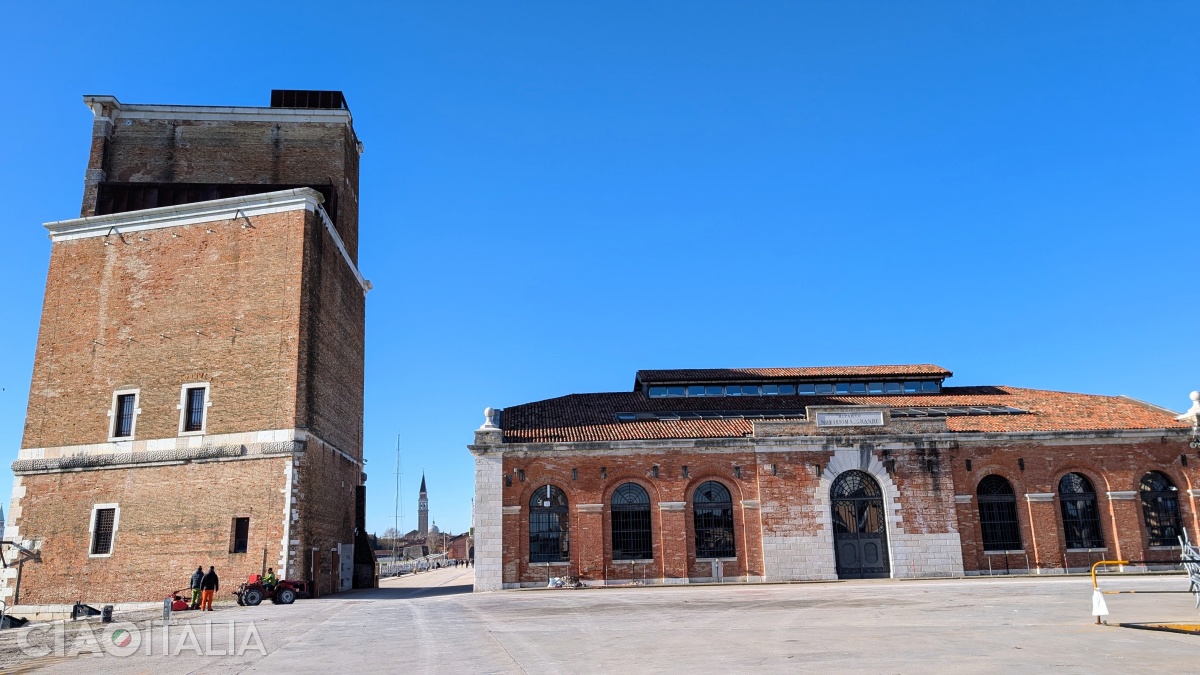
Once you step out of Bar Tesa 105, the Arsenal Tower, also known as Torre di Porta Nuova ("Tower of the New Gate"), located on your left, will likely be one of the first buildings to catch your eye. Its construction began in 1810, during the French occupation.
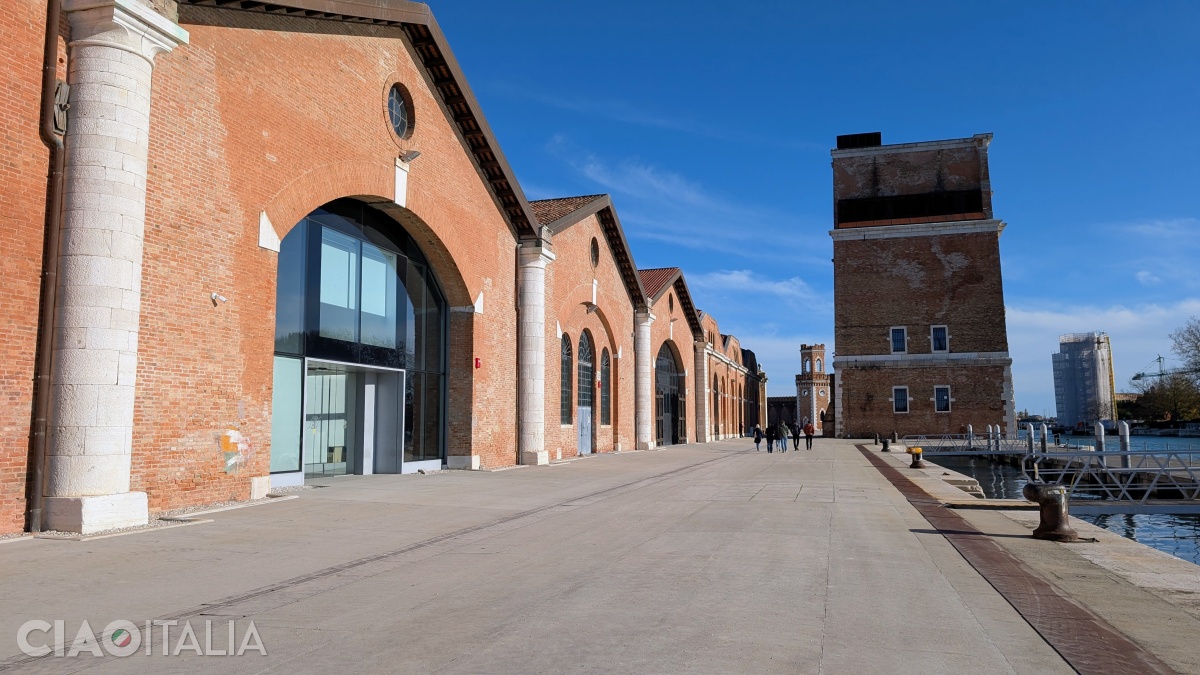
The French Navy wanted to produce large ships with a deep draft, but the Arsenal's infrastructure at the time was not suitable for them. Consequently, between 1809 and 1811, renovation works were carried out to overhaul the old production system and ensure a canal wide and deep enough to transport the ships to the sea. This was also when construction began on the tower, which was designed to support a crane capable of raising and lowering masts at great heights. At the same time, because the Rio dell'Arsenale did not allow for the passage of the large vessels already under construction, it was decided to reopen the waterway to the lagoon, which had been closed since the early 16th century. The new exit was named Porta Nuova ("The New Gate"). Due to the French withdrawal from Venice, the works were left unfinished; they were eventually completed by the new Austrian occupants in 1813.
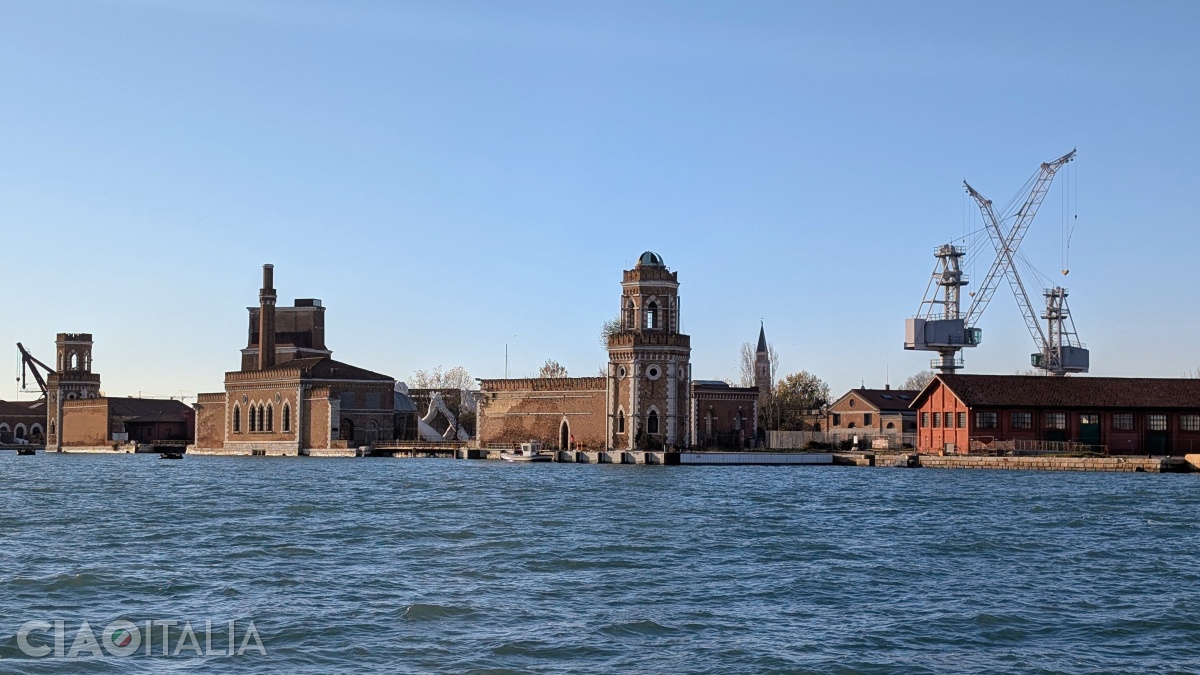
With the transition to iron shipbuilding and the development of new technologies, the tower lost its utility and was converted into a warehouse.
Renovated in 2011, it is now used as a venue for events and occasional exhibitions.
The "Building Bridges" Art Installation
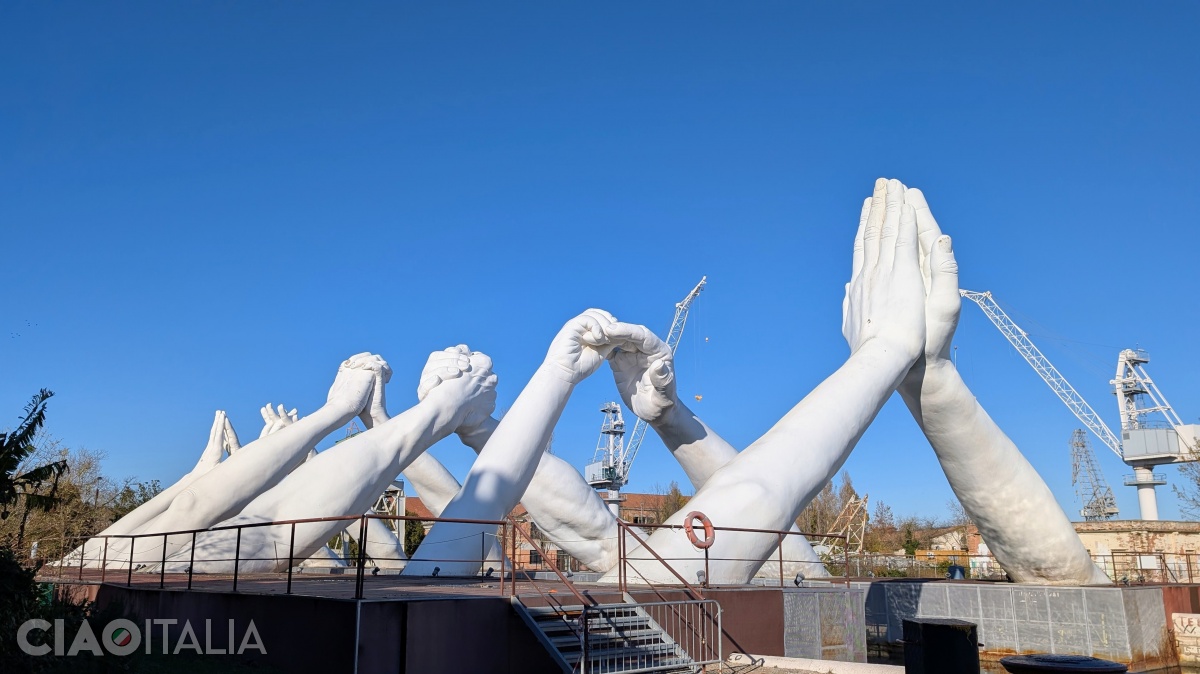
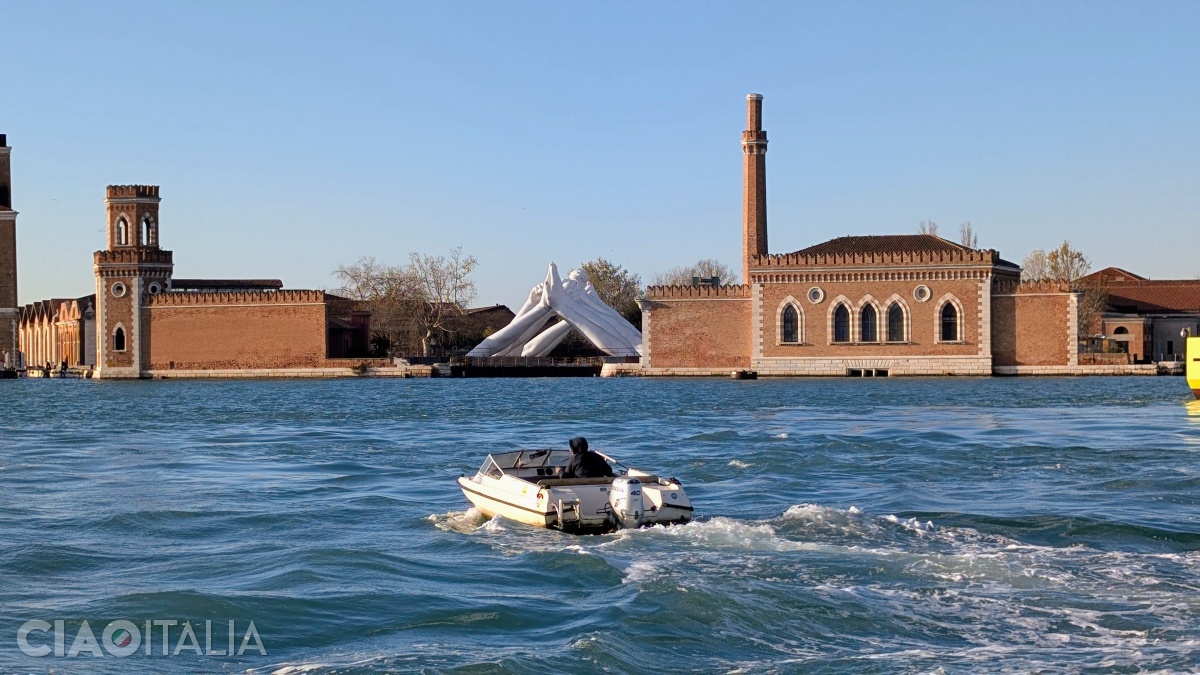
If you take a stroll toward the tower, just beyond it to the left, you will find the "Building Bridges" art installation, which sparked quite a bit of controversy in the art world. It was created by Lorenzo Quinn (son of actor Anthony Quinn) for the 2019 Biennale.
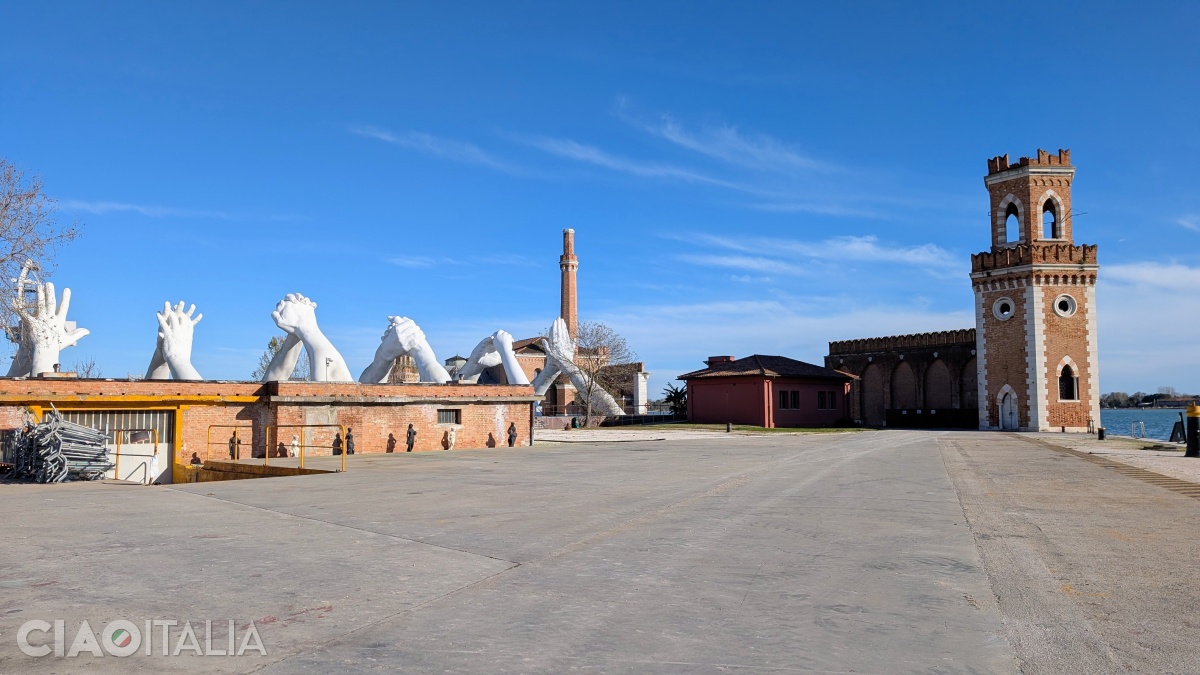
The sculpture, standing 15 meters high and 20 meters long, depicts six monumental pairs of arms with hands joined over a canal. They symbolize "Friendship", "Faith", "Help", "Love", "Hope", and "Wisdom", joining hands to overcome differences, uniting people and cultures, and helping to build a better world.
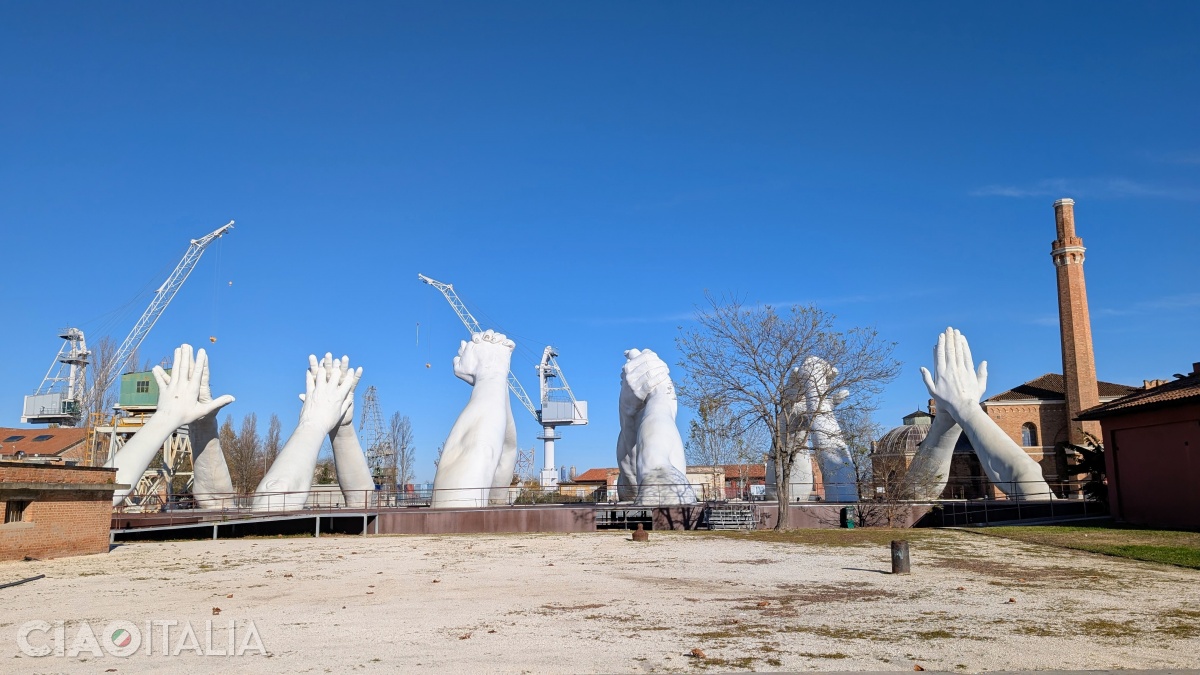
Lorenzo Quinn commented on the meaning of his work:
"Venice is the city of bridges. It is the perfect place to spread a message of unity and world peace, so that more of us, from everywhere, build bridges toward others instead of walls and barriers. [...] Humanity has never grown by creating barriers. It always grows when it opens its borders and welcomes new cultures. Venice is proof of this... it has always been a driving force of European growth."
The sculpture was manufactured in Valencia, transported by ship to Genoa, and brought from there to Venice using 18 trucks.
The Armstrong Mitchell Hydraulic Crane
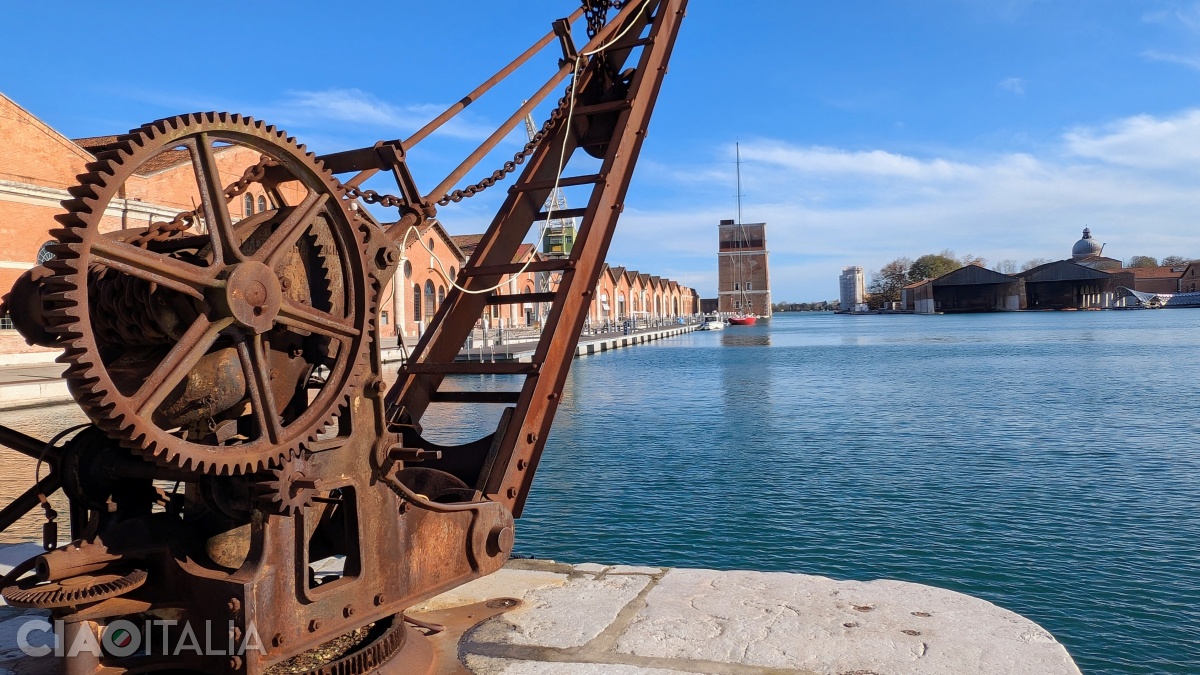
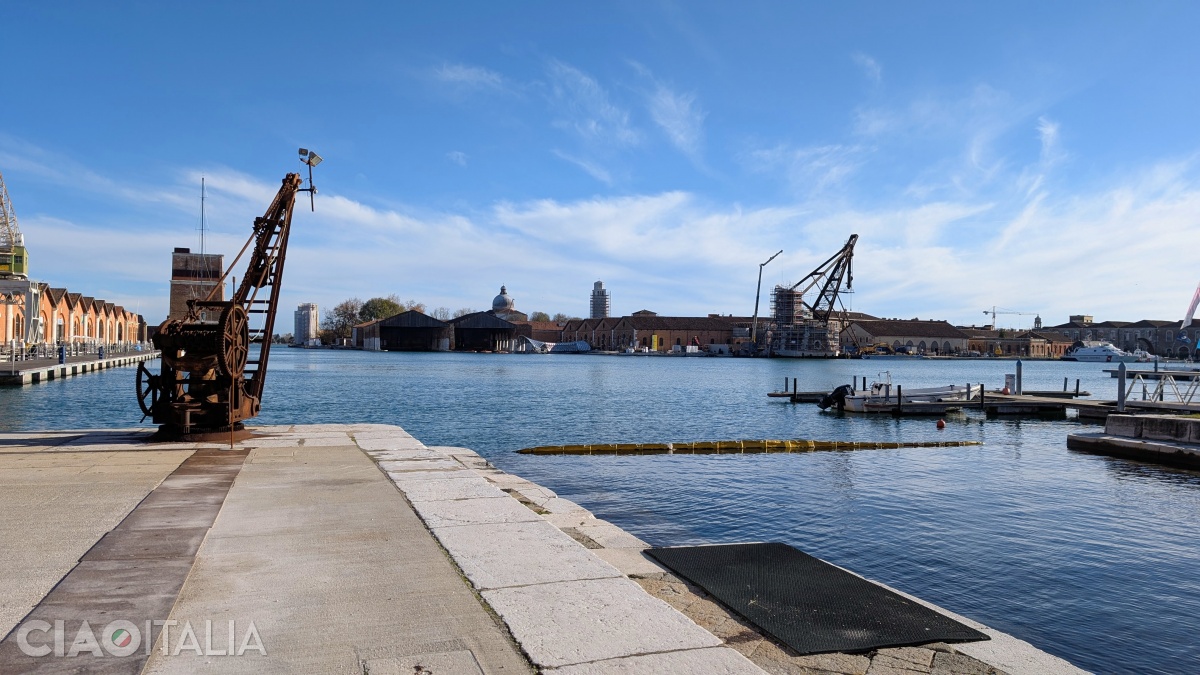
From the dock area in front of Bar Tesa 105, you will spot an old crane. This is the Armstrong Mitchell hydraulic crane, with a capacity of 160 tons, the only surviving example of the nine models of this type built between 1876 and 1905.
Manufactured in Newcastle, England, the massive crane was installed in the Arsenale between 1883 and 1885. The need for it was driven by the 1881 decision to build the ironclad Francesco Morosini, the first large metal-hulled warship manufactured in Venice, which required the placement of four heavy cannons. The innovative technology designed by Armstrong allowed the machine to be extremely precise in positioning heavy loads, providing a major boost to the naval industry. The crane, mounted on a pedestal of brick and Istrian stone, remained in operation until the 1950s.
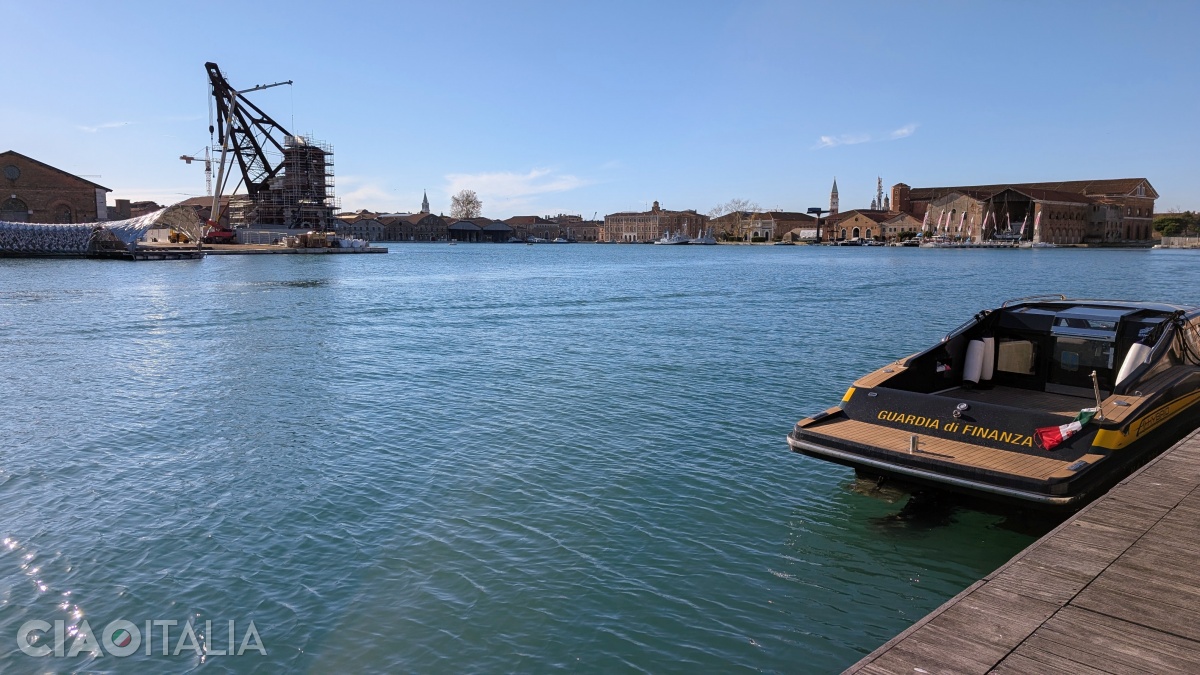
Nearby, the Fairbairn crane is also preserved; it has a 35-ton capacity and a curved "swan-neck" arm and was installed in 1874.
Walking along the docks to the right, you can get a close-up look at the Larini Nathan crane, which was used for dismantling and assembling heavy parts on smaller vessels.
The Enrico Dandolo Military Submarine
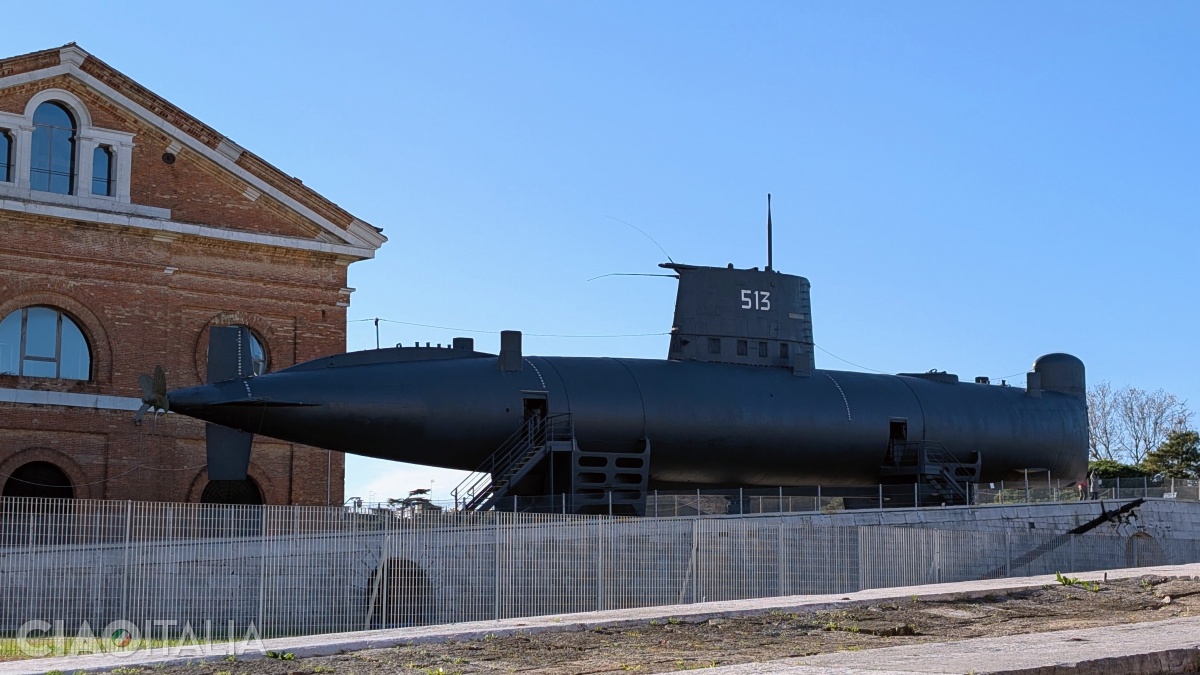
In the same area lies the Enrico Dandolo S 513 submarine (Toti class), placed on a 19th-century Istrian stone ramp.
The submarine dates back to 1967 and was one of the first four built during the Cold War. Measuring 46 meters in length and about 5 meters in width, it was silent and fast, equipped with advanced technology for its time.
From this part of the Arsenal, you can only see the submarine from the outside. However, if you visit the Naval Museum (located near Arsenale Sud), you can go inside by purchasing a special ticket, which grants access to the control room and the torpedo launch room.
Italian museums house two other submarines: one is the Enrico Toti (S506), located at the Leonardo da Vinci Science Museum in Milan, and the other is the Nazario Sauro (S518), located in Genoa, at the Galata Maritime Museum.
Bar Tesa 105
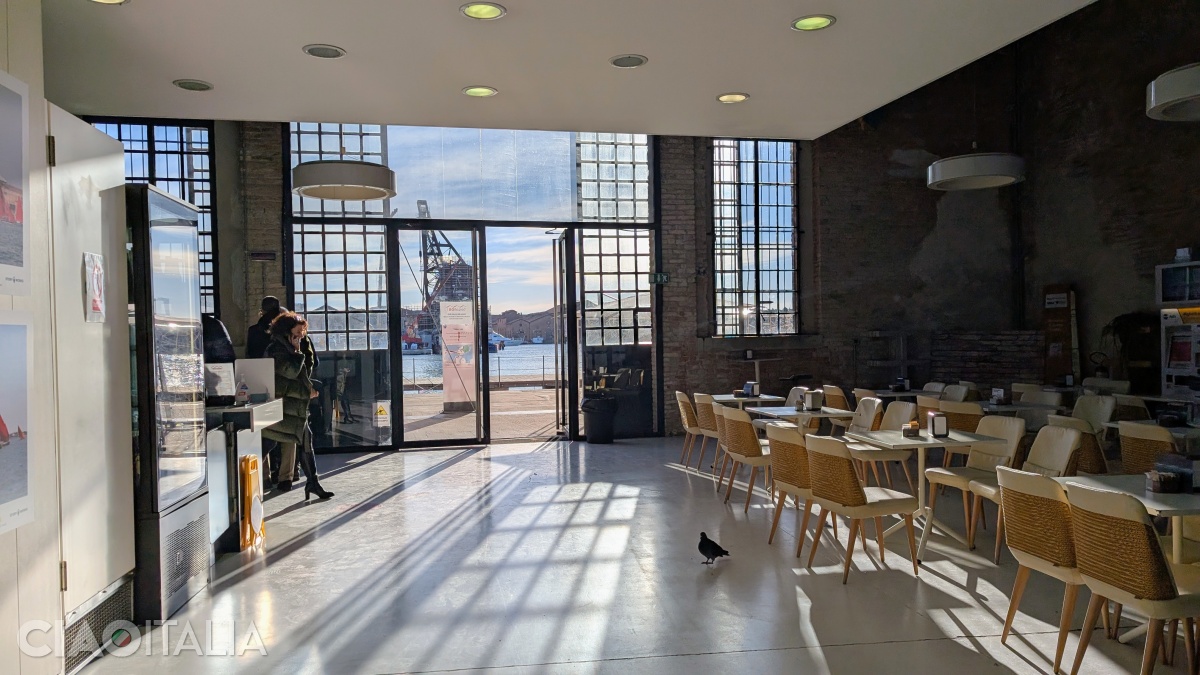
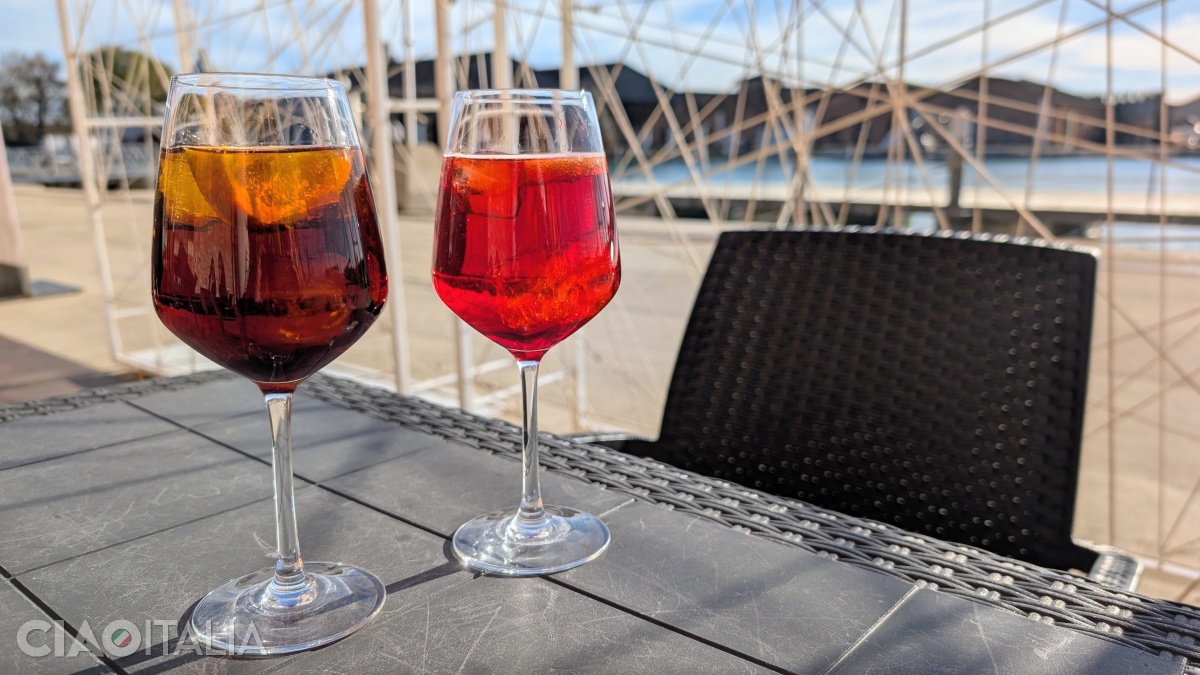
After taking a walk through the Arsenal area, you can stop for a coffee break or a spritz at Bar Tesa 105. The interior is decorated in a modern, minimalist style, and the terrace overlooks the Darsena Grande water basin and the old industrial buildings.
Arsenale Sud
Even if you are in Venice during the period when it is closed (meaning outside the Biennale season), or if you prefer not to pay for exhibition tickets to see the interior when it is open, a stroll around Arsenale Sud is still well worth it - at the very least to see the monumental gate or to visit the Naval Historical Museum.
Porta Magna
The monumental land entrance gate is called Porta da Tera or Porta Magna ("The Great Gate"). Built in 1460, it was among the first structures in Venice constructed in the Renaissance style. The four columns framing the gate - two on each side - most likely originated from an earlier building.
Carved above the archway are two allegorical figures representing Winged Victory. Higher up stands the imposing Lion of Saint Mark, placed there following the victory at Lepanto in 1571, as indicated by the inscription VICTORIAE N A VALIS MONIMENTUM MDLXXI. Its creator appears to have been Bartolomeo Bon, who also worked on the Basilica of Santa Maria dei Frari and the Porta della Carta at the Doge's Palace. At the very top stands the statue of Saint Justina, whose feast day is October 7th - the day of the victory at Lepanto. If you look closely at the details, you might notice something missing: the Lion of Saint Mark holds the customary open Gospel between its paws, but the word Pax ("Peace") is absent. An exhortation to peace would have been quite out of place above the entrance to a site dedicated to the production of weapons.
The metal enclosure was added in 1692 to celebrate Francesco Morosini's 1687 conquest of the Peloponnese from the Turks. The Baroque-style statues on the pillars are of mythological and allegorical inspiration; to the right and left of the entrance, you can recognize the gods Neptune and Mars.
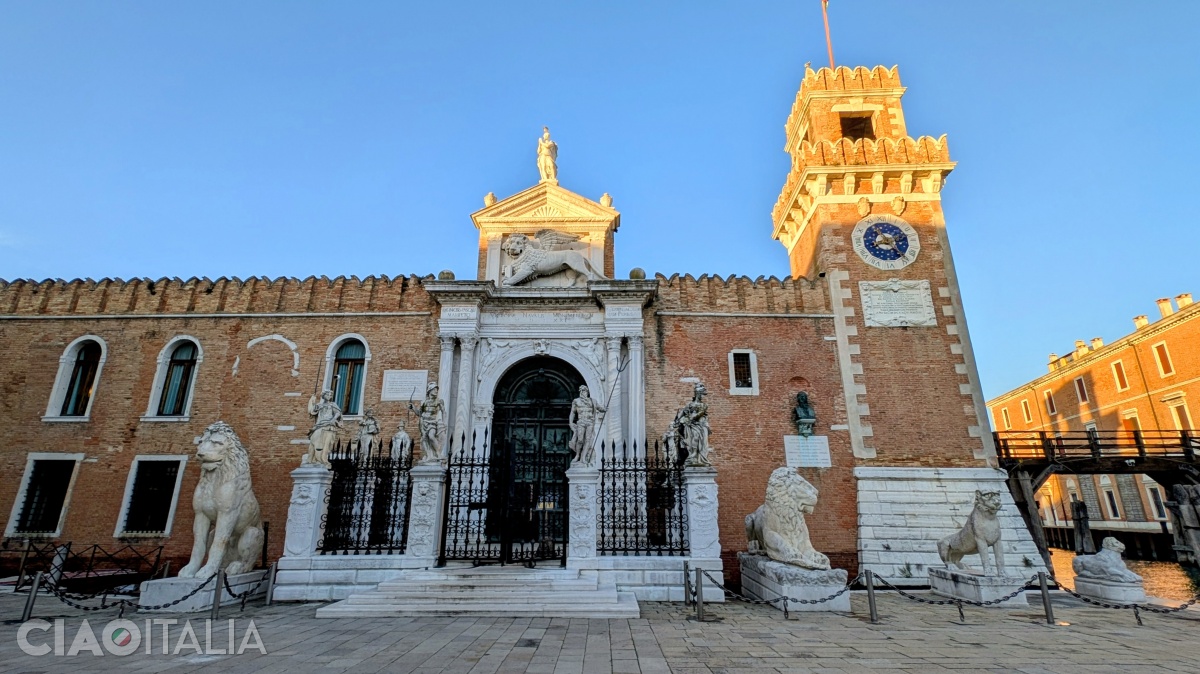
On that same occasion, two lions taken as spoils of war were placed on either side of the gate.
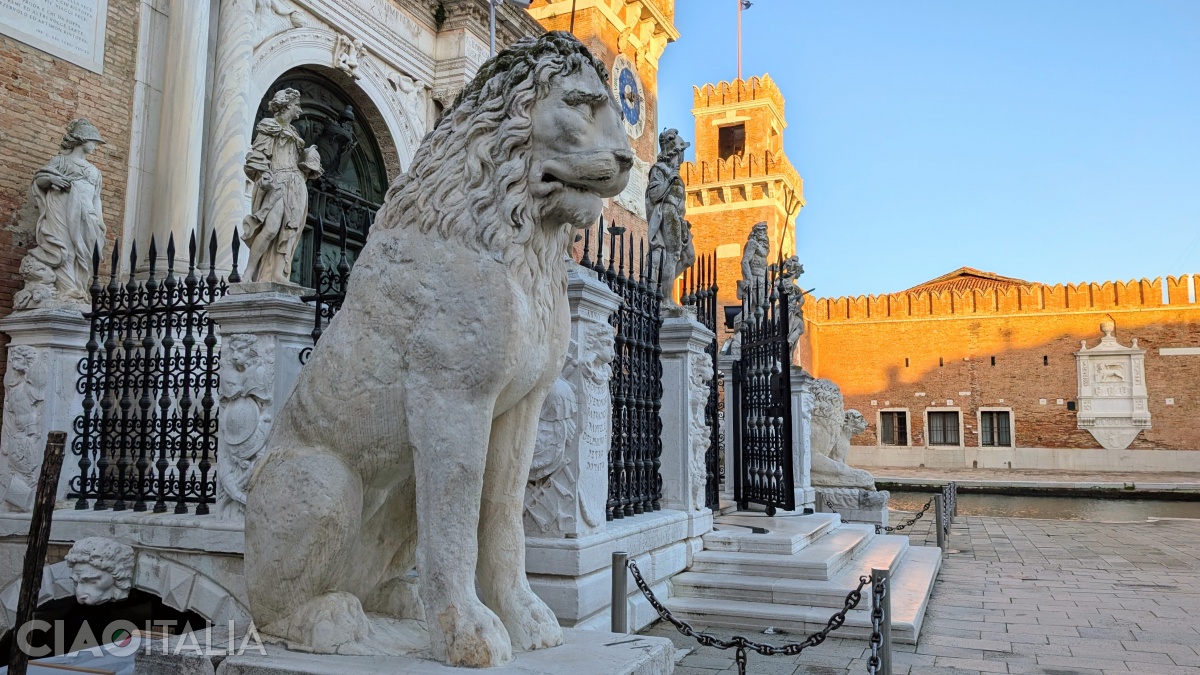
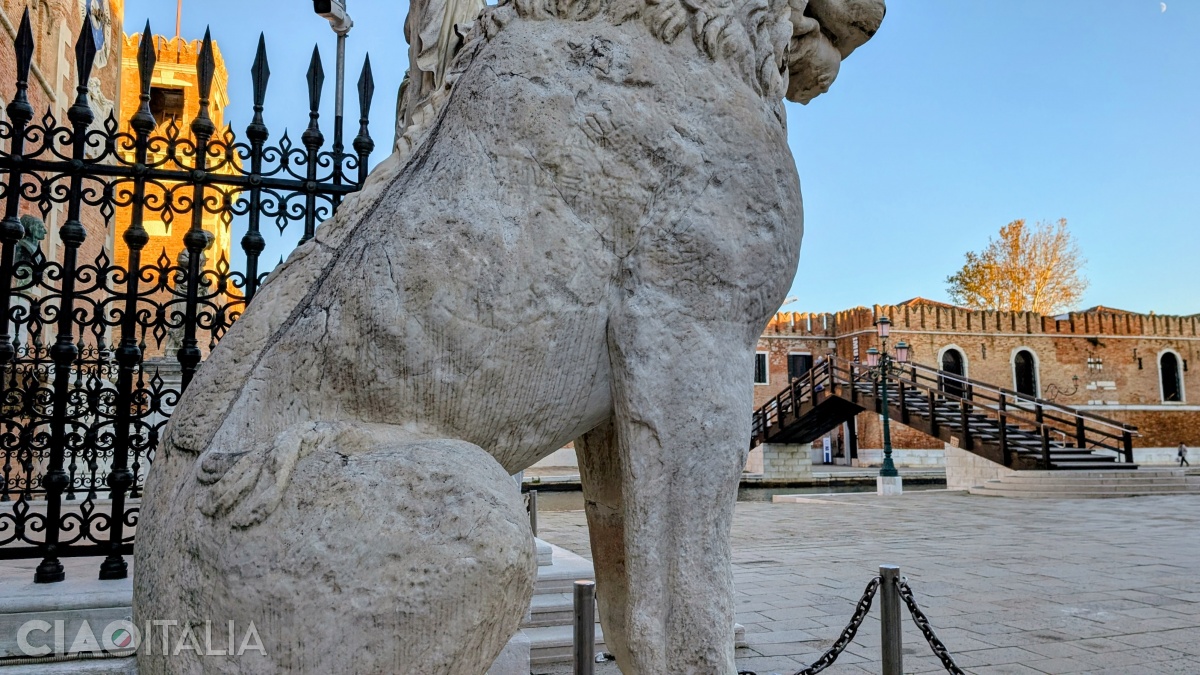
The marble lion on the left, standing about 3 meters high, is known as the "Piraeus Lion". Since the 1st or 2nd century, it stood watch at the entrance to the ancient port of Athens. It was so famous that Italians referred to Piraeus as Porto Leone. One hypothesis, based on the fact that the neck was hollow and bore traces of a tube (now gone), suggests it may have once served as a fountain.
If you look at its back, you will notice scratches in the stone. After extensive study, a Danish researcher concluded in 1856 that these are runic inscriptions left in the 11th century by Viking mercenaries hired by the Byzantine Empire to suppress revolts in Athens.
Today, a modern copy of this lion stands at the entrance to the port of Piraeus.
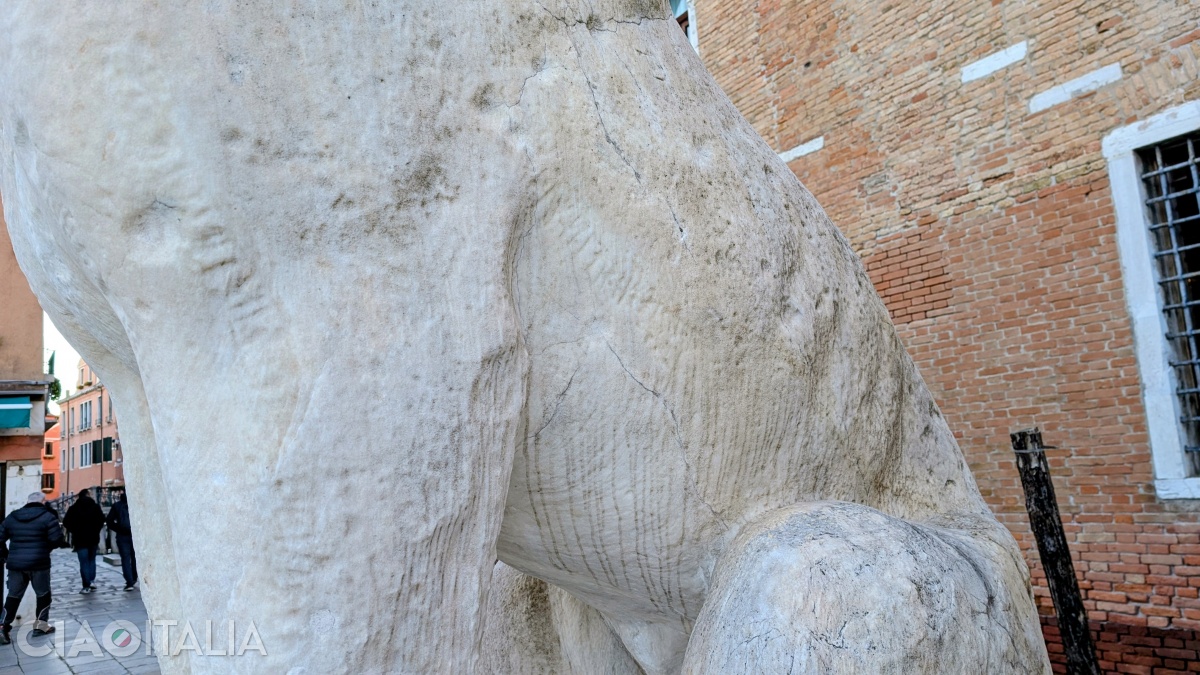
The lion to the right of the gate was also brought to Venice in 1687. It dates back to the 4th century BC and was likely located on the Sacred Way connecting Athens to Eleusis.
To its right, toward the Rio dell'Arsenale, are two more lions. The first, dating from the 6th century BC, was placed here in 1716. It most likely comes from the Greek island of Delos, as it is similar in style and size to eight other lions still found there.
The smallest lion, nearest the canal, is the result of reassembling two different sculptures; its origin and the date it was placed here remain unknown.
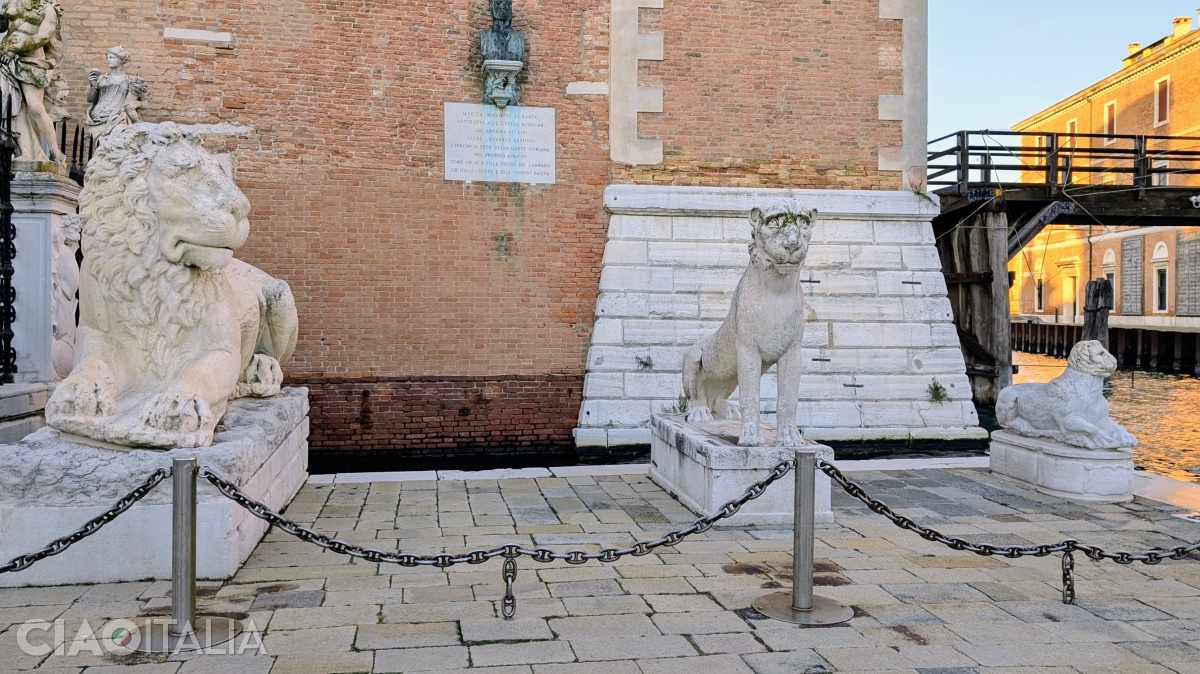
On the wall to the left of the gate is a plaque with the verses from the "Inferno" where Dante refers to the Arsenal. To the right, between Porta da Tera and Porta da Mar, stands a small bust of the poet.
Porta da Mar
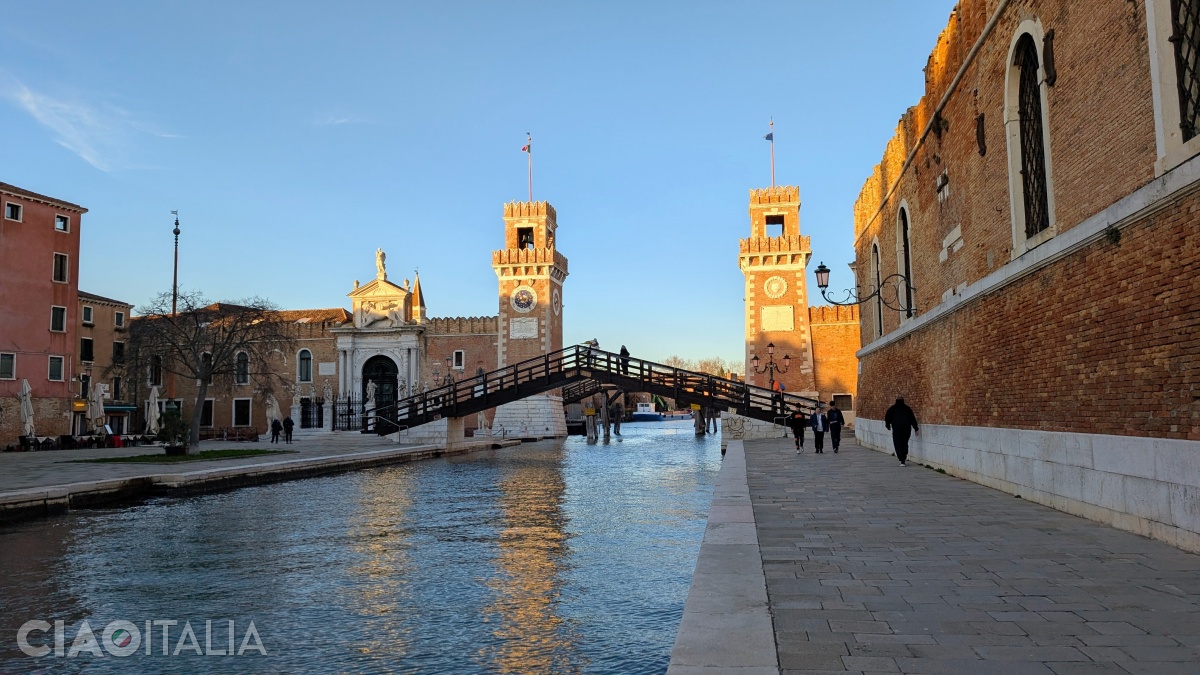
The twin towers were rebuilt in 1686, at the same time the water entrance (Porta da Mar) was widened.
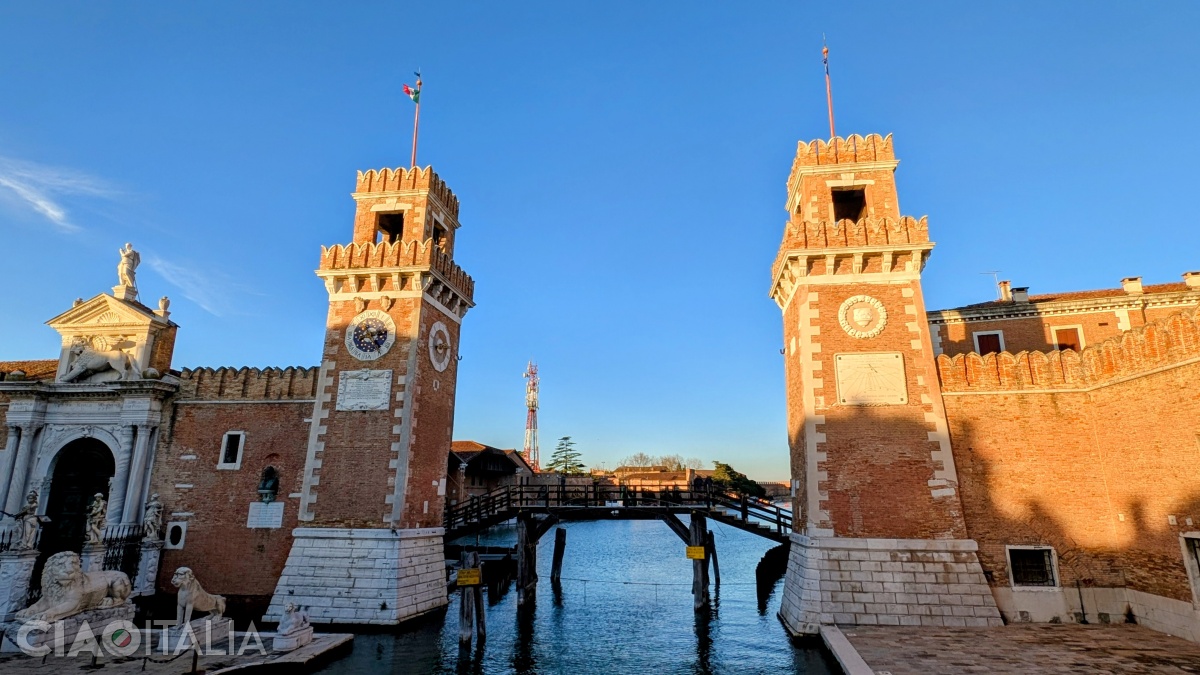
On the left tower, beneath the clock, an inscription commemorates this event. Above it, on a commemorative plaque, the coat of arms of Doge Marcantonio Giustinian is displayed, while the sides feature the coats of arms of the officials who led and administered the Arsenal - the Provveditori and Patroni.
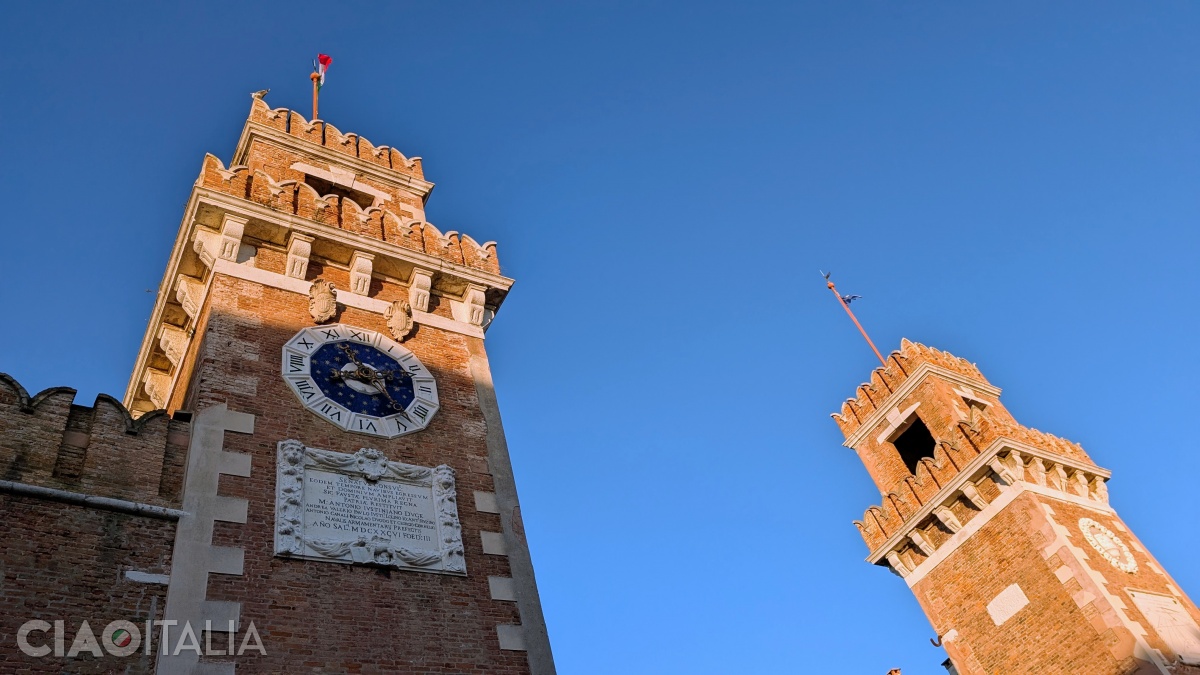
The two towers were restored after World War I. At that time, a plaque featuring a sundial was placed on the right tower, donated by captain and explorer Enrico Alberto d'Albertis (if you've been to Genoa, you may have visited his castle, which houses the Museum of World Cultures). Above the sundial, a white stone garland surrounds a small bas-relief depicting the Lion of Saint Mark, which was discovered during the renovation of some of the Arsenal's buildings.
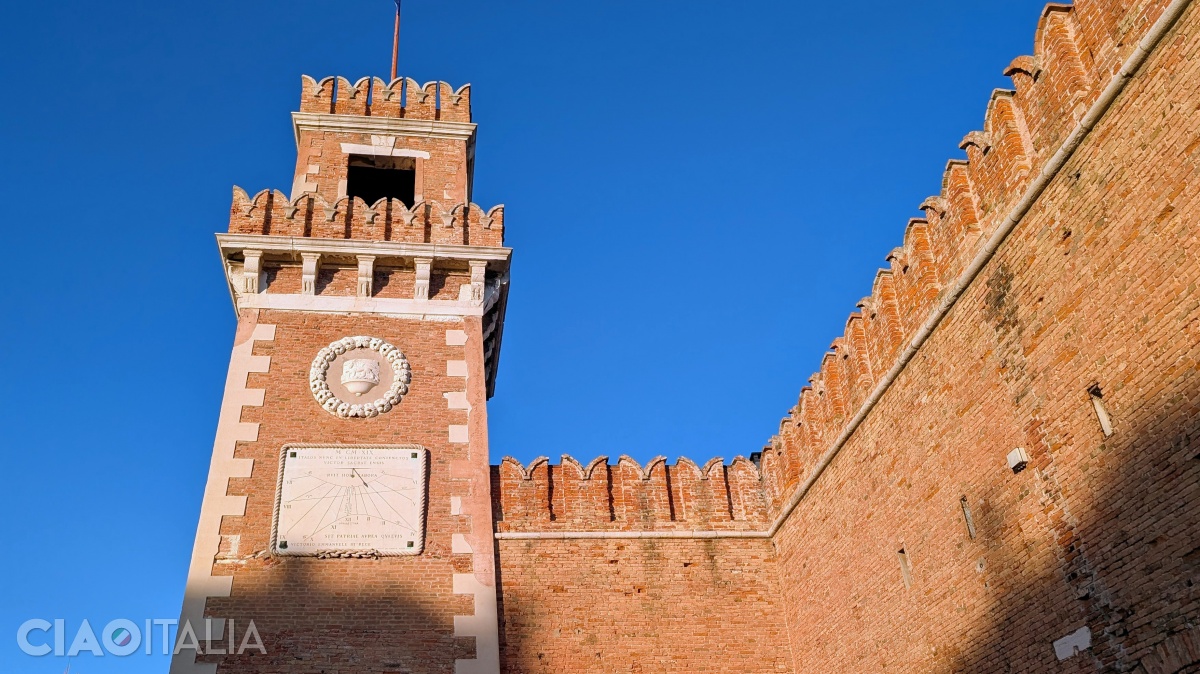
Naval Historical Museum
The Naval Historical Museum belongs to the Italian Navy and is the most important museum of its kind in Italy. It is located near Arsenale Sud, in Campo San Biasio, in a 15th-century building. The structure once served as a warehouse for the grain used to make a type of twice-baked bread that lasted for a long time. Known as pan biscotto ("biscuit bread"), it was ideal for long voyages at sea.
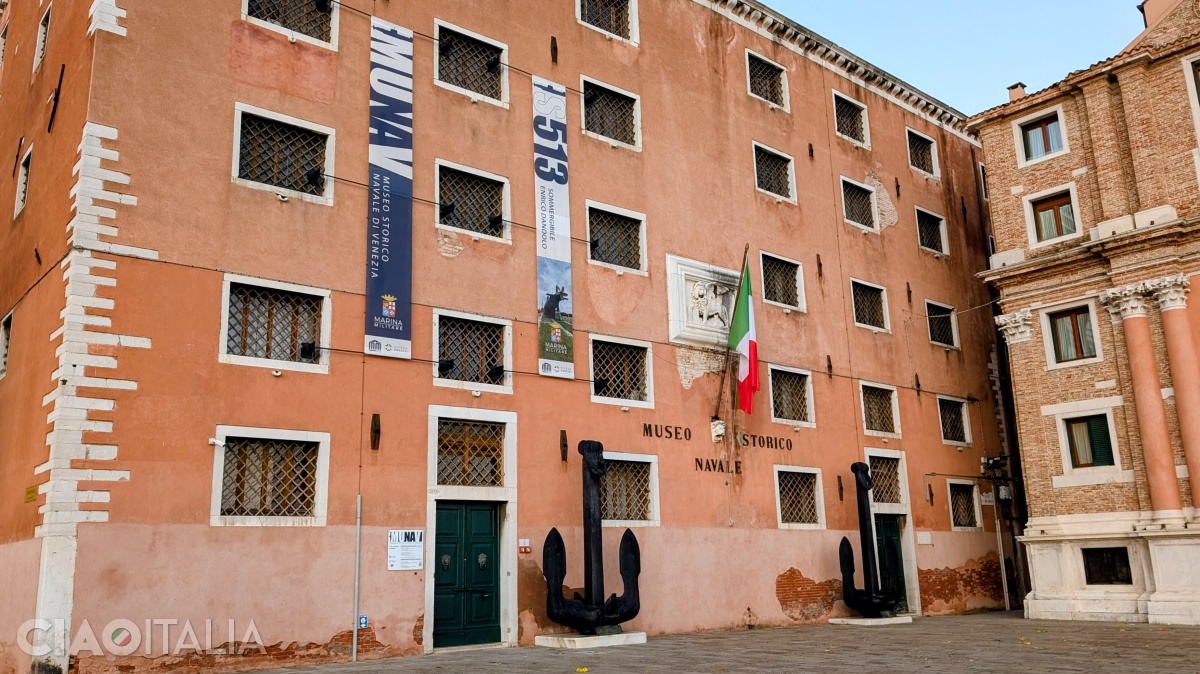
The Naval Museum has 4 floors and 42 rooms, covering an area of 4,000 m². Inside, you can see ship models, uniforms, naval instruments and maps, various unusual weapons used throughout the centuries, as well as full-size boats, such as Peggy Guggenheim's private gondola. You will also see a model of the famous Bucintoro, the gold-decorated ceremonial ship from which the Doge performed the renowned ritual of Venice's "Marriage to the Sea".
Naval Museum in Venice
Opening Hours:
Naval Museum
March 21 - November 22, 2026:
- Monday: closed
- Tuesday-Sunday: 10:00 AM - 6:00 PM
Last entry is one hour before closing.
Enrico Dandolo Submarine (visits are at set times):
Ticket Prices:
Naval Museum:
- Adult: €17
- Over 65: €14
- 15-26 years: €14
- Children 6-14 years: €8.5
- Children under 6: free
Naval Museum + Enrico Dandolo Submarine:
- Adult: €27
- Over 65: €24
- 15-26 years: €24
- Children 6-14 years: €17
- Children under 6: free of charge (submarine access is not permitted for safety reasons)
Buy Tickets for the Naval Museum
The Ships' Pavilion (Padiglione delle Navi) is also part of the museum and is located right within the Arsenal itself. It houses large vessels that could not be displayed in the main building.
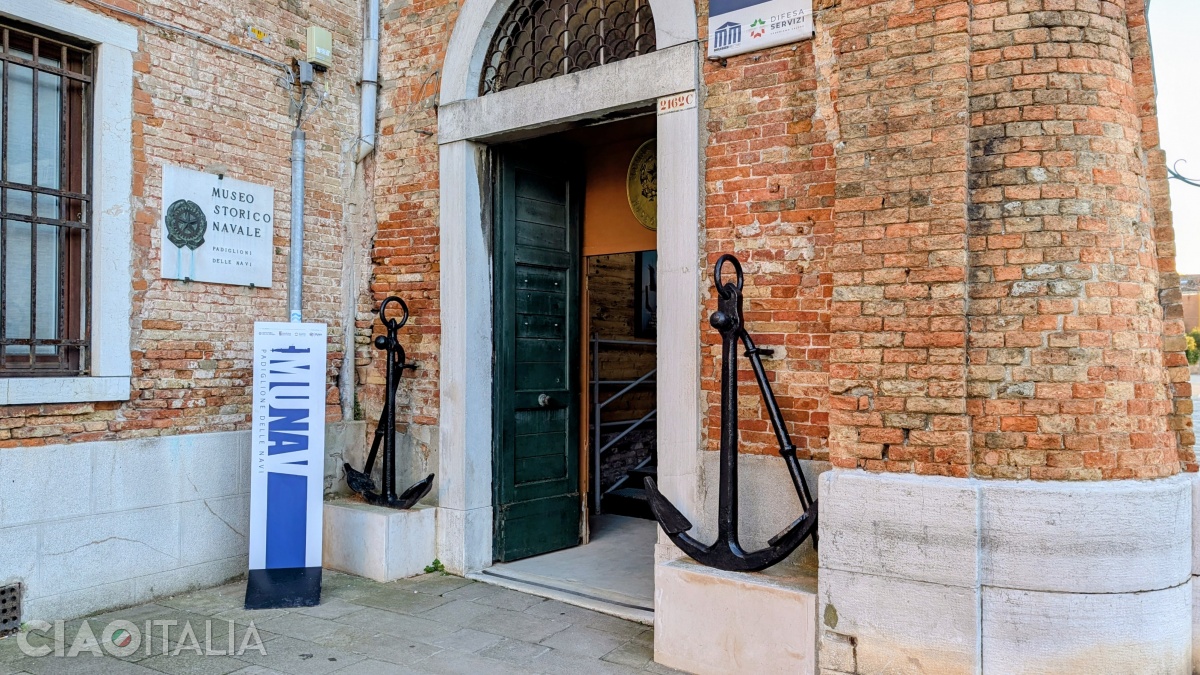
In the area between Darsena Grande and Canal de le Galeazze, you will find the Enrico Dandolo submarine, which can be visited at specific times with a special ticket that also includes admission to the Naval Museum.
Buy Tickets for the Naval Museum + Enrico Dandolo Submarine
The Arsenal Workers' Housing
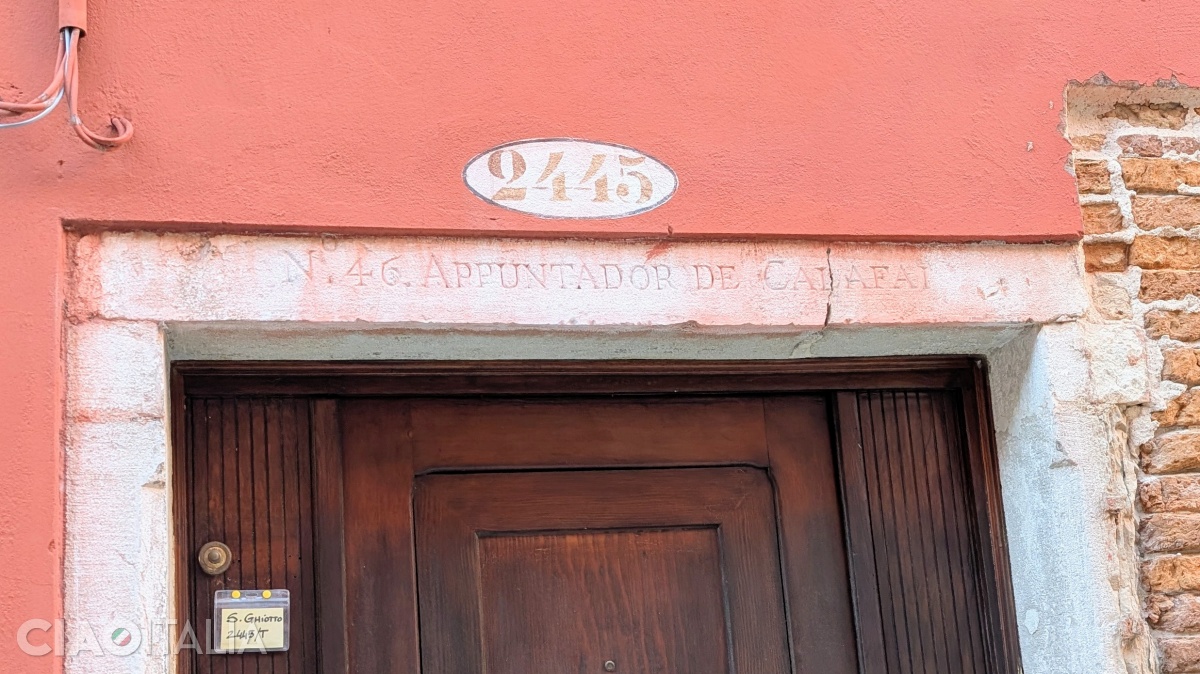
Near Arsenale Sud, traces of the former dwellings of the workers, known as arsenalotti, can still be seen. They lived rent-free or enjoyed minimal rent in houses located directly adjacent to the Arsenal walls. On Fondamenta dei Penini, at numbers 2446 and 2445, you can spot two inscriptions that use the old numbering system: No. 47. CAPPO MRO ALLE SEGHE and No. 47. APPUNTADOR DE CALAFAI. These were the homes of a master craftsman from the wood-cutting workshops and an overseer of the caulkers (the specialized workers responsible for making ship hulls watertight).
Traces of Workers' Tools in the San Martino Church
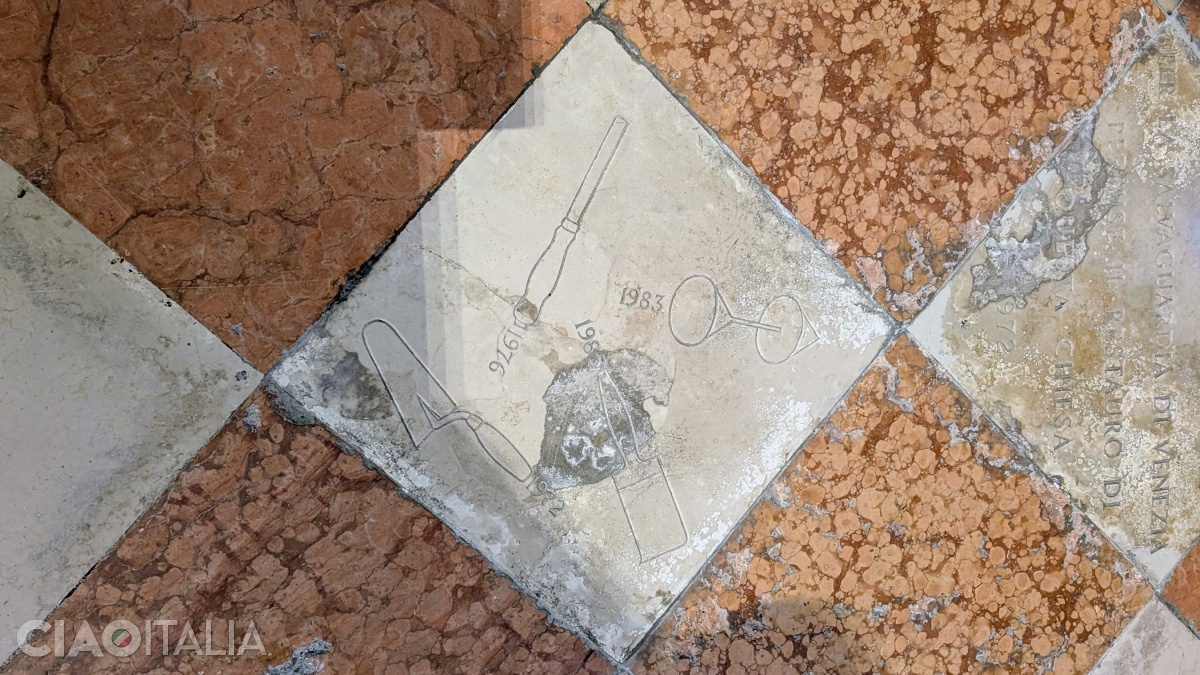
The Church of San Martino is one of the sights you can visit for free in Venice. In its floor, directly in front of the altar, you can observe carvings of the tools used by the Arsenal workers.
The second altar on the right of the church was the altar of the caulkers. In the painting Sacra Conversazione, you can see Saint Phocas (San Foca), their patron saint, depicted with a ship's wheel beneath his feet.